
DRESS Syndrome Symptom Checker & Risk Guide
Disclaimer: This tool is for educational purposes and does not provide a medical diagnosis. DRESS is a medical emergency. If you suspect you have this condition, seek immediate emergency care.
1. Check Your Symptoms
2. Medication History
Assessment Result
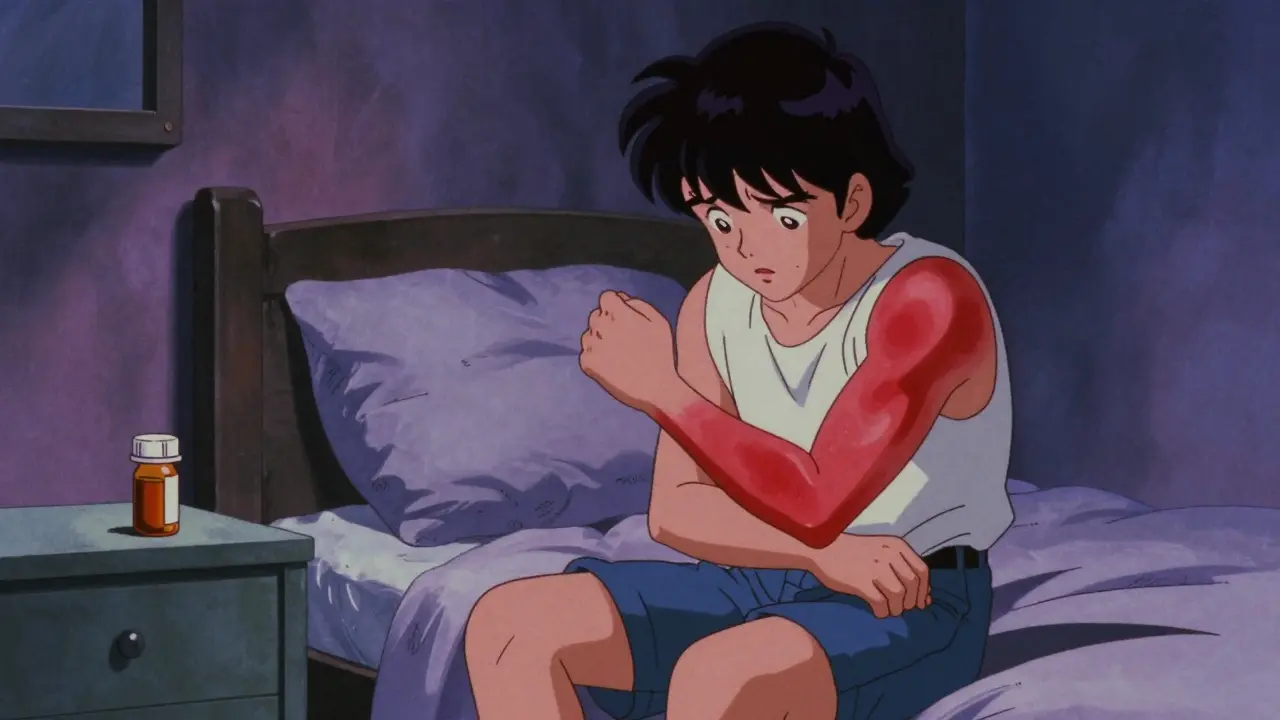
Imagine starting a new medication and feeling fine for a few weeks, only to suddenly wake up with a high fever and a rash that covers nearly your entire body. By the time you hit the emergency room, your liver enzymes are skyrocketing, and your kidneys are starting to struggle. This isn't a typical allergic reaction; it's a medical emergency known as DRESS syndrome is a severe cutaneous adverse reaction (SCAR) characterized by a complex multisystem inflammatory response following medication exposure. Also referred to as Drug-Induced Hypersensitivity Syndrome (DIHS), this condition is dangerous because it doesn't happen immediately, often tricking both patients and doctors into thinking the drug is safe.
The stakes are high. With a mortality rate of roughly 10%, the difference between a full recovery and permanent organ failure usually comes down to how quickly the suspect drug is stopped and how fast the inflammation is brought under control. If you or a loved one are noticing a late-onset rash after starting a new prescription, you need to know what to look for right now.
The Red Flags: How to Spot DRESS
Unlike a common hives reaction that pops up an hour after taking a pill, DRESS has a deceptive latency period. It typically strikes 2 to 8 weeks after you start the medication. This delay is why so many people are misdiagnosed with a simple viral infection at first.
Keep an eye out for these cardinal signs:
- Widespread Rash: A red, flat-to-raised morbilliform rash that often starts on the face and upper body, eventually covering 80-90% of the skin.
- High Fever: Temperatures often exceed 38.5°C (101.3°F), usually appearing before or alongside the rash.
- Facial Swelling: Edema, particularly around the eyes and face, is a hallmark sign present in nearly 68% of cases.
- Swollen Glands: Lymphadenopathy (swollen lymph nodes) occurs in about 75% of patients.
Beyond the skin, DRESS attacks the inside. In 90% of cases, internal organs are involved. The liver is the primary target, with 77.6% of patients showing elevated ALT levels-often exceeding 300 IU/L. Renal failure, pulmonary distress, and even cardiac issues can follow, making this a full-body crisis rather than just a skin problem.
The Culprits: High-Risk Medications
Not every drug causes DRESS, but certain classes are notorious for it. If you are taking any of the following, your vigilance should be higher:
- Allopurinol: Used for gout, this drug accounts for about 28% of DRESS cases.
- Anticonvulsants: Medications like Carbamazepine and Lamotrigine (used for epilepsy) are frequent triggers, making up 24% of cases.
- Antibiotics: Certain agents, including Vancomycin, contribute to roughly 20% of reactions.
Interestingly, genetics play a huge role. People with the HLA-B*58:01 allele are at a significantly higher risk for allopurinol-induced reactions. In Taiwan, where pre-prescription screening for this allele is mandated, the incidence of DRESS from allopurinol dropped by a staggering 80%.
| Feature | DRESS | SJS/TEN | AGEP |
|---|---|---|---|
| Latency Period | 2-8 Weeks | 4-28 Days | Hours to Days |
| Main Symptom | Rash + Organ Failure | Skin Sloughing/Blisters | Sterile Pustules |
| Fever | Very Common | Common | Common |
| Eosinophilia | Typical (>1,500 cells/μL) | Rare | Common |
| Mortality Rate | ~10% | 25-35% | <5% |
Diagnosing the Chaos
Diagnosing DRESS is notoriously difficult. In fact, a 2019 study found that 30-40% of cases are initially misdiagnosed. Because the symptoms mimic a bad flu or a viral exanthem, patients often bounce between primary care doctors and emergency rooms before finding a specialist who recognizes the pattern.
To get an accurate diagnosis, doctors use the RegiSCAR scoring system. This framework evaluates the presence of fever, rash, lymphadenopathy, and specific blood markers. When combined with laboratory tests, it offers 97% specificity. A key biological marker is the reactivation of HHV-6 (Human Herpesvirus 6), which occurs in 60-80% of cases and is believed to be a catalyst for the extreme inflammatory response.
If you suspect DRESS, the medical team must perform a complete blood count (CBC) with differential to check for eosinophils-white blood cells that usually spike between 1,500 and 5,000 cells/μL-and run liver and renal function tests immediately.
Treatment and the Road to Recovery
The moment DRESS is suspected, the first and most critical step is the immediate discontinuation of the culprit drug. Every hour the medication remains in your system increases the risk of permanent organ damage.
Treatment usually involves a high-dose course of Corticosteroids. While there aren't many large-scale randomized trials, observational data shows that starting steroids within 72 hours of diagnosis leads to a 60-70% response rate. However, you can't just stop steroids cold turkey; they require a slow taper, often lasting 3 to 6 months, with reductions as small as 5-10mg per week to prevent a relapse of the inflammatory storm.
In severe cases where ALT levels exceed 1,000 IU/L or there is respiratory distress, ICU-level monitoring is required. Some patients may also receive IVIG (Intravenous Immunoglobulin) or mycophenolate as steroid-sparing agents to reduce long-term side effects.
Patient Realities and Pitfalls
The clinical data only tells half the story. For many, the trauma of DRESS comes from the diagnostic delay. Patient forums are filled with accounts of people visiting the ER three or four times, being told they just have a "viral rash," only to end up in the ICU once their liver fails. This gap in knowledge is real: a 2021 study showed only 38% of primary care physicians could correctly identify DRESS criteria, compared to 89% of academic dermatologists.
Recovery is a marathon, not a sprint. Some patients, like those recovering from vancomycin-induced DRESS, may spend weeks in the hospital and months on prednisone before returning to normal life. The danger of failure occurs when the diagnosis is missed entirely, leading to chronic conditions like permanent renal impairment.
Is DRESS syndrome the same as a drug allergy?
No. A typical drug allergy (like hives) happens quickly and usually only affects the skin. DRESS is a systemic inflammatory disease that affects multiple internal organs and occurs weeks after starting the drug, making it far more dangerous and complex.
Can I take the medication again if I recover?
Absolutely not. You must avoid the culprit medication and any drugs in the same chemical class for the rest of your life. Re-exposure can cause a much faster and more severe recurrence of the syndrome.
How long does the rash from DRESS last?
The skin rash can persist for several weeks, even after the fever and organ inflammation subside. Full skin recovery typically happens gradually as the corticosteroids are tapered.
What is the role of HHV-6 in DRESS?
HHV-6 is a latent virus in most people. In DRESS, the drug seems to trigger the reactivation of this virus, which then drives a massive T-cell response, intensifying the attack on the skin and organs.
Should I get HLA testing before taking Allopurinol?
If you have an Asian background or are at high risk, testing for the HLA-B*58:01 allele can be life-saving. In some regions, this is now the standard of care to prevent DRESS before the first pill is ever taken.
Next Steps and Troubleshooting
If you are currently experiencing symptoms: Do not wait for a scheduled appointment. Go to an emergency department and specifically mention that you started a new medication 2-8 weeks ago. Bring the medication bottle with you.
For clinicians: If a patient presents with fever and rash but the timing doesn't fit a standard allergy, look back at their medication history from the last two months. Implement the RegiSCAR scoring and order a CBC with differential immediately to check for eosinophilia.
For long-term recovery: Stick strictly to the steroid tapering schedule. Stopping these medications abruptly can cause a rebound effect where the inflammation returns aggressively.
Ikram Khan
April 15, 2026 AT 02:19This is absolutely terrifying!! 😱 Imagine just taking a pill and your body basically decides to attack itself weeks later. So glad this info is out there to save lives!! ❤️
Randy Ryder
April 15, 2026 AT 11:27The focus on the HLA-B*58:01 allele is a great point regarding pharmacogenomics. It would be interesting to see if similar screening protocols are being adopted for the anticonvulsants mentioned, especially for those prone to hypersensitivity reactions. I wonder if the T-cell mediated response in DRESS differs significantly in its cytokine profile compared to standard SJS/TEN cases.
rupa das
April 16, 2026 AT 12:15probs just a flu for most people
Scott Lofquist
April 16, 2026 AT 18:14Actually, the mortality rate is often underreported because people just don't get to the right specialist in time 🙄. It's honestly a failure of the medical system if 40% of these cases are misdiagnosed. Get your testing done and don't trust a GP who tells you it's just a 'viral rash' 💅✨
Rim Linda
April 18, 2026 AT 11:35OMG the part about the liver enzymes skyrocketing is just too much!! 😭 I can't even imagine the panic in the ER when they realize it's not just a simple rash! 😱✨
David Snyder
April 19, 2026 AT 06:46It is really encouraging to see that Taiwan managed to drop the incidence by 80% through screening. That shows that we can actually prevent this if we just use the tools we have. Stay positive and always double check your meds!
Milo Tolley
April 20, 2026 AT 16:35The systemic inflammatory response syndrome (SIRS) manifestation here is absolutely harrowing!!! The fact that the latency period masks the etiology is a clinical nightmare!!!! 😱
S.A. Reid
April 20, 2026 AT 21:25It is quite fascinating that we are encouraged to trust these 'screenings' so implicitly. One must wonder if the mandate in Taiwan is less about health and more about establishing a genetic database for future state control. While the medical data is presented as absolute, the intersection of pharmacology and government surveillance is always a curious place indeed.
Clint Humphreys
April 21, 2026 AT 11:47You're spot on about the databases because you have to realize that these pharmaceutical companies aren't just 'finding' these alleles by accident, they're mapping us out so they can tailor drugs that keep us dependent on the system while they pretend to save us from a syndrome they probably helped create through poor early testing. It's all a cycle of manufactured crisis and curated cure, and if you look at the timing of the HHV-6 reactivation, it's almost too convenient that it mimics a natural virus to keep the doctors guessing and the billing codes high for the ICU stays.
Shaylia Helland
April 21, 2026 AT 11:47i remember reading something about how some people just have these really sensitive systems and it takes a while for the body to even realize it's reacting to something it doesn't like so the delay makes total sense if you think about it as a slow build up of stress in the immune system just until it finally snaps and everything goes haywire at once
Billy Wood
April 23, 2026 AT 08:24STOP THE DRUGS FAST!!! Get to the ER!!! Don't wait!!!
Olivia Lo
April 24, 2026 AT 17:46We must approach the pharmacological intervention with a balanced perspective. While corticosteroids are the current gold standard for modulating the hyperinflammatory state, we should consider the long-term psychological impact of a six-month taper. The systemic nature of DRESS requires a holistic recovery plan that respects the patient's bodily autonomy while managing the visceral inflammatory cascade through a carefully calibrated immunosuppressive regimen.
Tabatha Pugh
April 25, 2026 AT 23:39I've seen a few cases of this in my clinic and the biggest mistake is always the taper. People think they feel better after two weeks of prednisone and they just stop taking it, and then they come back three days later with a rebound rash that's twice as bad as the original one. You can't just cheat the endocrine system like that.