
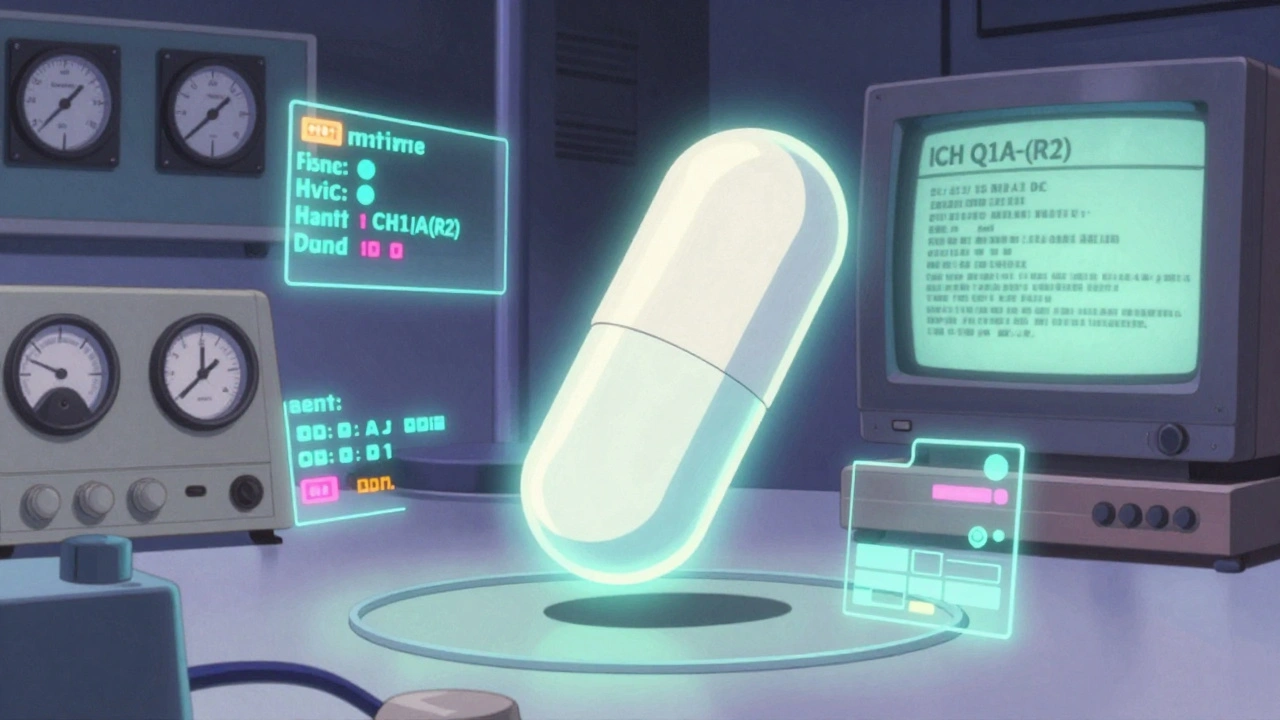
When you pick up a generic pill at the pharmacy, you expect it to work just like the brand-name version. But how does the FDA make sure that generic drugs don’t lose strength, break down, or become unsafe over time? The answer lies in stability testing-a rigorous, science-backed process that every generic drug must pass before it hits the market.
Why Stability Testing Matters for Generics
Stability testing isn’t just paperwork. It’s the backbone of patient safety. If a drug degrades too fast, it might not work. Worse, it could produce harmful impurities. The FDA requires generic manufacturers to prove their products stay safe and effective from the moment they’re made until the expiration date on the bottle. This isn’t optional. Under the Hatch-Waxman Act of 1984, generics could enter the market without repeating all the clinical trials of brand-name drugs. But they still had to prove they were bioequivalent-and stable. That’s where stability data comes in. Without it, the FDA won’t approve an ANDA (Abbreviated New Drug Application).What the FDA Actually Requires
The FDA doesn’t leave room for guesswork. Stability testing follows strict rules laid out in ICH Q1A(R2) guidance and detailed in the agency’s 2018 Q&A document for ANDAs. Here’s what you need to know:- You must test at least three batches of your drug product. Each batch must be made at pilot scale or larger, under current Good Manufacturing Practices (cGMP).
- Testing must cover physical, chemical, biological, and microbiological properties-things like color, potency, dissolution rate, microbial contamination, and preservative levels.
- For products with a shelf life of 12 months or longer, you need to test every 3 months in the first year, every 6 months in the second year, and then once a year after that.
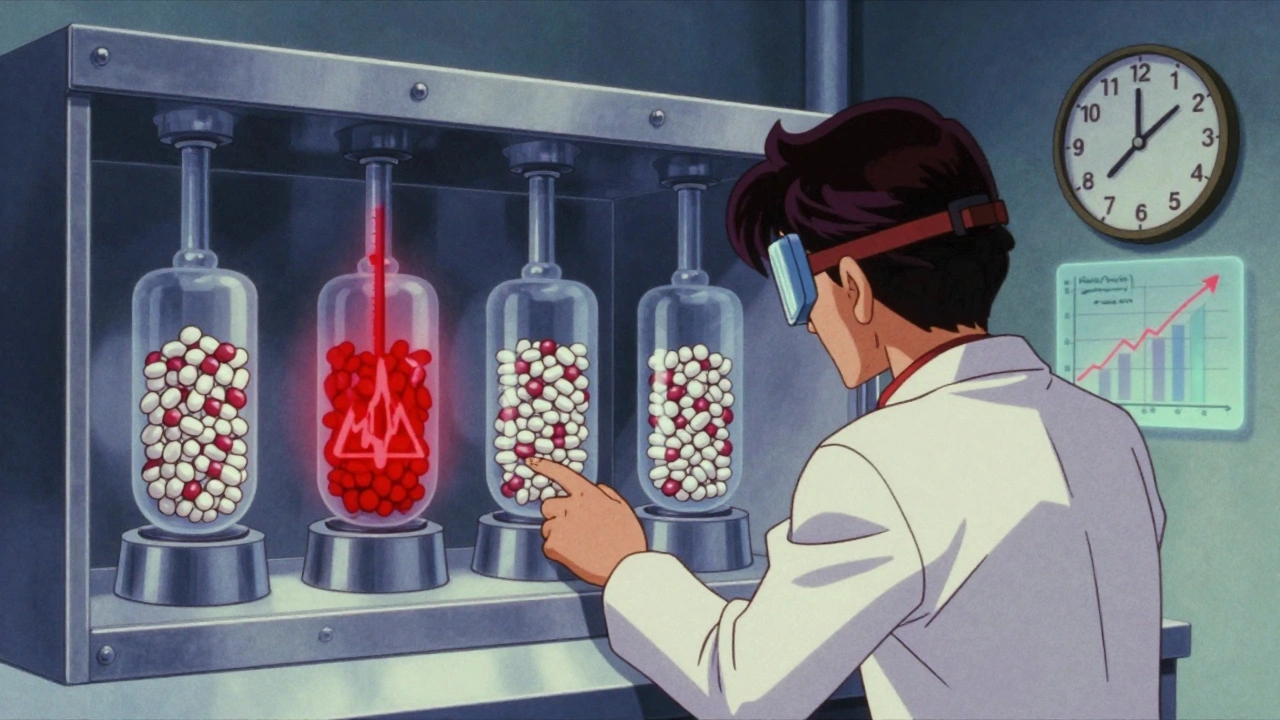
- Accelerated testing: 6 months at 40°C and 75% humidity. This shows how the drug behaves under stress.
- Long-term testing: 12 months at 25°C and 60% humidity-the conditions your drug will actually be stored in.
The FDA doesn’t accept just any data. You need to show that your stability studies are already underway when you submit your ANDA. At minimum, you must provide initial and one additional time point for both accelerated and long-term studies. But for full review, they expect 6 months of accelerated data and 6 months of long-term data.
Container and Packaging Must Match
It’s not just about the drug itself. The container matters too. If you’re planning to sell your generic in a blister pack, you must test stability using that exact same blister pack. Same for bottles, vials, or syringes. You can’t test one type of packaging and then switch later. The FDA requires that the container closure system used in stability studies is identical to what you’ll use for commercial sale. Why? Because packaging can affect how the drug degrades. A bottle that lets in moisture or light could ruin your product-even if the formula is perfect.Brackets and Matrixing: Saving Time Without Cutting Corners
Testing every strength and every package size can be expensive and slow. That’s where bracketing and matrixing come in. - Bracketing means testing only the highest and lowest strengths in a family of products (like 10mg, 20mg, 40mg tablets), assuming the middle strengths behave the same. You need scientific justification-like similar formulation and manufacturing process.The FDA approves these approaches if they’re scientifically sound. In 2022, 67.3% of ANDAs that used bracketing or matrixing got approval-up from 48% in 2018. But if you don’t explain your logic clearly, your application gets rejected.
Common Reasons Generic Applications Get Rejected
Stability issues are the #1 reason the FDA sends back generic applications. In 2019, 34.6% of Complete Response Letters from the FDA cited stability deficiencies. Here’s what goes wrong most often:- Inadequate protocols: Missing test methods, unclear sampling schedules, or no reference to USP chapters like <1151> or <1010>. Nearly 98% of completeness failures are due to this.
- Insufficient data points: Testing too infrequently, skipping time points, or not having enough batches.
- Poorly validated methods: If your test can’t detect degradation products, the FDA won’t trust your results. This was cited in 31.2% of stability-related rejections.
- Storage failures: Stability chambers that drift out of range. FDA inspections in 2022 found temperature excursions of over ±2°C in 18.4% of cases.
- Wrong container: Testing in a bottle you don’t plan to sell in.
One manufacturer lost six months because their stability chamber logged a 4.7°C spike-twice a month-for three months straight. The data from that period was thrown out. They had to restart.
Generics vs. Brand-Name Drugs: Same Rules, Different Pressure
Generic and brand-name drugs follow the same ICH guidelines. But there’s a key difference: brand-name companies build the reference data. Generics have to match it. Generic manufacturers don’t need to do forced degradation studies from scratch-the brand’s degradation pathways are already known. But they must prove their product degrades the same way. If the brand’s tablet breaks down into Compound X at 40°C, your version must do the same. If it doesn’t, the FDA will question your formulation. Also, generic companies face tighter financial pressure. With generics making up 90% of prescriptions but only 23% of spending, margins are thin. Stability testing can cost $487,500 per ANDA-nearly 19% of total development costs. That’s why many cut corners. And that’s why the FDA sees more stability failures in generic applications than in brand-name ones.What’s Changing in 2025 and Beyond
The rules are getting stricter. In June 2025, the FDA released a draft guidance proposing:- 24 months of real-time stability data for all new ANDAs (up from 12 months).
- Quality by Design (QbD) principles-meaning you have to prove you understand how every ingredient and step affects stability.
- New requirements for nanomaterials, which are becoming more common in complex generics.
The ICH is also updating Q1C(R2), adding stricter photostability rules and climate zone-specific storage conditions. That affects 73% of generic products.
On the tech side, the FDA is piloting blockchain for stability data verification. Imagine a tamper-proof digital ledger tracking every temperature reading, every test result, every batch. It’s not mandatory yet-but it’s coming.
How Manufacturers Are Adapting
Top generic companies are investing in automation. As of Q2 2023, 78.4% of the top 25 generic manufacturers use automated environmental monitoring systems to track stability chambers in real time. That’s up from 45% in 2020. They’re also doing pre-submission meetings with the FDA. Companies that meet with regulators before filing reduce their deficiency rates by 42.6%. It’s not a guarantee-but it’s the smartest move. For smaller firms, the cost is brutal. Indian manufacturers, who account for 40% of U.S. generic approvals, made up 63% of all stability-related rejections in 2022. Many don’t have the budget for full-scale labs or automated systems.What You Need to Do Next
If you’re developing a generic drug:- Start stability studies early-don’t wait until your ANDA is ready.
- Use the exact packaging you plan to sell.
- Validate every analytical method using USP standards.
- Document everything. The FDA will audit your logs.
- Consider bracketing or matrixing-but justify it with data.
- Invest in monitoring systems. A $20,000 automated chamber saves you $500,000 in delays.
- Request a pre-submission meeting with the FDA. It’s free, and it works.
Stability testing isn’t about checking boxes. It’s about ensuring every pill, every capsule, every injection does what it’s supposed to-when it’s supposed to. The FDA doesn’t trust promises. They trust data. And if your data isn’t solid, your product won’t make it to patients.
Do generic drugs need the same stability testing as brand-name drugs?
Yes. Both must follow the same ICH Q1A(R2) guidelines. The difference is that brand-name companies generate the original stability data, while generics must prove their product matches that data. Generics don’t need to repeat all the exploratory studies, but they must still conduct full, compliant stability testing on their own batches.
How long does stability testing take before an ANDA can be submitted?
You can submit an ANDA with as little as 6 months of long-term data and 6 months of accelerated data-but you must show the studies are ongoing. The FDA won’t approve the application until you’ve completed the full proposed shelf life. Most companies start stability testing 12-18 months before filing to stay ahead.
Can I use data from my brand-name reference drug for my generic’s stability submission?
No. You can reference the reference listed drug’s data to support your shelf-life claim, but you must generate your own stability data from your own batches. The FDA requires proof that your specific product, under your specific conditions, performs the same way.
What happens if my stability chamber has a temperature spike?
Any excursion above ±2°C can invalidate data from that period. The FDA will ask for a root cause analysis and may require you to repeat the test. Automated monitoring systems help catch these early, but manual logs are still required. Never assume a short spike won’t matter-it can derail your entire application.
Are there exceptions to the three-batch requirement?
Yes, but only in rare cases. For example, if you’re making a drug with a very short shelf life (less than 12 months), you may submit data from two batches. For continuous manufacturing, the FDA may accept fewer batches if you can prove consistent quality across production runs. Always request written guidance from the FDA before deviating from the standard.
What’s the biggest mistake generic manufacturers make with stability testing?
Waiting too long to start. Many companies treat stability testing as an afterthought-something to do right before filing. But stability studies take months, sometimes years. Starting late means delays, missed deadlines, and rejected applications. The best manufacturers begin stability testing the same day they finalize their formulation.
Haley P Law
December 8, 2025 AT 16:48Andrea DeWinter
December 9, 2025 AT 19:03George Taylor
December 10, 2025 AT 03:27Chris Marel
December 10, 2025 AT 17:12Arun Kumar Raut
December 11, 2025 AT 11:00precious amzy
December 12, 2025 AT 04:09William Umstattd
December 13, 2025 AT 00:01Brianna Black
December 14, 2025 AT 22:39Stacy Tolbert
December 15, 2025 AT 14:03Ronald Ezamaru
December 17, 2025 AT 07:03Ryan Brady
December 17, 2025 AT 19:10Iris Carmen
December 19, 2025 AT 01:30