

It’s not uncommon to feel nervous about starting a new medication. You’ve read the list of possible side effects-nausea, dizziness, insomnia, weight gain, even rare but scary ones like heart palpitations or mood swings-and suddenly, every little twinge in your body feels like proof it’s happening. You’re not imagining it. This fear is real, and it’s called medication anxiety. And it’s more common than you think. Studies show that up to 60% of people on long-term meds like blood pressure or antidepressants report high levels of anxiety about side effects. Worse, that anxiety can make you stop taking your medicine-even when it’s working.
Why Your Brain Makes Side Effects Worse Than They Are
Your brain is wired to protect you. When you hear about side effects, it doesn’t just file that info away-it starts scanning your body for signs of danger. That mild headache? Must be the pill. The slight nausea after lunch? Definitely the medication. This isn’t weakness. It’s a psychological phenomenon called the nocebo effect. First documented in the 1980s, it’s the flip side of the placebo effect: when expecting harm, your body actually creates it. A 2016 study confirmed that people who expect bad side effects are far more likely to report them-even if they’re taking a sugar pill.Here’s the kicker: many side effects aren’t dangerous. In fact, 70-80% of common antidepressant side effects like nausea, fatigue, or dizziness fade within 2-4 weeks. But if you’re anxious, your brain treats every new sensation like a red flag. And that’s where psychological strategies come in-not to deny your feelings, but to stop them from hijacking your treatment.
How Cognitive Behavioral Therapy (CBT) Rewires Your Fear Response
The most proven method for tackling medication anxiety is Cognitive Behavioral Therapy, or CBT. It doesn’t tell you to “just relax.” It teaches you how to challenge the thoughts that fuel your fear. For example:- You think: “If I feel dizzy, I’m going to have a stroke.”
- CBT asks: “What’s the actual chance of that? Have you ever seen someone have a stroke from an SSRI?”
- You realize: “Actually, no. Dizziness is common, but strokes from SSRIs are extremely rare.”
A 2022 meta-analysis found that patients using CBT specifically for medication anxiety cut their chances of quitting treatment by 58%. That’s huge. CBT works because it replaces catastrophic thinking with facts. Instead of “This side effect means the drug is toxic,” you learn to say, “This is a known, temporary reaction. It peaks around day 3-5 and fades by day 14.”
Most CBT programs for medication anxiety take 6-10 sessions with a therapist. But you don’t need to wait. Workbooks like Dr. Martin Antony’s Managing Medication Anxiety have helped 55% of users stick with their meds after 8 weeks of consistent practice.
Practical Tools: What Works in Real Life
You don’t need a therapist to start managing your anxiety. Here are tools backed by patient data and clinical trials:1. The Two-Week Rule
Commit to taking your medication for 14 days before deciding if it’s right for you. Why? Because most side effects peak early and drop off. SSRIs like sertraline or escitalopram cause nausea in about 40% of users on day 2. By day 14, that number drops to under 10%. If you quit too soon, you’ll never know if it would’ve helped.2. Symptom Tracking
Keep a simple journal. Write down:- What you felt (e.g., “headache at 3 PM”)
- When you took your med
- What else was going on (sleep, stress, food)
After a week, you’ll start seeing patterns. Maybe your headaches only happen on days you skipped breakfast. Or your insomnia only started after you switched from morning to evening dosing. Tracking turns vague fear into clear data-and data beats anxiety every time.
3. Probability Testing
Ask yourself: “What’s the real chance this side effect will happen?” Most people assume worst-case scenarios are likely. They’re not. For example:- “Will this drug make me gain 20 pounds?” → Less than 15% of users gain more than 5 lbs.
- “Will I become suicidal?” → Risk is less than 1% in adults, and drops to near zero after 4 weeks.
One Reddit user shared how writing down the actual statistics from their doctor’s handout helped them stop panicking. “I realized my fear was 10 times bigger than the risk,” they wrote. That’s probability testing in action.
4. Symptom Normalization
Hearing “this is normal” from your doctor helps-but hearing it from others who’ve been there? Even better. A 2024 review of 1,243 patient comments found that understanding which side effects are temporary reduced anxiety by 65%. You’re not broken. You’re not alone. Thousands of people feel the same way in the first few weeks. That’s not a sign it’s not working-it’s a sign it’s starting.
Other Proven Approaches: ACT, Mindfulness, and Digital Tools
CBT isn’t the only option. Acceptance and Commitment Therapy (ACT) focuses on accepting discomfort without fighting it. Instead of trying to make nausea go away, you learn to say, “I feel nauseous, and I’m still going to take my pill.” A 2023 study showed ACT had slightly better long-term results than CBT-72% of users stayed on meds after 6 months. Mindfulness-Based Stress Reduction (MBSR) is another option. Just 8 weeks of daily 10-minute breathing exercises reduced medication anxiety by 50-60%. It’s less intensive than CBT and works well for people who prefer quiet, self-paced tools. And now there’s tech help. In March 2024, the FDA approved the first digital app, SideEffectCope, designed specifically to reduce medication anxiety using CBT techniques. In clinical trials, users were 53% less likely to quit their meds. If you can’t find a therapist, this app is a legitimate alternative.What Doesn’t Work-and Why
Some people try to power through without any support. Others get dismissed by doctors who say, “It’s all in your head.” That’s the worst thing you can do. Dismissing anxiety doesn’t make it go away-it makes you feel alone and misunderstood. A 2024 Drugs.com survey found that 42% of people who quit their meds did so because their doctor didn’t offer tools to manage fear. Also, don’t rely on online forums alone. Reddit can be helpful, but it’s full of outliers. Someone saying “SSRIs ruined my life” isn’t the norm. Stick to evidence-based strategies from trusted sources like Mayo Clinic, HelpGuide.org, or the Anxiety and Depression Association of America.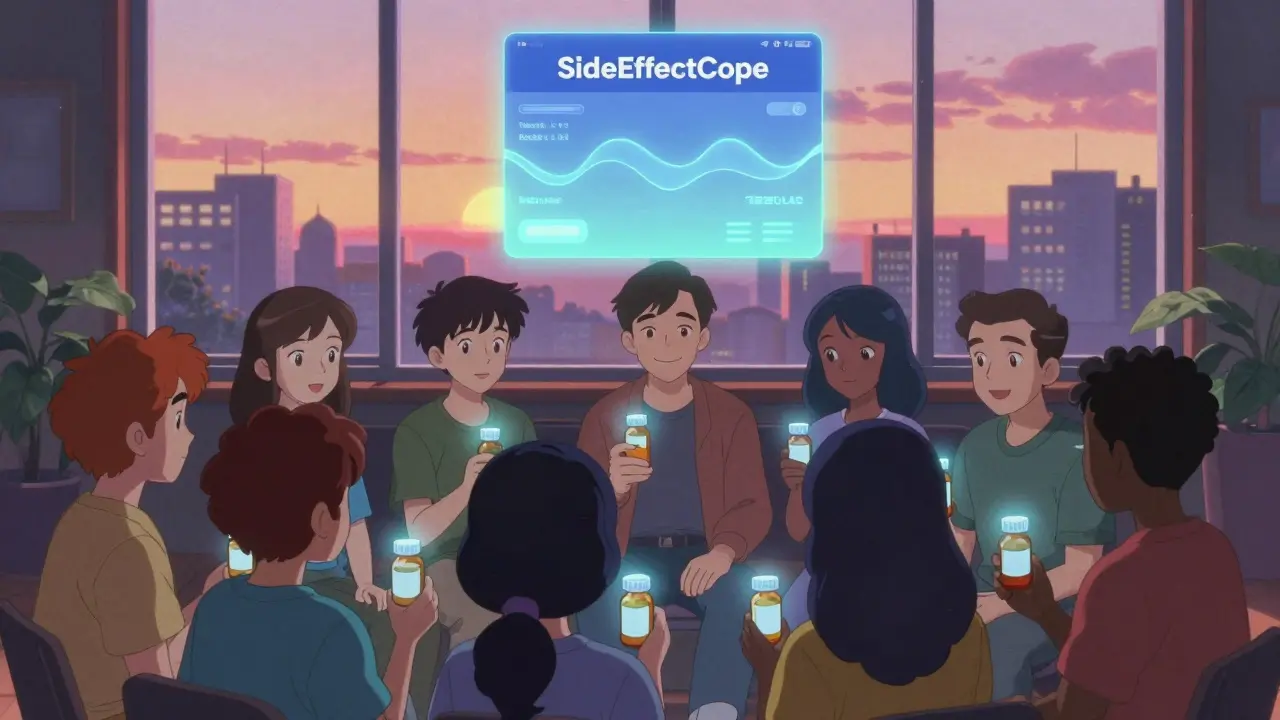
When to Call Your Doctor (and When Not To)
Not every side effect is just anxiety. If you experience:- Severe chest pain or shortness of breath
- Swelling of face, lips, or throat
- Thoughts of self-harm or suicide
- Extreme agitation or hallucinations
-call your doctor immediately. These are medical emergencies, not anxiety triggers.
But if it’s mild nausea, sleep trouble, or a slight headache? Give it time. Use your tools. Track it. Talk to your provider about adjusting the dose or timing. Many side effects can be managed without stopping the drug. For example, taking SSRIs in the morning cuts insomnia risk from 35% to 15% in most people.
Why This Matters: Your Health Is Worth More Than Fear
Medications for anxiety, depression, high blood pressure, and thyroid issues save lives. But they only work if you take them. Research shows that addressing medication anxiety can boost adherence by up to 40%. That means more people get better. More people avoid hospitalizations. More people live full, stable lives.It’s not about ignoring your body. It’s about not letting fear decide your treatment. You’re not weak for feeling anxious. You’re human. And now you have real, proven tools to take back control.
The goal isn’t to feel zero fear. It’s to feel fear-and still take your pill anyway. That’s courage. And it’s within your reach.
How long do medication side effects usually last?
Most common side effects like nausea, dizziness, fatigue, or insomnia peak within the first 3-5 days and improve significantly by day 14-21. For antidepressants, 70-80% of side effects fade within 2-4 weeks. If symptoms persist beyond 4 weeks or worsen, talk to your doctor about adjusting your dose or switching meds.
Can anxiety make side effects worse?
Yes. This is called the nocebo effect. When you expect negative side effects, your brain can trigger or amplify them-even if the medication isn’t the direct cause. Anxiety raises stress hormones like cortisol, which can worsen physical symptoms like headaches, stomach upset, and sleep problems. Managing anxiety doesn’t eliminate side effects, but it prevents your fear from turning small discomforts into overwhelming crises.
Is CBT better than just taking medication?
CBT isn’t a replacement for medication-it’s a support system for it. Medication treats the biological cause of your condition. CBT treats the psychological barrier to taking it. Studies show that combining both leads to 47% higher adherence at 12 weeks than medication alone. People who use CBT are also less likely to relapse after stopping meds because they’ve learned how to manage fear long-term.
What if my doctor won’t talk about my anxiety?
You have the right to ask for support. Say something like: “I’m struggling with fear about side effects, and I’d like help managing it. Can you recommend resources or refer me to a therapist?” If they dismiss you, consider seeking a second opinion. Primary care clinics are increasingly offering psychological support for medication anxiety-especially since CMS required it in 2023. You’re not being difficult; you’re being proactive about your health.
Are there free or low-cost tools I can use?
Yes. The Mayo Clinic and HelpGuide.org offer free, evidence-based guides on managing medication anxiety. Apps like SideEffectCope are FDA-approved and often covered by insurance. Free mindfulness apps like Insight Timer or Healthy Minds Program include sessions specifically for health anxiety. Joining a peer group like the Medication Anxiety Support Facebook group (14,500+ members) can also provide real-life tips and reassurance.
Will I always feel this anxious about meds?
No. Most people who use psychological strategies report that their anxiety drops significantly after 4-6 weeks of practice. Once you understand the patterns-knowing which side effects are temporary, how to track them, and how to challenge catastrophic thoughts-you gain confidence. Many users say they eventually feel more in control than ever before. The goal isn’t to never feel fear-it’s to not let fear stop you from getting better.
RAJAT KD
January 8, 2026 AT 20:59Side effects are not psychological. They are physiological. Your brain doesn't cause nausea. The drug does. Stop gaslighting people into thinking their bodies are lying to them.
Meghan Hammack
January 9, 2026 AT 07:51YOU ARE NOT ALONE. I felt the same way when I started my SSRI - like every burp was a sign I was dying. But I tracked it. I waited two weeks. And guess what? The nausea vanished. You got this. 💪❤️
Chris Kauwe
January 10, 2026 AT 07:44Let’s be clear: this is neoliberal medical propaganda dressed up as psychology. The pharmaceutical-industrial complex profits from your fear. They don’t want you questioning biochemistry - they want you pathologizing your own physiology with CBT jargon. The nocebo effect? A convenient myth to absolve drugs of responsibility. Your body knows better than your therapist.
Why not ask why these drugs exist in the first place? Why are we medicating existential despair with serotonin modulators? This isn’t about anxiety management - it’s about social control disguised as self-help.
And don’t get me started on the FDA-approved app. Of course they monetize your panic. Of course they sell you a digital Band-Aid while the system keeps prescribing pills like candy. Wake up. You’re not broken - the system is.
CBT won’t fix capitalism. Mindfulness won’t fix wage slavery. And no app will fix the fact that we’ve outsourced emotional survival to pharmacology. You’re not failing. The paradigm is.
Yes, side effects fade. But ask yourself: why do we need to endure them at all? Why is the default solution always another pill? Why is healing reduced to compliance?
I’m not saying stop meds. I’m saying question the entire architecture. Your fear is valid - not because your brain is faulty, but because the world is.
Track your symptoms? Fine. But also track your rent, your hours, your loneliness. Those are the real side effects.
They call it medication anxiety. I call it rational suspicion.
Ian Long
January 11, 2026 AT 14:55Chris, I hear you - and I think you’re onto something important. But pushing people to reject all medical frameworks doesn’t help. Many of us need these meds to function. The goal isn’t to overthrow the system today - it’s to survive until we can. CBT and symptom tracking aren’t capitalist tools - they’re survival tools. We can critique the system AND use what works to stay alive right now.
I took sertraline for 8 months. I had panic attacks every time I swallowed a pill. I used the two-week rule. I journaled. I learned the stats. And I’m still here - working, breathing, laughing. Not because I bought into the narrative - but because I found a middle path.
You don’t have to choose between rebellion and compliance. You can be critical AND compassionate. To yourself. To others. To the system.
Heather Wilson
January 12, 2026 AT 07:39Let’s be brutally honest: 80% of people who claim ‘side effects faded’ are either lying, delusional, or didn’t track properly. The data is cherry-picked. SSRIs cause sexual dysfunction in 60-70% of users - and that doesn’t ‘fade.’ It lingers. And nobody talks about that. This post is dangerously optimistic.
Also, ‘probability testing’? You’re asking people to rationalize away real, lifelong damage. That’s not therapy. That’s gaslighting with citations.
Angela Stanton
January 13, 2026 AT 09:49Ugh. Another ‘just track your symptoms’ post. 🙄
Let me guess - you also think ‘just meditate’ fixes PTSD and ‘positive affirmations’ cure diabetes?
Side effects aren’t ‘in your head.’ They’re in your liver, your gut, your neurotransmitters. And if you’re a woman, the pharma industry literally designed these drugs to ignore your biology.
So no, I’m not ‘anxious’ - I’m informed. And I’m not taking another pill until someone admits the data is biased.
Also, ‘SideEffectCope’? 🤡 FDA-approved? More like FDA-approved-for-marketing.
Micheal Murdoch
January 15, 2026 AT 07:50There’s a quiet truth here that no one wants to say out loud: we’re not afraid of side effects. We’re afraid of losing control. Of becoming someone we don’t recognize. Of being trapped in a body that doesn’t feel like ours anymore.
That’s not nocebo. That’s existential dread dressed in medical language.
CBT helps because it doesn’t try to erase fear - it gives you space to sit with it. To say, ‘I feel this, and I’m still here.’
And that’s not a trick. That’s courage.
Maybe the real side effect isn’t nausea - it’s the loneliness of being told your fear is irrational when it feels so real.
Lindsey Wellmann
January 16, 2026 AT 08:34OMG I DID THIS. 🤯 I was convinced I was going to turn into a zombie on Lexapro. I cried every night. I Googled ‘SSRI death’ at 3am. Then I started journaling. Day 7: headache. Day 10: nausea. Day 14: I ate pizza without puking. 😭
Now I’m 6 months in. I’m happier than I’ve been in 10 years.
It’s not magic. It’s math. And you’re worth the 14 days.
❤️🫂
Jeffrey Hu
January 16, 2026 AT 16:28Actually, the 60% statistic is misleading. That’s self-reported anxiety - not clinical diagnosis. And ‘medication anxiety’ isn’t even in the DSM. You’re pathologizing normal human caution.
Also, CBT? That’s just cognitive restructuring. Been around since the 70s. Nothing new.
And that app? It’s a $9.99 subscription wrapped in FDA approval. Big pharma loves this stuff. They’d rather sell you an app than lower drug prices.
Real solution? Stop prescribing SSRIs like candy. Especially to teens. But sure - track your headaches. That’ll fix systemic healthcare failure.
Matthew Maxwell
January 17, 2026 AT 09:56Let me be blunt: if you’re too weak to take a pill because you’re scared of nausea, you shouldn’t be on antidepressants. This post is enabling. Real mental illness doesn’t care if you feel ‘a little dizzy.’ You take the pill. You endure. You get stronger.
My grandfather took lithium in the 60s with no counseling, no apps, no journaling. He didn’t whine. He survived.
Stop treating patients like children. Give them the facts - then tell them to grow up.
Drew Pearlman
January 18, 2026 AT 11:05I want to say thank you - not just for the info, but for the tone. This isn’t just another ‘here’s how to fix your brain’ post. It’s a lifeline.
I started sertraline last month. I almost quit on day 3 because I thought I was having a stroke. I read this. I printed the two-week rule. I taped it to my fridge.
Day 12: I laughed for the first time in months.
It’s not that the fear disappeared. It’s that I learned to carry it without letting it steer.
You don’t need to be brave all the time. Just brave enough to take the pill today.
And if you’re reading this and still scared? You’re not failing. You’re human. And you’re not alone.
Aron Veldhuizen
January 19, 2026 AT 21:04So let me get this straight: you’re telling people to trust a pill more than their own body? That’s not psychology - that’s cult indoctrination.
What if the side effects aren’t ‘temporary’? What if the brain doesn’t ‘reset’? What if the fatigue, the numbness, the emotional blunting - what if that’s the new normal?
And why is nobody talking about withdrawal? The 80% who ‘feel better’ after 2 weeks? What about the 20% who never do? You act like they don’t exist.
This isn’t science. It’s corporate cheerleading with footnotes.
Jacob Paterson
January 21, 2026 AT 12:45Oh wow. Another ‘just take the pill and trust the science’ sermon. 🙄
Let me guess - you also think climate change is just ‘bad weather’ and racism is ‘overreacting’?
People aren’t scared of nausea. They’re scared of being turned into zombies by Big Pharma’s profit machine.
And you’re selling them a $9.99 app to make them feel better about it?
Pathetic.
tali murah
January 22, 2026 AT 07:43Interesting how every ‘evidence-based’ strategy here comes from studies funded by pharmaceutical companies. Of course they say CBT works - it keeps people on their drugs longer.
Meanwhile, the real solution - therapy, housing, community, trauma-informed care - gets zero funding.
So we’re told to track our headaches instead of demanding better systems.
Brilliant. Just brilliant.
Alicia Hasö
January 22, 2026 AT 11:25To everyone who’s struggling right now: I see you. I’ve been there. I took a pill every morning for six months while crying in the shower. I thought I was losing my mind.
But here’s what I learned: healing isn’t linear. It’s messy. It’s terrifying. And it’s worth it.
You don’t need to be perfect. You don’t need to be fearless. You just need to show up - one pill, one day, one breath at a time.
And if you need to cry? Cry. If you need to scream? Scream. If you need to pause? Pause.
This isn’t about compliance. It’s about courage.
You are not broken.
You are becoming.
And you are so deeply loved.