

Pediatric Safety Network Impact Simulator
This simulator demonstrates why isolation is dangerous in pediatric research. Adjust the parameters below to see how increasing the number of participating hospitals (sites) dramatically increases the likelihood of detecting a rare side effect.
Total Statistical Power
Total Patients Analyzed
Rare Event Detection
Probability of Detecting Signal
Based on ~2% incidence rateNetwork Strength
Weak Signal
Risk of false negatives is high
Children are not just small adults. Their bodies process drugs differently, their injuries happen in different contexts, and their long-term health outcomes require unique tracking methods. For decades, this reality meant that pediatric patients were often left out of major clinical trials or monitored with inconsistent standards. Today, a shift is underway. Pediatric Safety Networks are structured multi-institutional frameworks designed to systematically investigate treatment efficacy, safety outcomes, and side effects in pediatric populations through collaborative research methodologies. These networks allow hospitals, universities, and government agencies to pool data, share protocols, and catch rare side effects that no single institution could detect alone.
The stakes are high. When a new medication hits the market, or when a hospital implements a new critical care protocol, subtle adverse events can slip through the cracks. By connecting multiple sites, these networks create a statistical power that makes invisible risks visible. This article breaks down how these systems work, who runs them, and why they are essential for modern child health care.
How Pediatric Safety Networks Operate
At their core, these networks function as massive, coordinated learning labs. Instead of one hospital guessing if a new ventilator strategy causes fewer complications, seven hospitals test it simultaneously using the exact same rules. This approach eliminates local bias and speeds up results. According to a 2013 analysis by Carole M. Lannon and Laura E. Peterson published in Academic Pediatrics, these networks allow practice-based teams to "learn from one another, test changes to clinical practice, measure outcomes, and implement improvements" with a specific focus on safety metrics.
The infrastructure behind this collaboration is rigorous. It relies on three main pillars:
- Clinical Sites: The hospitals or clinics where patient care happens. They enroll patients, follow strict protocols, and collect raw data.
- Data Coordinating Centers (DCC): The technical backbone. They design study forms, calculate sample sizes, manage databases, and perform statistical analyses.
- Oversight Bodies: Independent boards that monitor safety and ethics, ensuring that patient welfare always comes before data collection.
This structure ensures that when a side effect is detected, it is verified quickly and accurately across different geographic regions and patient demographics.
Key Models: Critical Care vs. Injury Prevention
Not all safety networks look the same. Two major models have emerged, each addressing different types of risks. Understanding the difference helps clarify how side effects are tracked depending on whether the threat is medical or environmental.
| Feature | CPCCRN (Critical Care) | Child Safety CoIIN (Injury Prevention) |
|---|---|---|
| Primary Focus | Medical treatments and ICU protocols | Environmental and behavioral safety strategies |
| Sponsor | NICHD (NIH) | HRSA / Children's Safety Network |
| Side Effect Tracking | Direct monitoring of pharmacological and procedural adverse events | Tracking unintended consequences of policy interventions |
| Structure | 7 Clinical Sites + 1 Data Coordinating Center | 16 States + 34 Active Strategy Teams |
| Governance | Data and Safety Monitoring Board (DSMB) | State-level steering committees |
The Collaborative Pediatric Critical Care Research Network (CPCCRN) was established through NIH RFA-HD-14-022 to investigate the efficacy of treatment and management strategies to care for critically ill and injured children. Created by the Eunice Kennedy Shriver National Institute of Child Health and Human Development (NICHD), this network operated under a cooperative agreement mechanism. Its strength lay in its ability to monitor acute, life-threatening conditions. Because it pooled data from seven major clinical sites, it could detect rare adverse events that might be missed in a smaller study. The DCC provided critical support, including "developing protocol data management aspects, devising novel comparative study designs, and performing data analyses."
In contrast, the Child Safety Collaborative Innovation and Improvement Network (CoIIN) focused on broader public health issues. Managed by the Children's Safety Network with support from the Health Resources and Services Administration (HRSA), CoIIN ran two cohorts between 2017 and 2019. It involved 16 states and 34 active strategy teams. While CPCCRN tracked drug reactions in ICUs, CoIIN tracked the success-and potential negative side effects-of community programs. For example, one state program initially focused on general violence prevention but found, through real-time data tracking, that they needed to specifically integrate dating and sexual violence into their "green dot sessions" to see meaningful results.
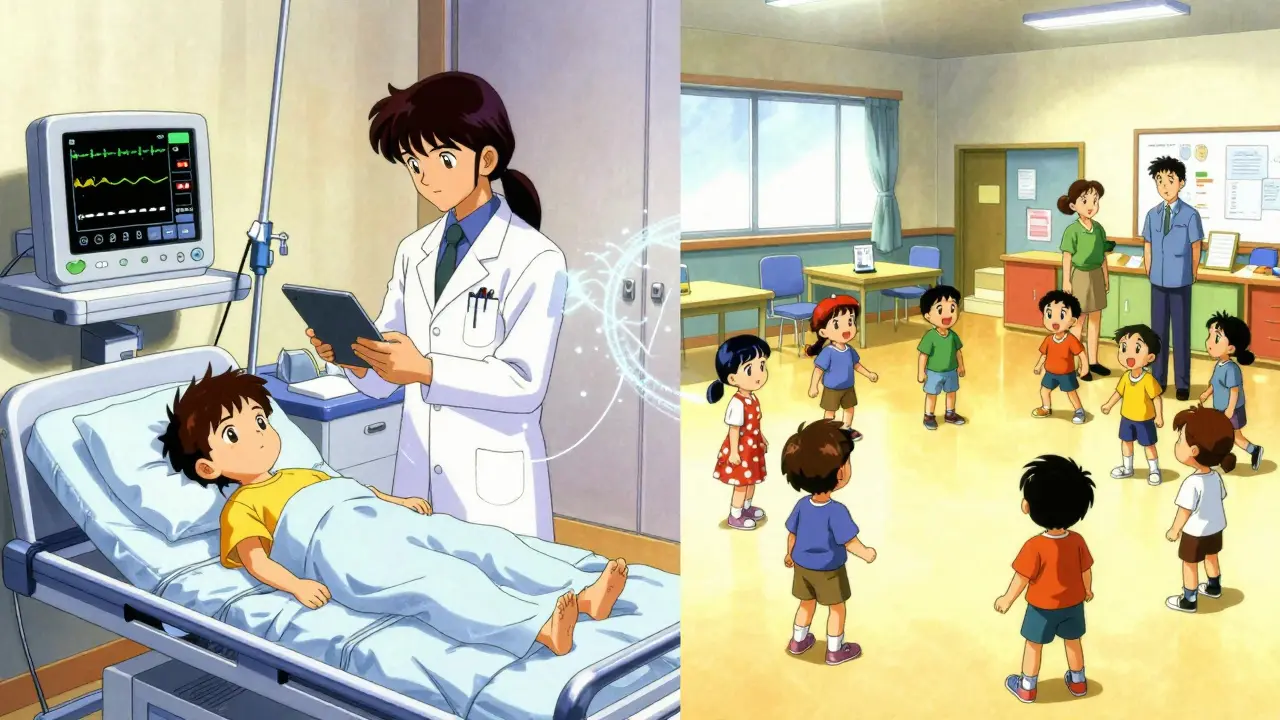
The Role of Data and Safety Monitoring Boards
One of the most critical components of any pediatric safety network is the Data and Safety Monitoring Board (DSMB). You cannot simply collect data on vulnerable children without independent oversight. The DSMB acts as a checkpoint. They review interim data to ensure that a study is safe to continue.
In the CPCCRN model, the DSMB was explicitly designed to monitor side effects and adverse events. If a new protocol showed signs of causing more harm than good, the board had the authority to halt the study immediately. This protects patients from experimental treatments that fail in real-world settings. The board also ensures that the data being collected is statistically sound. As noted by one Clinical Site Principal Investigator, the centralized sample size calculations provided by the DCC "prevented underpowered safety analyses in several protocols." Without this rigor, a study might claim a treatment is safe simply because it didn't have enough participants to show otherwise.
Challenges in Implementation
Running a national safety network is not easy. Participating institutions face significant logistical hurdles. First, there is the issue of standardization. A "side effect" must mean the same thing in Boston as it does in Seattle. The DCC addresses this by creating standardized data forms and protocol tools. However, human factors remain a challenge. Clinicians are busy, and adding research requirements to their workflow can cause friction.
Second, there is the tension between academic freedom and network mandates. In the CPCCRN, all clinical sites were required to participate in a "cooperative and interactive manner." This sometimes created tension between centers with differing research priorities. One hospital might want to study heart failure, while another focuses on trauma. The network’s governance structure, including Steering Committees with voting mechanisms, provides a way to resolve these conflicts, but it requires constant negotiation.
Third, resource commitment is heavy. CoIIN strategy teams reported spending 15-20 hours monthly during active implementation phases. This includes training staff, collecting real-time data, and analyzing results. For underfunded rural hospitals or state agencies, this time cost can be prohibitive. Many teams in CoIIN’s second cohort decided to select a smaller number of topic areas because "working simultaneously on multiple topic areas can be very challenging."

Why Collaboration Beats Isolation
The primary advantage of these networks is speed and scale. Traditional randomized controlled trials (RCTs) are slow and expensive. They often exclude children because parents are wary of experimental treatments, or because the condition is too rare to find enough participants in one location. Lannon and Peterson emphasized that these networks provide a platform for generating evidence "where traditional randomized controlled trials are impractical or unethical."
Consider a rare drug reaction. If Hospital A sees three cases, they might dismiss it as coincidence. If Hospital B sees two, they do the same. But if both hospitals feed their data into a central network, the algorithm flags five cases in a month-a clear signal of a problem. This pooled data analysis allows for rapid detection of rare adverse events. It also allows for faster dissemination of best practices. If Hospital C finds a way to reduce infection rates in catheter lines, the network can roll that change out to all other sites within weeks, saving lives immediately.
The Future of Pediatric Safety Research
While the original funding cycles for networks like CPCCRN and CoIIN have expired or concluded, the model has evolved. The infrastructure developed through CPCCRN informed subsequent NIH initiatives, such as the Pediatric Trials Network funded through UG3/UH3 mechanisms. The field is moving toward more integrated data systems that can capture longitudinal side effect data across care settings.
We are seeing a shift from static reports to dynamic, real-time monitoring. The goal is to build a continuous feedback loop where safety data informs treatment decisions instantly. This requires better interoperability between electronic health records and research databases. It also demands sustained federal investment. The historical underrepresentation of children in clinical safety research remains a concern, but these collaborative networks have proven that we can close the gap if we work together.
As technology improves, we can expect these networks to become even more sophisticated. Artificial intelligence may help identify patterns in side effects that humans miss. Blockchain could secure patient data while allowing seamless sharing between institutions. But the core principle will remain the same: collaboration is the only way to ensure that our smallest patients receive the safest possible care.
What is a Pediatric Safety Network?
A Pediatric Safety Network is a structured framework that connects multiple hospitals, universities, or state agencies to collaboratively track the safety and side effects of medical treatments or public health interventions in children. By pooling data, these networks can detect rare adverse events and improve care standards faster than individual institutions could alone.
How does the CPCCRN differ from the Child Safety CoIIN?
The CPCCRN (Collaborative Pediatric Critical Care Research Network) focuses on acute medical care in intensive care units, tracking side effects of drugs and procedures. It is sponsored by the NICHD. The Child Safety CoIIN focuses on broader injury prevention and behavioral safety strategies at the state level, tracking the effectiveness and unintended consequences of community programs. It is supported by HRSA.
Who oversees the safety of studies in these networks?
Safety is overseen by Data and Safety Monitoring Boards (DSMBs). These independent groups review data regularly to ensure that patients are not being harmed by the study protocols. They have the authority to stop a study if serious side effects are detected. Additionally, institutional review boards (IRBs) at each site ensure ethical compliance.
Why are collaborative networks necessary for pediatric research?
Children are often excluded from traditional clinical trials due to ethical concerns and small population sizes. Rare side effects may go unnoticed in single-hospital studies. Collaborative networks aggregate data from many sites, providing the statistical power needed to detect rare adverse events and generate evidence-based practices for pediatric care where traditional trials are impractical.
What challenges do participating institutions face?
Participating institutions face challenges such as high time commitments (15-20 hours monthly for some teams), the need for standardized data collection across diverse systems, and tensions between local research priorities and network-wide mandates. Ensuring consistent data quality and maintaining staff engagement over long periods are also significant hurdles.
Jake Williams
May 12, 2026 AT 16:51Another government waste of money. Let the free market decide what drugs are safe, not some bureaucratic committee in DC. These networks just slow down innovation and protect incompetent doctors from liability. We don't need more oversight, we need less regulation so parents can actually get the treatments they want without waiting for a consensus from seven hospitals that can't even agree on lunch menus. It's pathetic how we trust these 'experts' more than individual judgment.
Nilesh Mandani
May 13, 2026 AT 16:54The philosophical implication here is profound. When we aggregate data, do we lose the individuality of the child? Or do we gain a collective wisdom that protects them better? I think the latter is true, but it requires us to surrender our ego as individual practitioners. It is a humble approach to science. The collaboration allows us to see patterns that are invisible to the naked eye of a single institution. This is not just about statistics; it is about ethical responsibility. We must accept that no single hospital has the right to claim sole ownership of safety knowledge. The network is a mirror reflecting our shared vulnerability.
Guy Birtwhistle
May 14, 2026 AT 08:45Look, I get the sarcasm, Jake, but you're missing the point. These networks aren't about bureaucracy; they're about catching rare side effects before they kill someone. You think the free market cares about a 0.1% chance of liver failure in a toddler? No. They care about profit. These networks exist because the market failed children repeatedly. So please, keep your libertarian fantasies out of medical ethics discussions. We need rigorous data, not vibes.
Kenny Pines
May 15, 2026 AT 08:47I totally agree with Guy! 🙌 The CPCCRN model is genius. Imagine if every hospital just guessed? That would be scary 😱. Pooling data is the only way to make sure we catch those rare issues quickly. It’s like having a giant safety net woven together by scientists. Kudos to the NICHD for setting this up! 👏
Liz and Nick
May 15, 2026 AT 14:59i am so tired of reading these long articles that say nothing new. its all just jargon to impress each other. my kid got sick and no one helped him until it was too late. these networks sound nice on paper but do they actually save lives or just give grants to professors who never see a patient. i dont trust any of it
Natali Brown
May 16, 2026 AT 09:30Oh Liz, I hear your frustration and it is completely valid to feel skeptical when you have been through such a traumatic experience with your child's health. It is understandable that you might view these large institutional efforts with suspicion because they can feel distant and impersonal compared to the immediate, visceral pain of watching your child suffer. However, please consider that these networks were often born out of exactly those kinds of failures where isolated hospitals missed critical signals. The goal of the Data Coordinating Centers is to create a system where those mistakes are identified faster and shared broadly so that other families do not have to endure the same heartbreak. It is a slow process, and it is imperfect, but it is driven by people who genuinely want to prevent harm. I hope you can find some small comfort in knowing that there are dedicated teams working tirelessly to ensure that the next generation of protocols is safer and more responsive to the needs of vulnerable patients like your little one.
Kelsey Thomas
May 17, 2026 AT 03:11Hey everyone! 👋 Just wanted to add that the CoIIN part about injury prevention is super interesting too. It’s not just about drugs in the ICU. Tracking things like dating violence programs shows how broad these networks can be. It’s cool to see how data can help communities stay safe in unexpected ways. 🌟
swetha r
May 18, 2026 AT 17:24You guys are so naive. Do you really think the NIH isn't using this data to track our children's biometrics for some future control grid? The 'side effects' they track are just excuses to gather genetic information. The DSMB isn't protecting patients; they are filtering out dissenters. Wake up. The real danger isn't the drug reaction; it's the centralized database that links every hospital visit to a federal profile. They want to know everything about your child before they even turn one.
Derick Garcia
May 19, 2026 AT 07:12The notion that collaboration is inherently virtuous is a fallacy propagated by those who wish to dilute accountability. When seven hospitals share blame, none bear responsibility. The DSMB serves as a shield for negligence, not a sword against it. Furthermore, the standardization of 'side effects' imposes a hegemonic definition of health that ignores local biological variances. This is scientific imperialism disguised as cooperation. One should question why we prioritize statistical power over clinical intuition. The system is rigged to produce safe results by design, not by merit.
Abhimanyu Pandey
May 20, 2026 AT 22:10;;The irony is palpable;; while they preach safety;; the very act of pooling data creates a honeypot for hackers;; and malicious actors;; who will exploit this centralized weakness;; to cause chaos;; or worse;; manipulate the outcomes;; to serve corporate interests;; that pay the bills;; behind the scenes;; don't you see the trap;; laid out for us;; in plain sight;; ??
Dat Alexander
May 22, 2026 AT 07:04look i think the conspiracy theories are a bit much but the privacy concerns are real though. we need better encryption maybe blockchain as mentioned. but also the time cost for staff is huge. 20 hours a month is a lot for nurses already stretched thin. we need to respect their boundaries and not just dump research tasks on them without proper compensation or support systems in place
Raymond Roberts
May 23, 2026 AT 22:44its true that the logistics are hard but i think the benefits outweigh the costs if done right. the part about underpowered studies is key. if a study is too small it might miss a big risk. so bigger is better usually. but yeah the tension between different hospitals wanting to study different things is real. maybe they need better incentives to keep everyone on board instead of just forcing cooperation. anyway good article overall despite the typos