
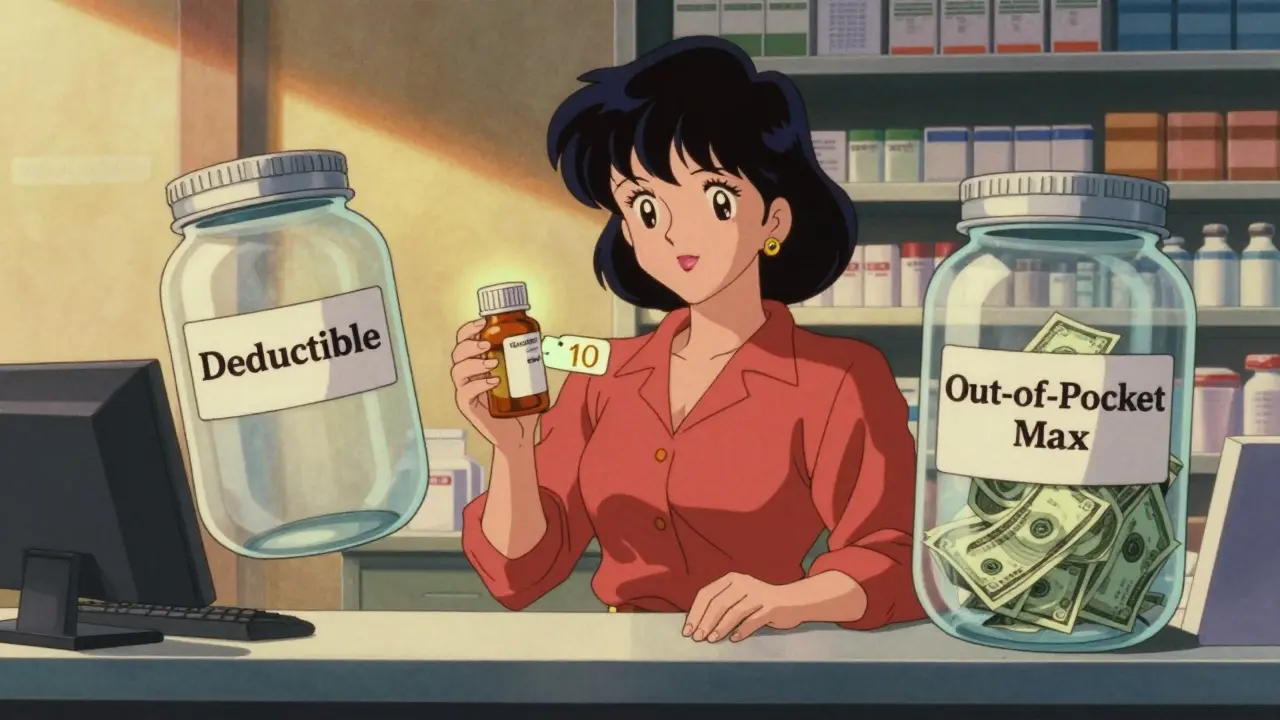
When you fill a prescription for a generic drug and pay $10 at the pharmacy, you might think that money is helping you meet your deductible. It’s not. But here’s the good part: it does count toward your out-of-pocket maximum. And that difference? It can save you thousands.
What’s the difference between a deductible and an out-of-pocket maximum?
Your deductible is the amount you pay for covered services before your insurance starts sharing the cost. For example, if your deductible is $2,000, you pay the first $2,000 of medical and prescription costs yourself. After that, you usually pay coinsurance - say, 20% - until you hit your out-of-pocket maximum.
Your out-of-pocket maximum is the total amount you’ll pay in a year for covered care - including your deductible, copays, and coinsurance. Once you hit that limit, your insurance pays 100% of covered services for the rest of the year. For 2026, the federal cap is $10,600 for an individual and $21,200 for a family on Marketplace plans.
Here’s the key: copays never count toward your deductible. But they always count toward your out-of-pocket maximum - if they’re for in-network care. That’s true whether you’re paying $5 for a generic antibiotic or $40 for a monthly blood pressure pill.
Why generic copays don’t count toward your deductible
Most health plans treat prescriptions and medical services as separate cost buckets. Even if you’re paying $10 copays for your diabetes meds every month, those payments don’t chip away at your $1,500 medical deductible. That’s by design.
Before the Affordable Care Act (ACA) in 2014, copays didn’t count toward anything. You could pay hundreds in copays and still owe your full deductible when you needed surgery or hospital care. The ACA changed that - but only partially. It forced insurers to let copays count toward the out-of-pocket maximum, which protects you from financial ruin. But it didn’t merge copays into the deductible. That’s why so many people get confused.
Think of it like two different jars. One jar is your deductible - you only drop cash into it when you pay full price for services (like a $300 MRI). The other jar is your out-of-pocket maximum - and every copay, every coinsurance payment, every dollar you pay after your deductible goes into that jar. When that second jar fills up, you’re done paying.
How prescription costs work in real plans
Not all plans are the same. There are three main models:
- Single deductible (27% of employer plans): One deductible covers both medical and prescriptions. Once you hit it, you pay coinsurance for everything. Copays don’t usually exist here - you pay a percentage until you hit your out-of-pocket max.
- Separate medical and prescription deductibles (37% of plans): You have two jars. One for doctor visits, one for prescriptions. You pay full price for prescriptions until you meet the prescription deductible - then you pay a copay. Those copays count toward your overall out-of-pocket maximum, but not your medical deductible.
- Copay-only (no prescription deductible) (36% of plans): You pay your $10 copay for generics right away, no deductible to meet. Those payments go straight into your out-of-pocket maximum. But again - they don’t touch your medical deductible.
Most people with chronic conditions end up in the third model. That’s actually the best-case scenario - because every time you refill your medication, you’re getting closer to your out-of-pocket maximum. One user on PatientsLikeMe shared that after paying $15 copays for insulin all year, they hit their $8,500 out-of-pocket max and got all their meds free for the rest of the year. That wouldn’t have been possible under pre-ACA rules.
Why this confusion costs people money - and health
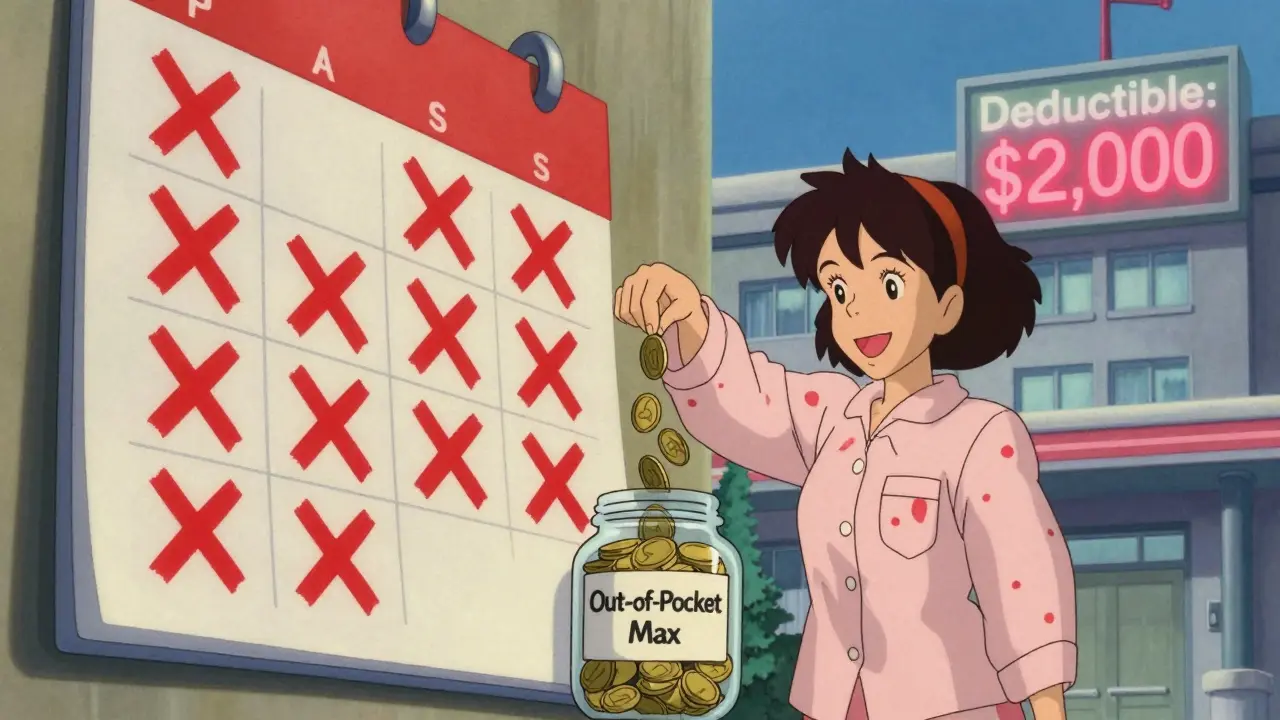
A 2023 survey found that 68% of people think their prescription copays count toward their deductible. That’s not just a misunderstanding - it’s dangerous.
People delay refills because they think they’re "still in deductible mode" and assume they’ll pay less later. But they’re not. They’re paying the same copay now - and it’s already helping them reach their out-of-pocket max. Delaying meds doesn’t save money. It just makes them sicker.
That’s why the Government Accountability Office found 41% of consumers were confused about prescription cost-sharing in 2023. And why underutilization of necessary medications costs the system an estimated $15 billion a year.
One user on HealthCare.gov wrote: "I paid $10 copays for my blood pressure meds all year. I thought I’d met my $2,000 deductible. I hadn’t. I still had to pay full price for a hospital visit. I felt cheated."
That’s not a flaw in the system - it’s a flaw in communication. The ACA made the rules fairer. But insurers and employers haven’t done enough to explain them clearly.
What you need to check in your plan documents
You don’t need to be an expert. But you do need to check two things before open enrollment:
- Summary of Benefits and Coverage (SBC): This is the standardized form every insurer must give you. Look for the "Cost-Sharing" section. Find the row for "Generic Prescription Drugs." Does it say "Copay" or "Deductible applies"? If it says "Copay," then you’re paying a fixed amount - and that amount counts toward your out-of-pocket maximum.
- Explanation of Coverage: This document (required by law) will spell out whether there’s a separate prescription deductible. If there is, it’ll say so. If it doesn’t mention one, you likely don’t have one.
Don’t rely on your HR rep or your pharmacy’s app. Read the documents yourself. Spend 15 minutes. It’s worth it.
What’s changing in 2025 and beyond
There’s momentum to simplify this. The Biden administration mandated clearer labeling on plan documents starting in 2025. The Centers for Medicare & Medicaid Services is testing "Integrated Deductible" plans in five states - where prescription copays count toward a single deductible. Early results show 28% higher medication adherence.
McKinsey predicts that by 2027, 60% of major insurers will offer at least one plan where generic copays count toward the deductible. Why? Because consumers are fed up. And companies are starting to realize that simpler plans lead to healthier people - and lower long-term costs.
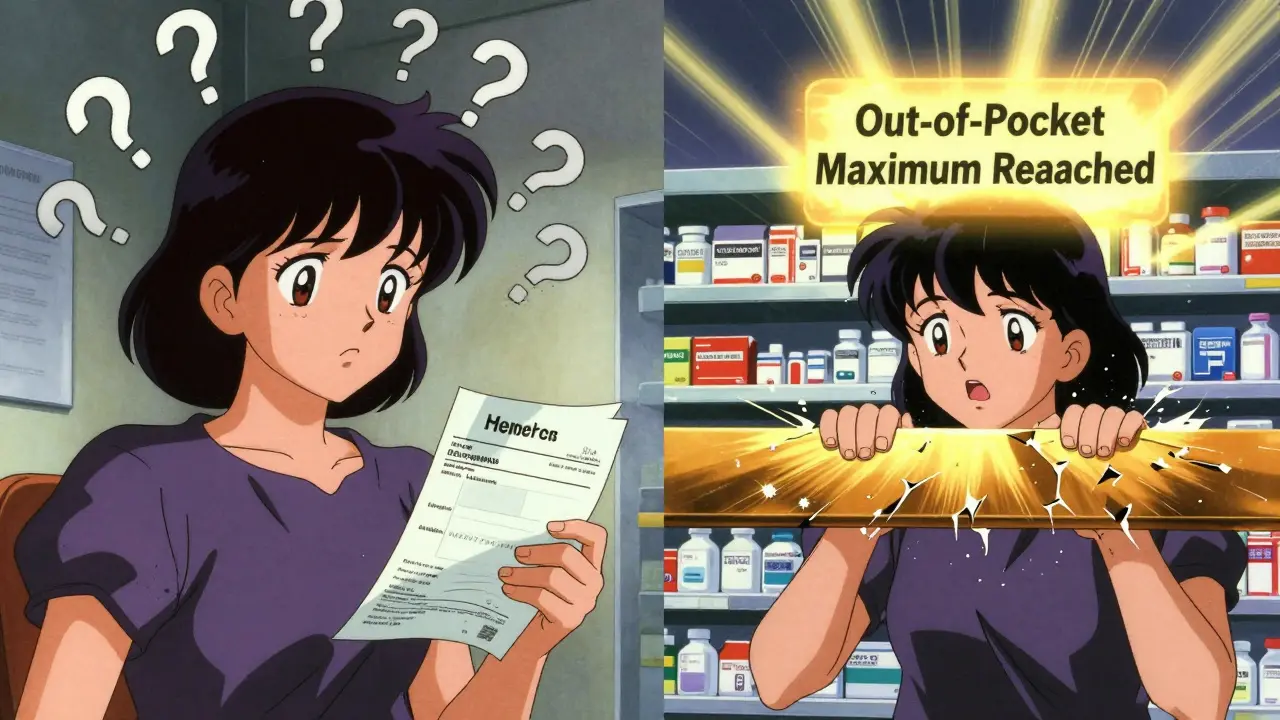
But for now? The system is still split. Your copays help you hit your out-of-pocket maximum. They don’t help you hit your deductible. And that’s something you need to know before you skip your next refill.
Real-world example: Sarah’s story
Sarah, 52, takes three generic medications: metformin, lisinopril, and atorvastatin. Each costs $10 per refill. She refills every 30 days - that’s $120 a month, $1,440 a year.
Her plan has a $2,000 medical deductible and a $7,000 out-of-pocket maximum. She doesn’t have a separate prescription deductible.
She paid $1,440 in copays last year. Her deductible? Still at $2,000. She still had to pay full price for a knee MRI in October - $800. But because her copays counted toward her out-of-pocket maximum, she only had to pay $2,560 more before her insurance covered everything else.
She didn’t hit her max - but she got close. If she’d needed surgery in December, she’d have paid nothing after her $1,440 in copays.
That’s the power of the out-of-pocket maximum. It doesn’t care if you paid it in copays or coinsurance. It just cares that you paid it.
Dana Termini
January 5, 2026 AT 15:28I wish more people understood this. I’ve been paying $15 for my thyroid med for years and thought I was wasting money because my deductible wasn’t dropping. Turns out, every dollar was quietly working toward my out-of-pocket max. No more skipping refills. I’m finally on track.
Thanks for the clarity.
Amy Le
January 7, 2026 AT 04:38So let me get this straight - the government forced insurers to count copays toward out-of-pocket max but not the deductible? That’s not a fix, that’s a loophole dressed up as compassion. You’re still getting gouged. And now you’re supposed to be grateful because you’re not bankrupt yet? This system is a joke.
And don’t even get me started on how they let insurers design these confusing ‘jars’ like some kind of financial magic trick.
Lily Lilyy
January 7, 2026 AT 12:10It’s so important to know this. Every time you take your medicine, you’re not just staying healthy - you’re building a shield. That $10 copay? It’s a brick in your wall of protection. One day, you’ll need surgery, or a hospital stay, and you’ll be so glad you kept filling those prescriptions.
You’re not wasting money. You’re investing in peace of mind.
Susan Arlene
January 8, 2026 AT 15:38bro i thought my copays were lowering my deductible for like 5 years lmao
just found out last year i was paying full price for an xray bc i thought i was ‘done’ with deductible. i wasnt. i was just paying into the other jar. my brain hurts now.
Ashley S
January 9, 2026 AT 06:21Why do we even have this mess? Someone’s making money off people being confused. This isn’t healthcare - it’s a puzzle designed to make you give up and stop taking your meds. I’m tired of being punished for being sick.
Rachel Wermager
January 9, 2026 AT 07:11The structural asymmetry between deductible and OOPM is a direct artifact of the ACA’s political compromise - specifically, the exclusion of prescription costs from the medical deductible to preserve provider reimbursement structures under the ‘separate benefit’ paradigm. This creates a misalignment in cost-sharing incentives that disproportionately impacts patients with chronic conditions requiring high-frequency, low-cost pharmaceuticals. The cognitive load imposed by dual-jar models leads to suboptimal adherence, which in turn elevates downstream utilization costs - a classic principal-agent failure.
Beth Templeton
January 10, 2026 AT 07:25Wow. So the system is designed so you pay for your meds but still get billed for everything else. Genius. Who came up with this? A cartoon villain? I’m impressed.
Also, I’m not paying $10 for a pill and thinking ‘oh good, I’m one step closer to not going broke.’ I’m thinking ‘why am I still broke?’
Joann Absi
January 10, 2026 AT 11:33THIS IS WHY PEOPLE ARE ANGRY. They’re telling you ‘you’re protected’ while you’re still getting billed for everything. It’s emotional manipulation. They want you to feel grateful for barely surviving. I’m not grateful. I’m furious.
And don’t even get me started on how they make you read 50 pages of legalese just to find out if your insulin counts. This isn’t healthcare. It’s a trap.
Mukesh Pareek
January 10, 2026 AT 21:26In India, we don’t have this problem. Insurance is rare. You pay cash or don’t get care. No ‘deductibles.’ No ‘jars.’ Just cost. You learn fast. No one gets confused because there’s no illusion of complexity. Maybe America needs less bureaucracy and more reality.
Jeane Hendrix
January 12, 2026 AT 09:55i’ve been reading the sbc’s for my family’s plans for 3 years now and honestly? i’m still not 100% sure. but i’ve learned to look for ‘generic copay’ and ‘out-of-pocket max’ and ignore everything else. the rest is noise. also - if your hr rep says ‘it all counts’ - ask them to show you the doc. they never can.
ps. i think the ‘two jars’ metaphor actually helps. i drew it on my fridge.
Leonard Shit
January 12, 2026 AT 16:17my dad’s on 5 meds. he pays $12 each. he thought he was ‘done’ with his deductible after a year. he wasn’t. he got hit with a $1,200 bill for a doctor visit he thought was covered. he cried. i cried.
we’re not stupid. we just weren’t told. this isn’t hard to fix. why isn’t it?