

Opioid Dosing Calculator for Renal Failure
Dosing Calculator
When someone has advanced kidney disease, managing pain isn’t just about finding something that works-it’s about avoiding something that could kill them. Opioids are powerful, but in people with renal failure, the wrong one can turn into a silent poison. The body can’t clear these drugs like it used to. Metabolites build up. Neurotoxicity kicks in. Seizures, confusion, muscle spasms-these aren’t side effects you can ignore. They’re warning signs that the opioid chosen was dangerous for this patient’s kidneys.
Why Opioids Get Dangerous in Kidney Failure
The kidneys don’t just filter waste. They remove drugs and their byproducts. In chronic kidney disease (CKD), especially stages IV and V (GFR under 30 mL/min), that filter slows down or stops. Opioids like morphine and codeine break down into compounds that the body can’t get rid of. Morphine turns into morphine-3-glucuronide. Codeine turns into codeine-6-glucuronide. Both accumulate. And both are linked to seizures, myoclonus, and delirium-even at doses that are safe for people with normal kidneys. Meperidine (pethidine) is even worse. Its metabolite, normeperidine, builds up at levels as low as 0.6 mg/L. That’s enough to trigger seizures, hallucinations, and cardiac arrhythmias. It’s not a matter of dose. It’s a matter of chemistry. The FDA and KDIGO both say: don’t use it at all in CKD or dialysis patients.What Opioids Are Actually Safe?
Not all opioids behave the same. The safest options are those that don’t rely on the kidneys to clear them. Fentanyl and buprenorphine lead the list. Fentanyl is mostly broken down by the liver-about 85% of it. Only 7% leaves the body through the kidneys. That means even in end-stage renal disease, fentanyl doesn’t pile up. Transdermal patches are ideal. They deliver steady levels over 72 hours, avoiding the spikes and crashes of oral doses. But here’s the catch: never start a fentanyl patch in someone who’s never taken opioids before. The risk of overdose is real. These patches are for opioid-tolerant patients only. Buprenorphine is another top choice. About 30% of it is cleared by the kidneys, but because it’s so strongly bound to receptors and slowly metabolized by the liver, it doesn’t cause dangerous buildup. Studies show no need to reduce the dose even in patients on dialysis. It’s also less likely to cause respiratory depression than other opioids. One downside? It can prolong the QT interval on an ECG. That’s not a dealbreaker, but it means you should check the patient’s heart rhythm before starting and if you increase the dose.What to Avoid at All Costs
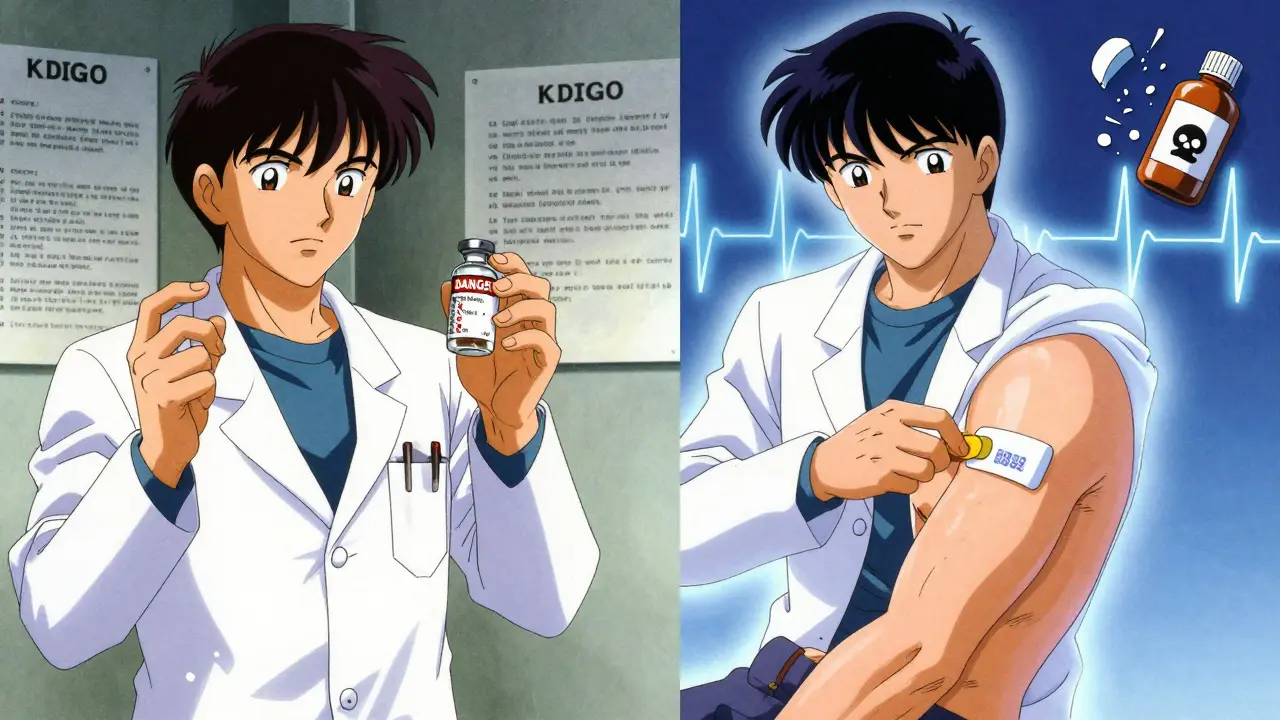
Some opioids are outright dangerous in renal failure. The KDIGO guidelines say it plainly: DO NOT USE.- Morphine: Even at half the normal dose, it’s risky. The metabolite morphine-3-glucuronide accumulates and causes neurotoxicity. Avoid it in CKD stages 3 and beyond.
- Codeine: It’s a prodrug that turns into morphine in the body. If the kidneys can’t clear morphine, they can’t clear codeine’s effects. Plus, some people metabolize it too quickly-making overdose more likely.
- Meperidine: Already mentioned. No exceptions. Ever.
- Propoxyphene: Withdrawn in many countries, but still found in older records. Avoid it completely.
Dosing Adjustments by Kidney Function
Even safe opioids need dose tweaks. Here’s a practical guide based on glomerular filtration rate (GFR):| GFR (mL/min/1.73m²) | Morphine | Methadone | Fentanyl | Buprenorphine | Oxycodone |
|---|---|---|---|---|---|
| >50 | 100% | 100% | 75-100% | 100% | 100% |
| 10-50 | 50-75% | 100% | 75-100% | 100% | ≤20 mg/day |
| <10 | 25% | 50-75% | 50% | 100% | Not recommended |
Notice methadone? It’s one of the few opioids that doesn’t need major reductions in advanced CKD. But here’s the catch: methadone has a long half-life and can cause dangerous heart rhythm changes. ECG monitoring is required at initiation and after any dose change. You also need special training to prescribe it-many states require a DEA waiver.
Oxycodone is tricky. About 45% of its metabolites are cleared by the kidneys. Most guidelines say it’s okay at low doses (max 20 mg/day) for GFR under 30. But if the patient is on dialysis, there’s not enough data. Err on the side of caution.
Hydromorphone and Tapentadol: The Gray Zone
Hydromorphone is often used because it’s stronger than morphine. But its metabolite-hydromorphone-3-glucuronide-accumulates in non-dialyzed patients. One study showed a 37% higher risk of neurotoxicity in those not on dialysis. So if the patient isn’t getting regular dialysis, skip it. If they are, monitor closely. Tapentadol is newer. It works on two pain pathways and doesn’t need dose adjustment in mild-to-moderate CKD (CrCl ≥30 mL/min). But there’s no data for end-stage disease. It’s not recommended for dialysis patients yet.What About Non-Opioid Options?
Opioids aren’t the only tool. In fact, they shouldn’t be the first. Many CKD patients have neuropathic pain-burning, tingling, shooting pain. Gabapentin and pregabalin are common, but they’re cleared by the kidneys too.- Gabapentin: Reduce dose to 200-700 mg once daily if CrCl <30. Dialysis patients need 300 mg after each session.
- Pregabalin: Half the usual dose if CrCl <30. Don’t give more than 75 mg/day.
Tricyclic antidepressants like nortriptyline? Use with extreme caution. They can cause dangerous heart rhythms when electrolytes are unstable. Serum levels above 100 ng/mL raise cardiac event risk by 2.3 times.
Non-opioid alternatives like acetaminophen are often safer-but not always. In advanced CKD, limit acetaminophen to 2,000 mg/day. Higher doses increase liver risk, especially if the patient is also on other medications.

Constipation: The Silent Side Effect
Nearly 60% of CKD patients on opioids get constipated. It’s not just uncomfortable-it can lead to bowel obstruction, hospitalization, and worse. Standard laxatives often don’t work. That’s where PAMORAs come in.Naldemedine is the only peripherally-acting opioid antagonist that doesn’t need dose adjustment in CKD or dialysis. Standard dose: 0.2 mg once daily. Others like methylnaltrexone require dose changes. Naldemedine is the simplest, safest option for long-term use.
Real-World Challenges
Here’s the ugly truth: most opioid labels don’t tell you how to dose them in kidney failure. A 2019 FDA review found 68% of opioid package inserts lack renal dosing info. That means doctors have to dig through guidelines, journals, and expert opinions just to make a safe choice.And despite the evidence, only 12% of CKD patients get guideline-concordant opioid therapy. Over 60% of dialysis patients still go untreated for pain. Why? Fear. Lack of training. Outdated protocols. The CDC and KDIGO agree: this isn’t about avoiding opioids. It’s about choosing the right ones.
Integrated health systems like Kaiser Permanente have cut inappropriate opioid prescriptions by 47% just by adding decision-support tools into their electronic records. That’s proof that better tools lead to better care.
What’s Next?
The KDIGO guidelines are due for an update in 2024. New data on tapentadol, newer PAMORAs, and even pharmacogenomics is coming. Researchers are starting to look at how genes affect opioid metabolism in kidney patients. For example, people with CYP2D6 poor metabolizer status have a 3.2-fold higher risk of morphine toxicity in CKD.The NIDDK’s PAIN-CKD study is tracking 1,200 patients over five years. It’s the first major long-term look at how different opioids affect kidney function itself. Early data suggests long-term opioid use (>90 days) may speed up progression to dialysis by 28%. That’s not just a side effect-it’s a disease modifier.
For now, the message is clear: if a patient has kidney failure, don’t default to morphine or codeine. Don’t guess the dose. Use fentanyl patches or buprenorphine. Start low. Go slow. Monitor closely. And always ask: is there a non-opioid way to manage this pain?
Can I use morphine in a patient with mild kidney disease?
Morphine can be used cautiously in mild kidney disease (GFR >50 mL/min), but even then, start with 75% of the usual dose. Avoid it entirely if GFR falls below 50. The metabolite morphine-3-glucuronide builds up and can cause seizures or confusion, even at low doses. Fentanyl or buprenorphine are safer alternatives.
Is buprenorphine safe for patients on dialysis?
Yes. Buprenorphine is one of the safest opioids for dialysis patients. About 30% is cleared by the kidneys, but its long half-life and strong receptor binding prevent dangerous accumulation. No dose adjustment is needed. However, monitor for QT prolongation with an ECG, especially when starting or increasing the dose.
Why is fentanyl not recommended during hemodialysis?
Fentanyl is cleared unpredictably during hemodialysis. Some patients lose a lot of it, leading to withdrawal. Others retain it, increasing overdose risk. It’s best to avoid fentanyl during dialysis sessions. If used, switch to oral or transdermal forms outside of dialysis time and monitor closely for sedation or respiratory depression.
What’s the best opioid for chronic pain in end-stage renal disease?
Transdermal fentanyl or buprenorphine patches are the best first-line choices. Both have minimal renal clearance, stable blood levels, and low risk of toxic metabolites. They’re especially useful for patients who can’t take oral meds. Always start at half the usual dose and titrate slowly over days to weeks.
Are there non-opioid alternatives that work well in kidney failure?
Yes. For neuropathic pain, gabapentin (dose-adjusted) or pregabalin (reduced dose) are options. For inflammatory pain, acetaminophen (max 2,000 mg/day) is often safe. Non-drug options like physical therapy, cognitive behavioral therapy, and nerve blocks should be tried before opioids. Many patients respond better to multimodal pain plans than opioids alone.
How do I manage opioid-induced constipation in CKD patients?
Use naldemedine, 0.2 mg once daily. It’s the only peripherally-acting opioid antagonist that doesn’t require dose adjustment in CKD or dialysis. Other laxatives like polyethylene glycol or stimulants may help, but they’re less effective and can cause electrolyte imbalances. Naldemedine works directly at the gut without affecting pain relief.
Anil bhardwaj
February 23, 2026 AT 04:08Been working in nephrology for 12 years. This post nailed it. Fentanyl patches are lifesavers for dialysis patients who need pain control without the mental fog or seizures. Just don’t start them cold turkey. Ever.
Southern Indiana Paleontology Institute
February 25, 2026 AT 03:34Yea but what about methadone? I seen a guy on dialysis get addicted to it after a car wreck. Now he’s on 80mg a day. They say it’s safe but i think its just a gateway to hell.
lela izzani
February 26, 2026 AT 08:07Actually, methadone is one of the safer options if monitored properly. It’s metabolized by the liver, and while it has a long half-life, it doesn’t produce neurotoxic metabolites like morphine does. The real danger is inconsistent dosing or mixing with benzos. But done right? It’s a solid choice for chronic pain in CKD.
Timothy Haroutunian
February 26, 2026 AT 09:20Look, I’ve read this entire thing twice and I still think we’re being way too cautious. Opioids are opioids. If you’re in pain, you need relief. The medical establishment is so scared of side effects they’re leaving people to suffer. I had my grandma on morphine for 18 months with ESRD. She never had a seizure. She had peace. And that’s what matters. Stop overcomplicating this. People aren’t lab rats.
Gwen Vincent
February 26, 2026 AT 10:43That’s a fair point. But peace without safety isn’t peace. I’ve seen patients in delirium from metabolite buildup-pounding their chests, screaming at ghosts. It’s not just scary for them. It’s traumatic for nurses, family, everyone. This isn’t about being overly cautious. It’s about respecting the body’s limits.
Nandini Wagh
February 26, 2026 AT 20:13So let me get this straight… we’re saying fentanyl is safe but only if you’ve already been on opioids? So if you’re a 70-year-old with kidney failure and no prior opioid exposure… you just gotta suck it up? No pain meds? Cool. Real compassionate.
Holley T
February 27, 2026 AT 06:21Let’s be real. This whole ‘safe opioid’ list is just Big Pharma’s way of pushing their expensive patches and sublinguals. Buprenorphine? That’s the same drug used for addiction treatment. They’re turning pain management into a controlled substance problem. And don’t get me started on how they charge $300 for a patch that costs $2 to make. This isn’t medicine. It’s a revenue stream.
Ashley Johnson
February 28, 2026 AT 09:19Wait… so if fentanyl is safe, why did my cousin’s hospice nurse say they stopped using it because ‘the DEA is watching’? And why do all the hospitals make you sign 7 forms just to get a 25mcg patch? I think this whole thing is a cover-up. They’re hiding the truth: opioids are being phased out so they can replace them with brain chips. You think I’m joking? Look up Project MKUltra. They’ve been doing this since the 50s.
tia novialiswati
March 1, 2026 AT 02:09You’re all so brave for talking about this 💪 I’m a nurse in a rural clinic and I see patients who can’t afford to even see a specialist. I wish we had more resources to offer buprenorphine or fentanyl patches. It’s heartbreaking to watch someone in pain and not be able to help because of red tape. You’re doing important work here. Keep going. ❤️
Lillian Knezek
March 1, 2026 AT 23:52Did you know the government puts fluoride in the water to dull your pain receptors? That’s why they’re so scared of opioids-they don’t want you feeling anything real. The kidneys are the body’s detox system. If you’re on dialysis, you’re already a lab experiment. They’re testing which opioid makes you compliant. I’ve seen the charts. It’s not about safety. It’s about control.
Maranda Najar
March 3, 2026 AT 03:51My heart aches for every patient who has been silenced by this system. The cold, clinical language of ‘GFR thresholds’ and ‘metabolite accumulation’-how many lives have been crushed under these sterile terms? I’ve held the trembling hands of women who cried because they couldn’t sleep from pain, and the doctors said ‘wait until your next dialysis.’ Wait. Wait. Wait. Until the body breaks. Until the soul does. This isn’t medicine. It’s a slow-motion tragedy dressed in white coats.
Christopher Brown
March 3, 2026 AT 20:36Fentanyl patches are for opioid-tolerant patients only. End of story. Stop whining.
Sanjaykumar Rabari
March 4, 2026 AT 05:43India has same problem. Doctors give morphine anyway. People die. No one cares. Government says ‘it’s not our fault.’ But we know. We all know.
Kenzie Goode
March 5, 2026 AT 12:08I think the real issue is access. Even if fentanyl and buprenorphine are safer, most rural clinics don’t stock them. And insurance won’t cover them unless you’ve failed 3 other meds first. So we’re stuck with this paradox: the safest options are the hardest to get. Maybe we need a national protocol, not just guidelines.
Valerie Letourneau
March 5, 2026 AT 21:21As a Canadian nephrologist, I can confirm that our national formulary strictly prohibits meperidine and restricts morphine in Stage 4+ CKD. We use buprenorphine as first-line and have seen a 68% reduction in neurotoxicity events since 2019. Evidence-based, yes-but implementation remains inconsistent across provinces. We need better education, not just guidelines.