
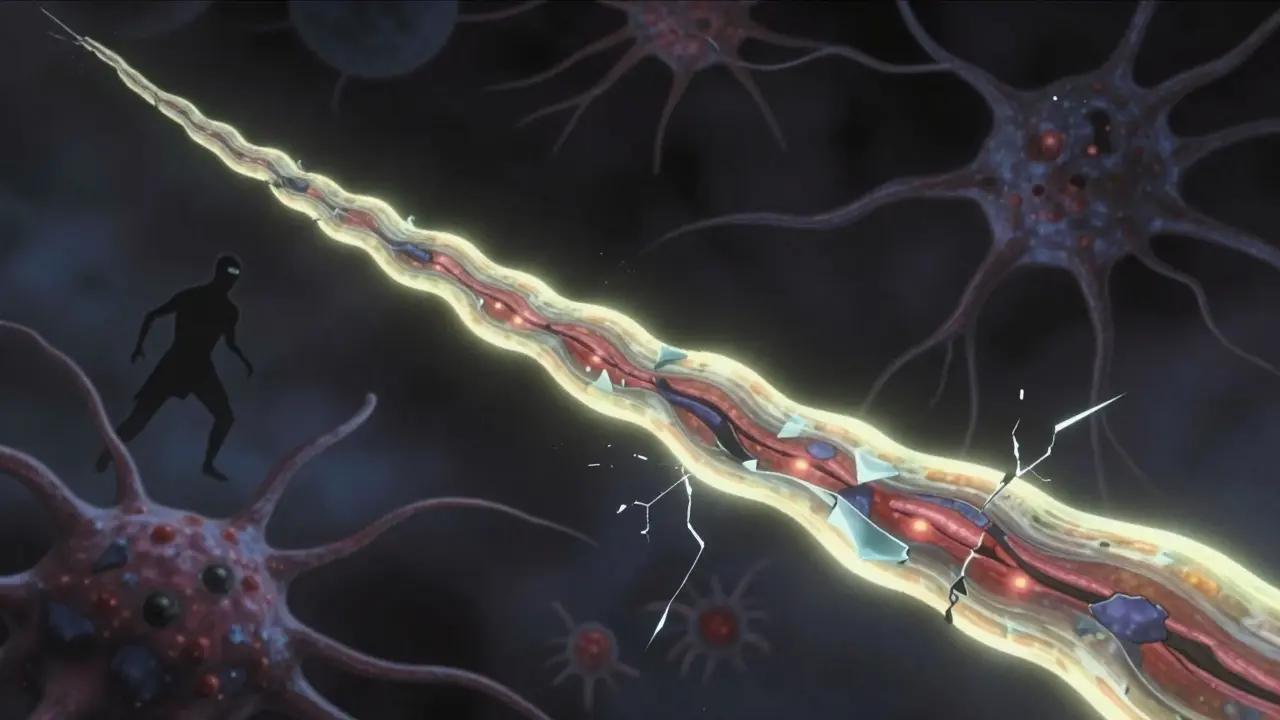
When you hear about multiple sclerosis (MS), you might think of flare-ups-sudden numbness, blurred vision, or trouble walking. But what happens between those flare-ups is just as important, and often more damaging. The real story of MS isn’t just inflammation. It’s about what happens when nerves lose their protective coating and start to break down from the inside out. And that’s where the lasting damage comes from.
What Actually Goes Wrong in the Nervous System?
Multiple sclerosis is an autoimmune disease. That means your body’s own immune system attacks parts of your central nervous system-your brain and spinal cord. It doesn’t go after random cells. It targets the myelin sheath, the fatty insulation that wraps around nerve fibers like plastic on an electrical wire. When myelin gets stripped away, signals from your brain can’t travel fast or clearly. That’s why you might feel weak, clumsy, or have trouble thinking clearly during a flare-up.
But here’s the catch: the body can repair some of that damage. New myelin can grow back, and nerves can sometimes find new pathways. That’s why many people with MS have periods where they feel fine again after a relapse. The problem isn’t just the attacks. It’s what happens after they stop.
Research shows that in chronic MS, axons-the long, thread-like parts of nerve cells that carry signals-start to degenerate. This isn’t just from the inflammation. It’s from the loss of myelin itself. Without that insulation, axons become overworked. They struggle to keep their electrical signals running. Their energy supply, mostly from mitochondria, drops. Sodium channels that help transmit signals start to fail. And over time, the axons themselves begin to wither and die.
This is irreversible. Once an axon is gone, the brain can’t replace it. That’s why, over time, even people who had few relapses can end up with lasting disability. The damage isn’t always visible on an MRI. You can have a clear scan and still be losing nerve connections quietly, inside your brain and spinal cord.
Why Some People Get Worse Over Time
Most people are first diagnosed with relapsing-remitting MS (RRMS). About 85% of cases start this way. You have attacks, then recover. But over time, many of them shift into secondary progressive MS (SPMS). Around 40% make this transition within 10 to 15 years. And when that happens, the pattern changes.
In RRMS, new lesions show up on MRI. Inflammation is active. That’s why drugs that calm the immune system help so much-they cut relapses by 30% to 50%. But in SPMS, those new lesions stop appearing. The inflammation fades. And yet, disability keeps getting worse. That’s the puzzle doctors have been trying to solve.
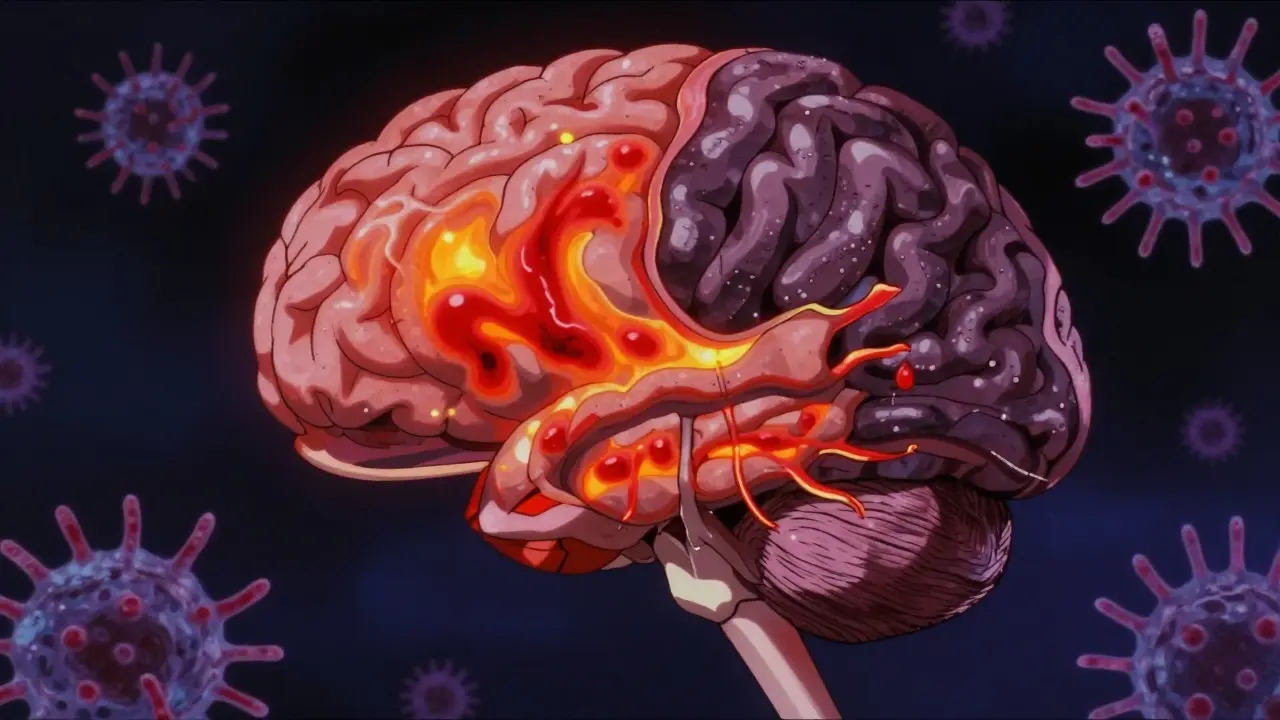
What’s driving the decline now? It’s not just the old damage. It’s what’s happening inside the brain itself. Studies point to immune cells lingering in the meninges-the protective layers around the brain. These cells form clusters, almost like tiny lymph nodes, and they release chemicals that slowly poison the underlying tissue. This is especially common in people who developed MS at a younger age. Those with these clusters have worse disability, faster progression, and higher death rates.
Another big clue? The brain’s own support cells, called microglia, become overactive. They’re supposed to clean up debris, but in MS, they get stuck in overdrive. They start chewing away at nerve fibers that are already weakened. And in areas of the brain that look normal on MRI, these cells are still active. That’s why you can have a "normal" scan and still be losing function.
How Current Treatments Help-and Where They Fall Short
There are 21 FDA-approved disease-modifying therapies (DMTs) for MS today. Most of them target inflammation. They reduce relapses. They shrink new lesions. They delay the time until you need a wheelchair. For many people, especially early on, these drugs make a huge difference.
But here’s the problem: none of them stop the slow, silent loss of nerve fibers. They don’t fix broken myelin. They don’t bring back dead axons. They don’t protect mitochondria. They don’t stop microglia from attacking.
Think of it like a car. DMTs are like changing the oil and replacing the spark plugs. They keep the engine running cleanly. But if the engine block is cracking from old age, no amount of oil will fix that. That’s where we are with MS. We’ve gotten good at managing the inflammation, but we’re still blind to the real cause of long-term disability: neurodegeneration.
That’s why some people on powerful DMTs still get worse. Their relapses stop, but their walking gets slower. Their hands get clumsier. Their memory fades. The disease is still moving, just not in the way we can easily measure.
The Silent Progression: Atrophy and Hidden Damage
One of the clearest signs of this hidden damage is brain atrophy-the shrinking of brain tissue. Studies show that people with MS lose brain volume faster than healthy people. Over six years, the amount of gray matter loss predicts disability progression better than relapse rate. Gray matter is where nerve cell bodies live. Losing it means losing processing power.
Even more telling? The Multiple Sclerosis Functional Composite (MSFC) score, which measures walking speed, hand movement, and thinking, picks up changes that the traditional EDSS scale misses. EDSS focuses on walking ability. But MS affects so much more. Someone might walk fine but struggle to hold a cup, remember names, or stay focused. That’s why MSFC is becoming more important in research-and in real-life care.
MRI scans now use something called magnetization transfer ratio (MTR) to spot early damage. It’s not about new lesions. It’s about how healthy the tissue looks. Lower MTR means less myelin, more inflammation, or damaged axons-even in areas that look normal. This is how doctors are starting to see the invisible.

What’s Coming Next: The New Frontier of MS Treatment
The next wave of MS drugs isn’t about stopping inflammation. It’s about saving nerves.
Right now, there are 17 active clinical trials targeting progressive MS. Some are testing drugs that boost mitochondrial function-helping nerves produce more energy. Others are trying to block sodium channels that leak and overload damaged axons. One experimental drug, ibudilast, showed promise in slowing brain shrinkage in SPMS patients.
Another approach? Getting myelin to grow back. Scientists are testing molecules that can wake up the brain’s own repair cells-oligodendrocyte precursor cells-and help them rebuild the insulation. Early results are mixed, but the idea is solid: if you can remyelinate axons, you might stop them from dying.
And then there’s the B cell story. Drugs that remove B cells from the bloodstream-like ocrelizumab and ofatumumab-are already approved for some forms of MS. But now researchers are looking at how B cells inside the brain, especially near the meninges, drive progression. Future drugs might target those specifically.
Even more exciting? Research into the role of astrocytes. These brain cells help support neurons. In MS, they lose receptors that respond to norepinephrine-the body’s natural stress signal. Without them, they can’t protect nerves. Drugs that restore this signaling could be a game-changer.
What This Means for You
If you have MS, especially if you’re past the first few years, it’s not enough to just track relapses. You need to monitor function. How’s your balance? Your hand coordination? Your memory? Are you still doing the things you love? These are the real signs of progression.
Work with your neurologist to get regular brain scans that measure atrophy-not just lesions. Ask about MSFC testing. Don’t assume that because you haven’t had a relapse, you’re safe. The real threat is silent.
And if you’re newly diagnosed? Start early with a DMT. But understand: the goal isn’t just to avoid relapses. It’s to protect your brain for the long haul. The sooner you slow inflammation, the less damage you’ll have to fight later.
There’s hope. We’re not just managing MS anymore. We’re learning how to stop it from destroying nerves. And that’s the next big step.
Can MS be cured with current disease-modifying therapies?
No, current disease-modifying therapies (DMTs) cannot cure MS. They reduce relapse rates by 30% to 50% and slow the formation of new lesions in relapsing-remitting MS, but they do not reverse existing nerve damage or stop the progressive degeneration of axons that occurs in later stages. No approved drug today can regenerate myelin or restore lost neurons.
Why do some people with MS get worse even if they have no relapses?
This is called progressive MS. Even without new inflammation or visible lesions, nerve fibers (axons) continue to degenerate due to chronic demyelination, mitochondrial failure, and overactive immune cells inside the brain. These processes happen silently and are not stopped by current anti-inflammatory drugs. The loss of axons leads to permanent disability, even if relapses stop.
Is MRI enough to track MS progression?
No, standard MRI that looks for new lesions misses a lot. The real progression in MS is shown by brain atrophy-shrinkage of gray and white matter-and changes in normal-appearing tissue measured by advanced techniques like magnetization transfer ratio (MTR). Functional tests like the MSFC (measuring walking, hand movement, and cognition) are often better predictors of long-term disability than MRI alone.
Do all MS patients eventually become disabled?
Not all, but many do. About 40% of people with relapsing-remitting MS develop secondary progressive MS within 10 to 15 years. Disability varies widely-some maintain independence for decades, while others need mobility aids. Early treatment, healthy lifestyle choices, and monitoring for silent progression can significantly delay disability.
What’s the difference between RRMS and SPMS?
Relapsing-remitting MS (RRMS) involves clear flare-ups followed by recovery, with new lesions visible on MRI. Secondary progressive MS (SPMS) means the disease shifts into a steady decline without clear relapses. Lesions stop forming, but disability worsens due to nerve damage. People with SPMS don’t respond well to standard DMTs because the main driver is no longer inflammation-it’s neurodegeneration.
Aisling Maguire
February 28, 2026 AT 07:08Also, I’ve been doing daily yoga and cold showers. Not magic, but it’s something. My MSFC score improved slightly last year. Maybe it’s placebo. Maybe it’s not. Either way, I’m not just waiting for the next drug.
Byron Duvall
February 28, 2026 AT 09:16Full Scale Webmaster
March 1, 2026 AT 16:45Also, the fact that they admit MRI misses 70% of damage? That’s not science. That’s negligence. And they call this progress? I call it a cover-up.
Angel Wolfe
March 1, 2026 AT 17:45Sophia Rafiq
March 2, 2026 AT 10:45Martin Halpin
March 3, 2026 AT 08:19Eimear Gilroy
March 4, 2026 AT 18:11Ajay Krishna
March 5, 2026 AT 07:49Charity Hanson
March 5, 2026 AT 23:29Gigi Valdez
March 6, 2026 AT 00:28Sneha Mahapatra
March 6, 2026 AT 09:16Miranda Anderson
March 8, 2026 AT 04:29Katherine Farmer
March 9, 2026 AT 01:40Brandie Bradshaw
March 9, 2026 AT 12:01Ben Estella
March 10, 2026 AT 13:23