
When you’ve tried multiple antidepressants and nothing works, it’s easy to feel hopeless. For some people with treatment-resistant depression, the answer might be an MAOI-but only if you know how to use it safely. Monoamine oxidase inhibitors, or MAOIs, are among the oldest antidepressants still in use today. They work differently from SSRIs or SNRIs, and that’s exactly why they can help when other drugs fail. But they also come with risks that can be deadly if mishandled. The biggest danger? Combining them with the wrong other meds.
Why MAOIs Still Matter
MAOIs like phenelzine (Nardil), tranylcypromine (Parnate), and the selegiline patch (Emsam) were developed in the 1950s. Back then, they were among the first drugs shown to lift severe depression. Today, they’re not first-line choices. But for about 20-30% of people whose depression doesn’t respond to other treatments, MAOIs can be the difference between staying stuck and finally feeling better. Studies show response rates of 40-60% in treatment-resistant cases, especially when symptoms include extreme fatigue, oversleeping, or intense sensitivity to rejection.The reason they work is simple: they block an enzyme called monoamine oxidase. This enzyme normally breaks down serotonin, norepinephrine, and dopamine-the brain chemicals tied to mood, energy, and motivation. By stopping its job, MAOIs let those chemicals build up. It’s a powerful effect. But that same power makes them dangerous if mixed with other drugs that also boost serotonin.
The Deadly Mix: MAOIs and SSRIs/SNRIs
The most well-known and life-threatening interaction is between MAOIs and SSRIs like fluoxetine (Prozac), sertraline (Zoloft), or SNRIs like venlafaxine (Effexor). When these are combined, serotonin levels can spike dangerously fast. This is called serotonin syndrome.Serotonin syndrome isn’t just feeling a little off. It can mean high fever, muscle stiffness, rapid heartbeat, confusion, seizures, and even death. A 1995 study in the Journal of Clinical Psychiatry looked at eight cases where fluoxetine was followed by an MAOI. Seven of those patients died. That’s why the FDA requires a boxed warning on all MAOI labels: Do not use with SSRIs or SNRIs.
The timing matters just as much as the drugs themselves. If you stop an SSRI, you can’t start an MAOI right away. For most SSRIs, you need to wait 14 days. But fluoxetine is different. Its active metabolite, norfluoxetine, sticks around for weeks. You must wait at least five weeks after stopping fluoxetine before starting an MAOI. And if you’ve been on an MAOI, you can’t start an SSRI for at least 14 days after stopping it. Skipping this wait can be fatal.
What About Tricyclics? It’s Complicated
Tricyclic antidepressants (TCAs) like amitriptyline or nortriptyline have been treated as off-limits with MAOIs for decades. But recent evidence is changing that view. A 2022 review in PMC found that combining certain TCAs with MAOIs isn’t as risky as once thought-if done correctly.The key is sequence and choice. Clomipramine, a TCA with strong serotonin effects, should never be mixed with an MAOI. But nortriptyline? It’s been used safely in combination with phenelzine in clinical studies. One 2009 trial showed a 57% response rate in treatment-resistant patients using phenelzine plus nortriptyline, with few serious side effects.
Here’s the catch: you must start the TCA first-or at the same time as the MAOI. If you add the MAOI after the TCA is already in the system, your risk of serotonin syndrome jumps. That’s why some doctors still avoid this combo. But for specialists who know how to manage it, it’s a viable option for people who’ve run out of other choices.
Safer Alternatives: What You Can Combine
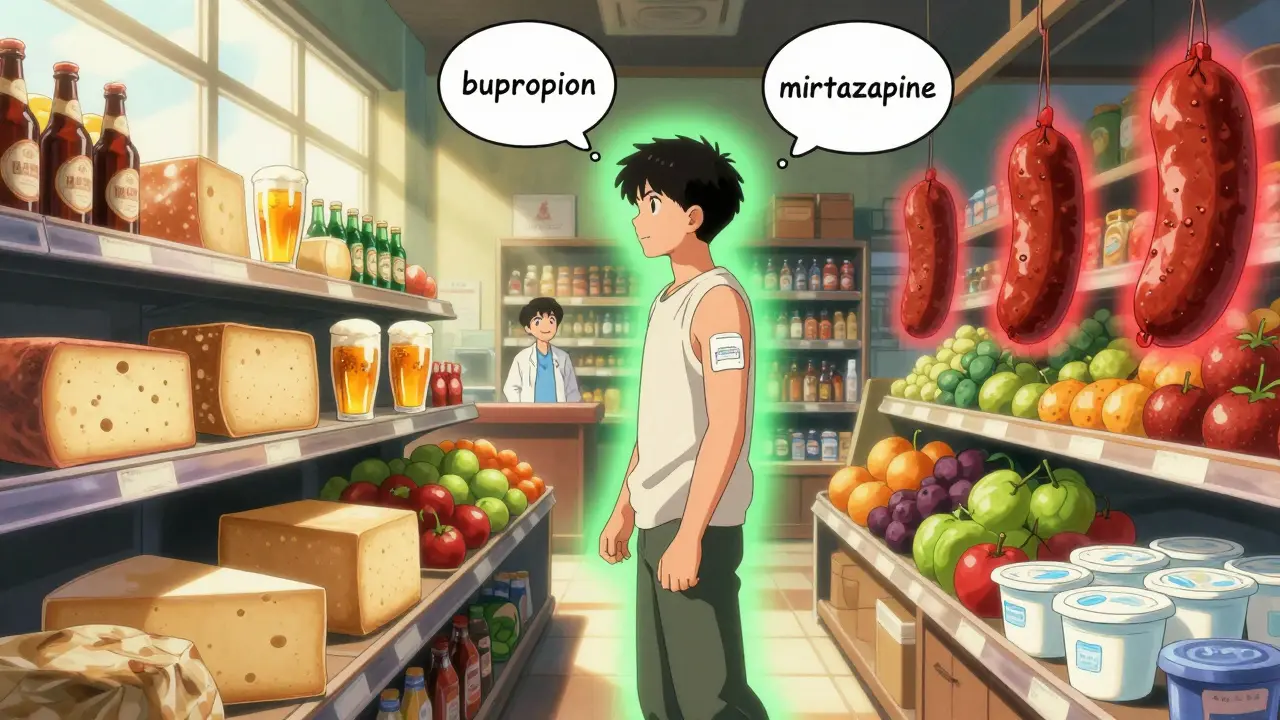
You don’t have to stick with just one antidepressant. There are several that can be safely paired with MAOIs, without the risk of serotonin syndrome.- Bupropion (Wellbutrin): It works on dopamine and norepinephrine, not serotonin. That makes it one of the safest options to add to an MAOI. Many clinicians use it to boost energy and motivation in patients who still feel sluggish.
- Mirtazapine (Remeron): This drug increases serotonin and norepinephrine in a unique way that doesn’t trigger serotonin syndrome when combined with MAOIs. It’s especially helpful for people who struggle with sleep or appetite loss.
- Trazodone: Often used as a sleep aid, trazodone has minimal serotonin effects at low doses. It’s commonly added to MAOIs for insomnia without causing issues.
- Nortriptyline: As mentioned, this TCA can be used cautiously under expert supervision.
Even dopaminergic agents like pramipexole (used for Parkinson’s) have been safely combined with MAOIs in cases of severe anhedonia-when a person can’t feel pleasure at all. These combinations require slow dosing and close monitoring, but they’ve helped people who had no other options.
What About Anxiety and Sleep Medications?
You don’t have to suffer from insomnia or panic attacks on top of depression. Benzodiazepines like lorazepam or non-benzodiazepine sleep aids like zolpidem are generally safe to use with MAOIs. They don’t affect serotonin levels the way SSRIs do. Many patients on MAOIs benefit from these additions, especially during the first few weeks when side effects like agitation or insomnia can be strong.Even over-the-counter cold medicines can be risky. Avoid decongestants like pseudoephedrine or phenylephrine-they can cause dangerous spikes in blood pressure when taken with MAOIs. Always check with your doctor before taking anything new, even a cough syrup.
Dietary Restrictions: Still a Real Thing
MAOIs don’t just interact with drugs. They react with tyramine, a compound found in aged, fermented, or spoiled foods. When tyramine builds up and hits your bloodstream while you’re on an MAOI, it can trigger a sudden, dangerous rise in blood pressure-a hypertensive crisis.You need to avoid:
- Aged cheeses (cheddar, blue, parmesan-anything stored for weeks)
- Tap beer and homebrewed alcohol
- Fermented sausages like salami or pepperoni
- Soy sauce, miso, and other fermented soy products
- Overripe fruits and spoiled foods
The good news? The selegiline patch (Emsam) at the lowest dose (6 mg/24hr) doesn’t require dietary changes for most people. That’s why it’s become more popular. But if you’re on oral MAOIs, you still need to be strict. Even a small amount of tyramine-like a bite of blue cheese-can trigger a crisis.
Stopping MAOIs Isn’t Simple
You can’t just quit an MAOI cold turkey. Abruptly stopping can cause a withdrawal-like syndrome with symptoms like:- Restlessness (reported in 62% of cases)
- Upset stomach (48%)
- Tingling or burning skin (37%)
- Flu-like symptoms (55%)
- Severe sleep problems (71%)
- Headaches (68%)
Always taper slowly-over two to four weeks-under medical supervision. Your doctor will help you reduce the dose step by step to avoid this.
Who Should Consider MAOIs Today?
MAOIs aren’t for everyone. But they’re the most effective option for a small group: people with severe, long-lasting depression who’ve tried at least two other classes of antidepressants without success. They’re especially helpful when depression comes with atypical features-like sleeping too much, feeling heavy or numb, or being extremely sensitive to rejection.Only about 5-10% of psychiatrists regularly prescribe them. Why? Because many aren’t trained in how to use them safely. A 2019 study found only 32% of psychiatry residents felt confident managing MAOIs. That’s changing, slowly. More doctors are learning from published case studies and updated guidelines.
What’s Next?
Research is moving forward. Newer MAOI derivatives are being tested-ones that target only one type of enzyme (MAO-B), which could reduce side effects. There’s also early work combining MAOIs with ketamine for rapid relief in treatment-resistant cases. At Yale, a 2023 pilot study showed promising results.But right now, the best tool we have is knowledge. Know the risks. Know the safe combinations. Know the timing. Know the diet. When used correctly, MAOIs aren’t a last resort-they’re a lifeline.
Can I take an SSRI after stopping an MAOI?
Yes, but you must wait at least 14 days after stopping the MAOI before starting an SSRI. If the MAOI you took was phenelzine or tranylcypromine, 14 days is standard. But if you were on fluoxetine (Prozac) before the MAOI, you need to wait five weeks after stopping fluoxetine before starting the MAOI, and then another 14 days after stopping the MAOI before starting any other SSRI. Never rush this timing-it’s the most common cause of fatal serotonin syndrome.
Is bupropion safe with MAOIs?
Yes, bupropion is one of the safest antidepressants to combine with MAOIs. Unlike SSRIs or SNRIs, it doesn’t significantly affect serotonin levels. Instead, it boosts dopamine and norepinephrine, which complements the MAOI’s action without increasing serotonin syndrome risk. Many clinicians add bupropion to MAOIs for patients who still feel tired or unmotivated after starting treatment.
Can I drink alcohol while on an MAOI?
It’s not recommended. Alcohol can interact unpredictably with MAOIs. Tap beer and homebrew contain tyramine and can trigger high blood pressure. Even wine or spirits can cause dizziness, headaches, or worsen depression symptoms. If you choose to drink, limit it to small amounts and avoid any fermented or aged beers. Always talk to your doctor first.
Why is the selegiline patch safer than oral MAOIs?
The selegiline patch (Emsam) delivers the drug through the skin, not the gut. At the lowest dose (6 mg/24hr), it doesn’t inhibit the enzyme in the digestive tract that breaks down tyramine. That means you don’t need to follow strict dietary restrictions. At higher doses, dietary limits return, but many patients stay on the low dose and avoid food triggers entirely. This makes it easier to use and more tolerable for long-term treatment.
What should I do if I accidentally take a dangerous drug with my MAOI?
Call emergency services immediately. If you’ve taken an SSRI, SNRI, or decongestant like pseudoephedrine while on an MAOI, you could be at risk for serotonin syndrome or a hypertensive crisis. Symptoms include sudden high fever, stiff muscles, fast heart rate, confusion, or severe headache. Don’t wait. Go to the ER or call 999. Tell them you’re on an MAOI and what you took. Time is critical.
If you’re considering MAOIs, work with a psychiatrist who has experience with them. Don’t rely on general practitioners or online advice. These drugs are powerful-and when used right, they can change lives. But they demand respect, knowledge, and careful planning.
Tim Goodfellow
December 21, 2025 AT 00:03MAOIs are the dark horses of psychopharm and most docs won't touch them because they're scared of lawsuits not science
I've seen people go from bedbound to hiking mountains on phenelzine after 5 failed SSRIs
Yeah the diet sucks but once you get used to it it's just another routine like brushing your teeth
And the patch? Game changer for people who can't stand the cheese police
holly Sinclair
December 22, 2025 AT 22:08What fascinates me about MAOIs isn't just their mechanism but how they reveal the limitations of our current neurochemical models
We treat depression like a serotonin faucet that's turned too low but MAOIs suggest it's more about the entire ecosystem of monoamines
The fact that blocking one enzyme can unlock pathways other drugs can't touch implies our understanding of neurotransmission is still primitive
It's like trying to fix a symphony by adjusting one violin while ignoring the bass, percussion, and conductor
And yet we still reduce complex mental states to single neurotransmitter ratios
MAOIs force us to confront that reductionism
They're not just a treatment-they're a philosophical challenge to the entire pharmacological paradigm
Why do we assume more selective = better? Maybe the brain needs messy, broad modulation
Maybe the side effects aren't bugs-they're features of a system that's too complex for our tidy drug design
I wonder if future psychiatry will look back on SSRIs the way we now look at bloodletting
Not evil, just... incomplete
And maybe MAOIs are the ghosts of a more holistic approach we're only now remembering how to use
Monte Pareek
December 24, 2025 AT 16:30Stop acting like MAOIs are some dangerous black magic
They're just tools and if you don't know how to use them don't pretend you're an expert
I've prescribed them for 18 years and I've never lost a patient to serotonin syndrome if they followed the rules
The real danger is doctors who don't know the guidelines and then scare patients with horror stories
Read the damn papers not Reddit memes
And yes bupropion + MAOI is the most underrated combo in psych
It's like giving someone a turbocharger on a perfectly tuned engine
People think they're risky but they're safer than mixing two SSRIs
And if you're worried about diet just use the patch
It's 2024 not 1974
Stop treating patients like children
Give them the facts and let them decide
Most people can handle responsibility if you treat them like adults
Connie Zehner
December 26, 2025 AT 01:56OMG I was on Parnate for 3 years and it saved my life but I had to give up cheese and wine and my husband left me because I cried every time I saw a charcuterie board 😭
But now I'm on the patch and I can eat everything and I just got engaged!! 💕
MAOIs are magic but you have to be willing to suffer a little first
And yes I still check every label like a paranoid detective
But worth it
Dikshita Mehta
December 27, 2025 AT 01:44One thing no one talks about is how MAOIs change your relationship with food
It's not just about avoiding tyramine
It's about learning to eat with intention
I used to snack mindlessly
Now I read labels
I cook more
I notice flavors
It became a kind of mindfulness practice
And honestly it helped my depression more than the drug itself sometimes
Control over small things builds confidence
And confidence is the first step out of the black hole
Alex Curran
December 28, 2025 AT 06:26Just had a patient on phenelzine + nortriptyline for 14 months
Had tried 12 meds before
Zero side effects
Now runs marathons
Doctors still act like it's nuclear fusion
It's just pharmacology
And yes we started the TCA first
Slow titration
Weekly BP checks
Done right it's safer than a weekend bender
pascal pantel
December 28, 2025 AT 22:29MAOIs are a relic
Modern psych should be about ketamine esketamine TMS and psychedelics
Not 1950s enzyme inhibitors with dietary restrictions
People cling to them because they're desperate not because they're rational
The fact that only 32% of residents feel confident using them should tell you something
We're not advancing
We're just rearranging deck chairs on the Titanic
And the diet? A joke
Who has time to check every damn label in 2024
It's unsustainable
And frankly unethical to ask people to live like this
Kathryn Featherstone
December 30, 2025 AT 11:44I've been on Emsam for 2 years
Didn't know it could be this simple
My doctor just said try the patch
No diet changes
No waiting periods
Just applied it like a nicotine patch
Three weeks later I woke up and realized I hadn't cried in days
It didn't feel like a miracle
It felt like coming home
Still take trazodone for sleep
And bupropion for energy
But I'm not scared anymore
Just grateful
Mahammad Muradov
December 30, 2025 AT 14:11Anyone who says MAOIs are safe is either a doctor or a fool
That 1995 study killed seven people
And you think your friend's cousin's psychiatrist is qualified to manage this
What about the people who don't read the fine print
What about the ones who take a cold pill and die
This isn't a lifestyle choice
It's a gamble with your life
And you're not helping by making it sound like yoga
Nicole Rutherford
December 31, 2025 AT 12:19MAOIs are the last resort for people who didn't try enough meds
Why not just go straight to ketamine or psilocybin
At least those work fast
And you don't have to become a food detective
Or wait five weeks for one drug to clear
It's 2024
Why are we still playing Russian roulette with 1950s drugs
It's not brave
It's just stubborn
Sahil jassy
January 2, 2026 AT 05:57My dad was on phenelzine for 10 years
Never had a problem
He just avoided blue cheese and tap beer
And never mixed meds
He said it was like driving a manual car
Hard at first
Then you just know how to do it
And he lived better than most people his age
Still walks 5 miles every morning
And makes his own pickles
Which he says are safer than store bought
Elaine Douglass
January 3, 2026 AT 18:04I'm so glad someone finally wrote this
I've been on Emsam for a year
And I didn't know bupropion was safe with it
My doctor never told me
Now I take it and I actually feel like myself again
Not numb
Not tired
Just... me
Thank you
Dorine Anthony
January 5, 2026 AT 13:50Just a heads up
Some people think the selegiline patch means no diet restrictions
But that's only true at 6mg
At 9mg and 12mg you still need to avoid tyramine
And most docs don't explain that
So people eat blue cheese and end up in the ER
It's not the drug
It's the info gap
Gloria Parraz
January 7, 2026 AT 09:17I used to think MAOIs were a myth
Until I saw my sister come back from the dead
She was in a hospital bed
Didn't speak for months
Then they tried phenelzine
Two weeks later she asked for a coffee
Then she called her mom
Then she laughed
Real laugh
Not the fake one she'd been forcing for years
It wasn't perfect
But it was real
And that's more than any SSRI ever gave her
Chris Clark
January 7, 2026 AT 19:59MAOIs are the OG antidepressants
They were the first to work
And they still work when everything else fails
Yeah the diet sucks
Yeah you gotta wait
But so what
Life is hard
Why should treatment be easy
And if you're scared of the side effects
Maybe you're not ready for the real work
of healing