

Lithium Thyroid Risk Estimator
This tool uses data from the article to estimate the relative risk of thyroid complications. Note: This is an educational estimate, not a medical diagnosis.
Assessment Result
Calculating...Enter your details and click calculate to see the estimated risk profile.
Imagine finding a medication that finally stabilizes your mood and stops the crushing lows of bipolar disorder, only to wake up months later feeling exhausted, freezing cold, and mentally foggy. This is the paradox of Lithium is a mood-stabilizing medication used primarily to treat bipolar disorder by preventing manic and depressive episodes. While it is often the gold standard for psychiatric stability, it has a complicated relationship with the thyroid gland that can lead to lifelong endocrine issues.
Why Lithium Messes With Your Thyroid
Lithium doesn't just float in your bloodstream; it actively interferes with how your thyroid produces and releases hormones. It essentially acts as a blockade. For starters, it stops the iodination of tyrosine residues in Thyroglobulin is a protein produced by the thyroid gland that serves as a precursor to thyroid hormones T3 and T4 ], meaning the thyroid can't build the hormones it needs. It also blocks the release of these hormones into the blood and prevents the peripheral conversion of T4 into the more active T3.
Beyond the chemistry, there are structural changes. Lithium alters tubulin polymerization, which disrupts the normal function of thyroid follicular cells. In some cases, it activates tyrosine kinase pathways, causing the thyroid cells to proliferate. This is why many long-term users develop a Goiter is an abnormal enlargement of the thyroid gland ]. Depending on where you live and how much iodine is in your diet, goiter rates in lithium patients range from 30% to 59%.
Hypothyroidism: The Most Common Complication
For a huge chunk of patients, the result is Hypothyroidism is a condition where the thyroid gland does not produce enough thyroid hormone, leading to a slowed metabolism ]. Around 20% of all lithium users are affected, though some recent data suggests up to 32% of bipolar patients on the drug develop thyroid disorders. The symptoms are often insidious: weight gain, dry skin, and a level of fatigue that doesn't go away with sleep.
Not everyone is at the same risk. Women under 60 are particularly vulnerable, developing hypothyroidism at 3.2 times the rate of men on the same dose. There is also a clear link between the dose and the risk; evidence suggests that for every additional 100 mg of lithium you take per day, the odds of progressing to severe thyroid dysfunction increase by about 27%.
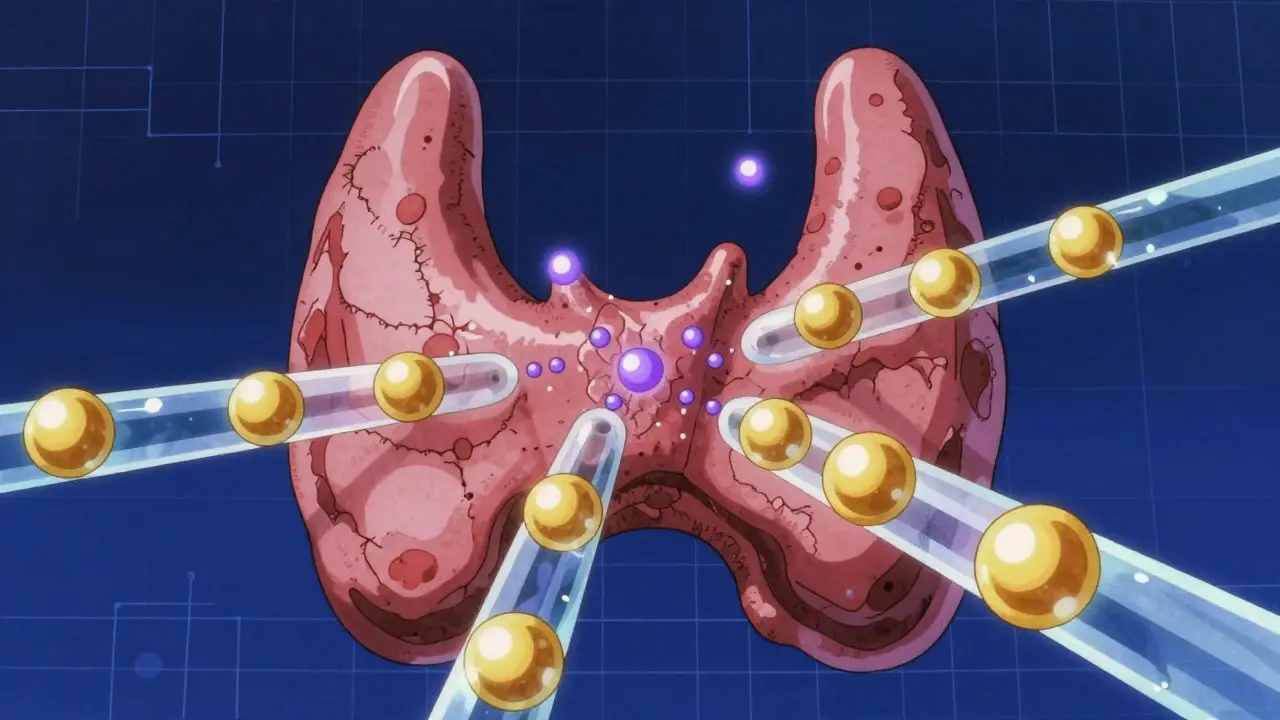
When Things Go the Other Way: Hyperthyroidism
While hypothyroidism is the norm, about 3-5% of patients experience Hyperthyroidism is the overproduction of thyroid hormones, which accelerates the body's metabolism ]. In the context of lithium, this usually isn't the classic autoimmune Graves' disease. Instead, it often manifests as painless thyroiditis-a transient inflammation that leaks stored hormones into the blood. This typically resolves on its own within three to six months without needing heavy antithyroid drugs.
However, there is a rare and dangerous scenario: lithium removal-induced hyperthyroidism. In extremely rare cases, if lithium is removed too abruptly (such as via emergency hemodialysis for toxicity), it can trigger a thyroid storm, a life-threatening surge of thyroid hormones.
Comparing Lithium to Other Mood Stabilizers
If you're worried about your thyroid, you might wonder how lithium stacks up against other options. While Valproate is an anticonvulsant medication used to treat bipolar disorder and epilepsy ] can cause some TSH elevations in about 5-10% of patients, and Carbamazepine is a medication used in the treatment of epilepsy and bipolar disorder ] has almost no thyroid impact, lithium is by far the most aggressive on the endocrine system.
| Medication | Primary Thyroid Risk | Estimated Incidence | Risk Level |
|---|---|---|---|
| Lithium | Hypothyroidism / Goiter | 20% - 32% | High |
| Valproate | Transient TSH elevation | 5% - 10% | Low to Moderate |
| Carbamazepine | Minimal impact | Very Low | Low |

Managing the Interaction: Clinical Strategies
You don't have to choose between mental stability and a healthy thyroid. The key is proactive monitoring. The standard approach involves a baseline TSH (Thyroid Stimulating Hormone) and free T4 test before the first dose, followed by checks every six months in the first year, and annually thereafter.
If hypothyroidism develops, the standard treatment is Levothyroxine is a synthetic version of the T4 hormone used to treat hypothyroidism ]. Interestingly, people on lithium often need replacement doses that are 20-30% higher than those not taking the medication. If you're taking 50 mcg and still feeling sluggish despite a "normal" TSH, your dose might need a tweak because lithium changes how your body utilizes the hormone.
One big pitfall for doctors is the "TSH lag." It usually takes 6 to 8 weeks after starting lithium for TSH levels to actually rise. Some primary care physicians see a mild elevation in the first three months and panic, discontinuing the lithium unnecessarily. Real management requires patience and looking at the trend over several months, not a single snapshot.

New Frontiers and Preventive Measures
Science is moving toward smarter ways to handle this. A recent 2024 study introduced a predictive algorithm that looks at your gender, age, and other medications (like gabapentin) to figure out if you're a "high risk" patient before the thyroid even starts to fail. This allows for much closer monitoring for those who need it most.
There's also a bit of hope in the form of selenium. A randomized controlled trial showed that taking 100 mcg of selenium daily reduced the incidence of hypothyroidism from 24% down to 14% over two years. It's a simple addition that could potentially save someone from needing lifelong hormone replacement.
Looking further ahead, researchers are working on lithium analogs. A candidate called RG101 is currently in Phase II trials; it aims to provide the same mood-stabilizing power as lithium but without the thyroid-disrupting side effects. Until then, the tradeoff remains: the unrivaled ability of lithium to prevent suicide and severe mood swings versus the need for regular blood work and potential hormone therapy.
Will stopping lithium automatically fix my thyroid?
In many cases, lithium-induced hypothyroidism is reversible, and thyroid function can return to normal after discontinuation. However, this isn't a guarantee for everyone, and in very rare instances, abrupt removal can actually trigger a hyperthyroid state or thyroid storm. Always taper off under a doctor's supervision.
Why do I feel tired even when my TSH is in the normal range?
Lithium can interfere with the peripheral conversion of T4 (the inactive hormone) to T3 (the active hormone). You might have a "normal" TSH because your brain thinks there is enough hormone, but your tissues aren't actually getting the active T3 they need. This is why some patients require higher doses of levothyroxine or a combination of T3/T4 therapy.
How often should I actually get my thyroid checked?
The American Thyroid Association generally recommends baseline tests before starting, then every 6 months for the first year. If your levels remain stable, once a year is usually sufficient. However, if you notice new symptoms like extreme cold intolerance or unexplained weight gain, you should request a test immediately regardless of the schedule.
Does the dose of lithium affect the thyroid risk?
Yes. Recent data shows a dose-response relationship where each 100 mg/day increase in lithium dose correlates with a 27% increase in the odds of developing more severe thyroid dysfunction. Higher doses generally equal higher risks.
Can I take selenium supplements to prevent thyroid issues?
Some research suggests that 100 mcg of selenium daily can reduce the risk of developing hypothyroidism while on lithium. However, you should never start supplements without consulting your doctor, as too much selenium can be toxic and may interact with other medications.
Next Steps for Patients and Caregivers
If you are starting lithium, your first step is to ensure you have a baseline TSH and Free T4 record. This is your "gold standard" for comparison later. If you've been on the drug for years and start feeling "off," don't assume it's just a symptom of your bipolar disorder; ask your doctor for a full thyroid panel.
For those already diagnosed with hypothyroidism, keep a symptom diary. If your TSH is stable but your energy is still bottoming out, discuss the possibility of T3/T4 combination therapy or a dose adjustment with your endocrinologist. Remember that the goal is to balance psychiatric stability with physical health-you don't have to sacrifice one for the other.
Jon Moss
April 25, 2026 AT 00:23That feeling of being freezing cold while everyone else is fine is the worst part of the thyroid crash.