

Most people trying to lose weight are tired of counting calories, skipping meals, or feeling hungry all the time. What if you could lose weight without starving yourself-just by changing when you eat? That’s the promise of time-restricted eating, a form of intermittent fasting that’s backed by solid science and used by millions worldwide.
What Is Time-Restricted Eating?
Time-restricted eating (TRE) means eating all your meals within a set window each day-usually between 8 and 12 hours-and fasting for the rest. The most popular version is the 16:8 method: 16 hours of fasting, 8 hours of eating. For example, you might eat from 10 a.m. to 6 p.m. and fast from 6 p.m. until 10 a.m. the next day. No calorie counting. No food elimination. Just a schedule. This isn’t about starving. It’s about syncing your eating with your body’s natural rhythm. Your metabolism, hormone levels, and digestion all follow a daily cycle called the circadian rhythm. Eating during daylight hours-when your body is primed to process food-helps insulin work better, reduces fat storage, and improves how your cells use energy. Studies show this approach isn’t just a trend. A 2025 review by Harvard T.H. Chan School of Public Health, analyzing 99 clinical trials with over 6,500 people, found that time-restricted eating leads to the same weight loss as traditional calorie restriction-but with fewer people giving up. Why? Because it’s easier to stick to. You don’t need to track every bite. You just need to wait until your eating window opens.How Much Weight Can You Lose?
The numbers don’t lie. People who stick with time-restricted eating lose an extra 1.7 to 2.5 kilograms (3.7 to 5.5 pounds) over 8 to 52 weeks compared to those eating without any schedule. That’s not magic. It’s biology. The 16:8 method is the most studied. Nine out of 13 TRE studies in a 2025 NIH meta-analysis used this format. Participants lost weight even when they didn’t cut calories. That’s because fasting lowers insulin levels, which tells your body to burn stored fat instead of holding onto it. When you eat less often, your body gets longer breaks from digesting and processing food, giving your metabolism a chance to reset. Alternate-day fasting-where you eat normally one day and restrict calories the next-produced even better results in some studies. People lost 1.3 kilograms more than those on traditional diets. But it’s harder to keep up. Social events, family dinners, and work lunches become tricky. That’s why most people stick with 16:8 or 14:10. And it’s not just about the scale. Waistlines shrink by 1.5 to 2.2 centimeters. LDL (bad) cholesterol drops by 4.8 to 7.2 mg/dL. Triglycerides fall by 8.3 to 12.6 mg/dL. Blood pressure improves. Inflammation markers like C-reactive protein go down. These are real, measurable changes that lower your risk of heart disease and diabetes.Why It Works Better Than Just Eating Less
You might think, “If I eat fewer calories, I’ll lose weight. Why bother with fasting?” Because it’s not just about calories. It’s about timing. A 2025 study from UTSW Medical Center found that people who ate their meals earlier in the day-say, 8 a.m. to 4 p.m.-improved insulin sensitivity by 12.4%. Those who ate later, from noon to 8 p.m., didn’t see the same benefit. Your body handles food better in the morning. Eating late at night messes with your sleep, raises blood sugar, and slows fat burning. Also, when you fast, your body switches from using glucose for energy to burning fat. That process, called ketosis, doesn’t require a keto diet. It happens naturally after 12 to 14 hours without food. That’s why even a 12-hour fast can help. You don’t need to go 16 hours to feel results. Traditional diets often fail because they’re too restrictive. You cut out carbs, fats, or entire food groups. People get hungry, tired, and frustrated. Time-restricted eating lets you eat what you want-just within a window. That flexibility makes it sustainable.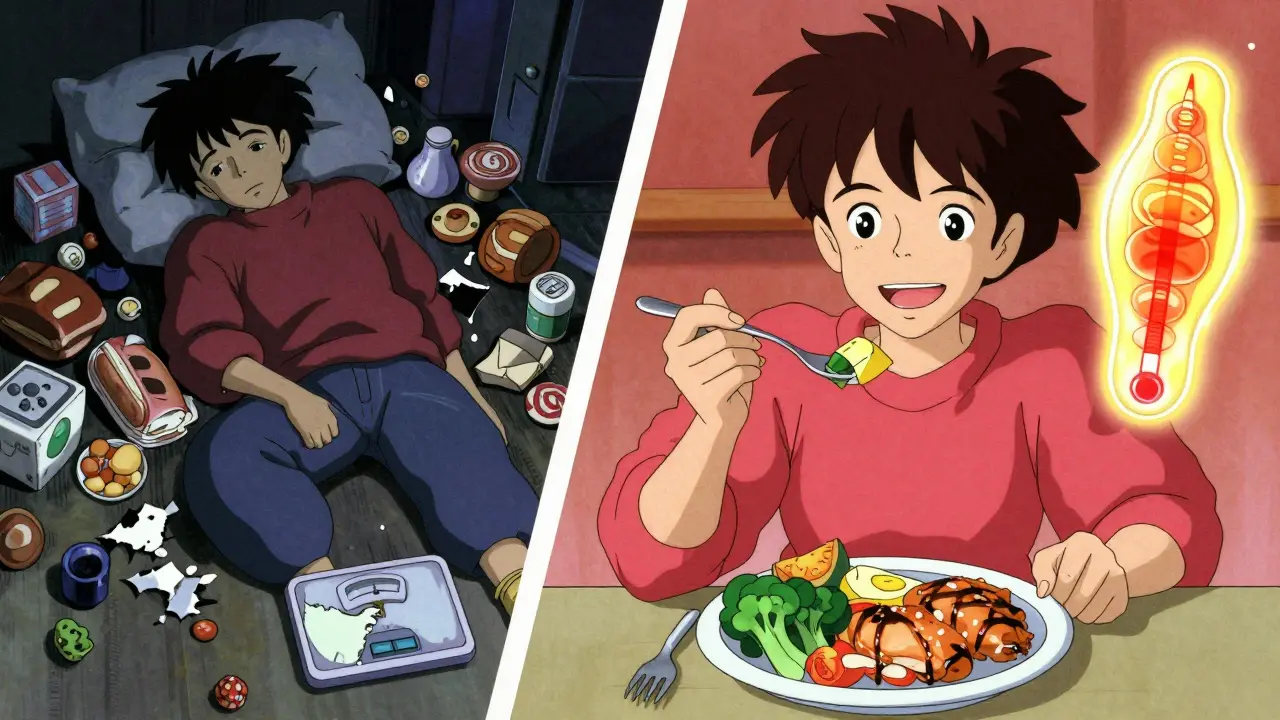
Who Should Try It? Who Should Avoid It?
TRE works best for adults who are overweight or have insulin resistance. The Endocrine Society’s 2025 study found that people with type 2 diabetes saw their HbA1c drop from 7.8% to 6.9% after 12 weeks using intermittent fasting. That’s a big improvement. But it’s not for everyone. People with a history of eating disorders should avoid it. Pregnant or breastfeeding women shouldn’t fast. Underweight individuals or those with nutrient deficiencies need to be careful. Older adults with low muscle mass should focus on protein intake during eating windows to avoid losing lean tissue. One major concern: hunger. In the first week, 78.3% of people report feeling hungrier than usual. That’s normal. Your body is adjusting. Ghrelin-the hunger hormone-takes about 72 hours to settle. After that, the cravings fade. Hydration helps. Drinking water, herbal tea, or black coffee during fasting hours keeps you full and prevents dehydration, which often feels like hunger.How to Start Without Overwhelming Yourself
Don’t jump into 16:8 on day one. Start slow. Step 1: Eat within a 12-hour window. For example, 7 a.m. to 7 p.m. That’s easy. You’re already not eating overnight. Step 2: After a week, shorten it to 10 hours. Eat from 9 a.m. to 7 p.m. Step 3: After another week, try 8 hours. 10 a.m. to 6 p.m. is a common sweet spot. During your eating window, focus on whole foods: vegetables, lean proteins, healthy fats, and complex carbs. Don’t binge on junk food just because you’re “allowed” to eat. You’ll undo the benefits. Protein is key. Aim for 1.2 to 1.6 grams per kilogram of body weight. So if you weigh 70 kg, get 84 to 112 grams of protein daily. That keeps your muscles intact while you lose fat. And eat your biggest meal earlier. Lunch over dinner. Your body burns calories more efficiently in the morning.Real-Life Challenges and How to Handle Them
The biggest complaint? Social life. Reddit users in r/IntermittentFasting (over 1.2 million members as of June 2025) say 44.6% of their negative experiences involve skipped dinners, missed parties, or awkward explanations. One user wrote: “Dinner invitations became impossible to accept without explaining my eating schedule.” That’s real. But it’s fixable. You can adjust your window. If you have a dinner party on Friday, eat from noon to 8 p.m. that day. No need to be rigid. Flexibility is part of why TRE works long-term. Another issue: energy crashes. About 58% of people report feeling sluggish during the first few weeks. That’s often due to low electrolytes. Add a pinch of salt to your water. Drink broth. Eat foods rich in potassium and magnesium-bananas, spinach, nuts-during your eating window. And don’t feel guilty if you slip. One missed day won’t ruin progress. Consistency over weeks and months matters more than perfection.
Aaron Bales
December 31, 2025 AT 23:37Just started 14:10 last week. No crazy changes, just pushed breakfast to 9 a.m. and stopped snacking after 7 p.m. Lost 2.3 lbs in 10 days without feeling hungry. Weirdly easy.
Stop overthinking it. Just try it for two weeks.
Lawver Stanton
January 1, 2026 AT 01:37Okay but let’s be real - this whole ‘bio-rhythm’ thing is just capitalism repackaging hunger as a lifestyle brand. I’m supposed to believe my mitochondria are judging my dinner time like a strict yoga instructor? I ate a whole pizza at 1 a.m. last night and woke up feeling like a god. My liver didn’t even flinch. Science? More like science-adjacent influencer content.
Also, who schedules their life around a 16-hour fast? I have a kid. I have a job. I have a cat who screams if I don’t feed her at 6 a.m. This isn’t biohacking - it’s self-flagellation with a wellness app.
And don’t even get me started on the ‘black coffee during fast’ cult. You’re not fasting, you’re just sipping bitter liquid while fantasizing about bacon.
Sara Stinnett
January 1, 2026 AT 18:39Oh, so now we’re pretending biology is a buffet with operating hours? Fascinating. Let me grab my monocle.
It’s not about ‘timing’ - it’s about caloric deficit dressed up in circadian pajamas. The Harvard study? 99 trials, yes - but how many were double-blind? How many controlled for protein intake? How many participants were just… bored? Humans are terrible at self-reporting. And yet we treat this like divine revelation.
Also, ‘eat earlier’? So if I live in Arizona and work nights, I’m biologically doomed? Your ‘science’ is just cultural bias with a lab coat.
And don’t get me started on the ‘no junk food’ sermon. If you’re fasting to avoid guilt, you’ve already lost.
It’s not biology. It’s morality in disguise. And I’m not buying it.
linda permata sari
January 3, 2026 AT 06:35In Indonesia, we’ve been doing this for generations - not because of science, but because of culture. We eat at dawn, then again at sunset. No apps. No tracking. Just family, rhythm, and rice.
My grandmother never heard of ‘16:8’ - but she lived to 92, never had diabetes, and still walks two miles every morning.
Maybe the answer isn’t in studies. Maybe it’s in tradition.
Westerners overcomplicate everything. We just eat when the sun says so. And we’re fine.
Also - kopi tubruk. Always. Even during fast. It’s not breaking anything. It’s honoring the ritual.
Paul Huppert
January 3, 2026 AT 16:14Has anyone tried 12:12 and then slowly went to 14:10? I did that over 3 weeks and didn’t feel a single crash. The energy drop in week one was real, but after that? I felt like I had more mental clarity. No magic, just… less chaos.
Also, I drink salted water during fast. Helps with the headaches. Just a tip.
Hanna Spittel
January 3, 2026 AT 20:18⚠️ ALERT: Big Pharma HATES this one weird trick! 🤫
They don’t want you to know that your insulin is secretly a government spy! 💉👁️
But if you fast at 10pm while listening to binaural beats and chanting ‘I am a metabolic god’ 🧘♀️✨, your fat cells will self-destruct and send you a thank you note 💌
Also, I lost 14 lbs in 2 weeks and now I’m dating a yoga instructor. Coincidence? I think not. 😏
Brady K.
January 5, 2026 AT 08:00Let’s reframe this, shall we? You’re not ‘fasting’ - you’re giving your digestive system a goddamn vacation. Your pancreas has been working 24/7 since 2012. It’s not a diet. It’s a labor strike. And your body? It’s finally saying, ‘Enough.’
It’s not about calories. It’s about cellular repair. Autophagy isn’t a TikTok buzzword - it’s your cells doing spring cleaning while you sleep.
And yes, if you eat pizza at midnight, you’re not ‘breaking the fast’ - you’re sabotaging your mitochondria like a toddler with a flamethrower.
Stop treating this like a diet. Treat it like a reset button. One you press with discipline, not deprivation.
And if you’re still arguing about ‘what if I eat late?’ - you’re not ready for this. Go back to counting almonds.
Marilyn Ferrera
January 5, 2026 AT 12:30Important note: electrolytes. Seriously. Sodium, potassium, magnesium. If you’re crashing, it’s not hunger - it’s dehydration with a side of mineral deficiency.
Try adding a pinch of sea salt to water. Or drink broth. It’s not fancy. It’s biology.
Also - protein intake during eating window matters more than people admit. Don’t just eat carbs to ‘fill the window.’
Robb Rice
January 6, 2026 AT 06:34I've been doing 16:8 for 8 months now. Lost 18 lbs. My blood work improved. My sleep is better.
But I do have to say - I accidentally ate a cookie at 7:15 p.m. last week. Felt terrible. Like I'd broken a sacred vow.
Then I realized: I'm not a monk. I'm just a guy who wants to feel better.
So I just adjusted my window to 9 a.m. to 7:30 p.m. that day. No guilt. No drama.
Flexibility is the secret. Not perfection.
Harriet Hollingsworth
January 6, 2026 AT 14:55Everyone’s acting like this is some holy grail. But what about people who work night shifts? What about single parents who eat when their kids do? What about people who just need comfort food after a long day?
You’re not ‘biohacking’ - you’re shaming normal life.
And if you think eating at 8 p.m. makes you a ‘bad person’ - you’ve got bigger problems than your waistline.
This isn’t health. It’s purity culture with a science veneer.
Retha Dungga
January 7, 2026 AT 06:40Jenny Salmingo
January 8, 2026 AT 09:46I started with 12 hours because I was scared. Now I’m at 14. I still eat carbs. I still eat chocolate. I just don’t eat it at 11 p.m.
It’s not about restriction. It’s about rhythm.
And honestly? I sleep better. That’s enough for me.
Brandon Boyd
January 10, 2026 AT 02:22First week was rough. Headaches. Cravings. Felt like I was detoxing from sugar addiction - because I was.
By week three? I woke up hungry at 8 a.m. - not because I had to eat, but because my body wanted to.
That’s the shift. You stop fighting hunger. You start listening to it.
And yeah, I still have pizza on Fridays. But now I eat it at 5 p.m. And I enjoy it more.
Because I didn’t binge. I chose.
Branden Temew
January 10, 2026 AT 12:55So… if I eat 10 a.m. to 6 p.m., and my friend eats noon to 8 p.m., are we both ‘doing it right’ - or is one of us just deluding themselves?
Science says timing matters. But what if my ‘timing’ is just my schedule?
Is this about biology… or about control?
And if it’s about control - why are we calling it ‘health’?
Just asking. Not judging. Just… wondering.