

Taking a "water pill" can feel like a contradiction. Your doctor prescribes a medication to get rid of excess fluid, but if you lose too much, you end up dehydrated, dizzy, or plagued by muscle cramps. It's a delicate balancing act. If you drink too little, you risk kidney strain; drink too much, and you might actually undo the work the medication is doing, potentially leading to a hospital trip for heart failure overload.
The goal isn't just to drink more water, but to manage your hydration management in a way that supports your heart and kidneys without overwhelming them. Understanding how different medications move water and salt through your system is the first step to feeling steady again.
What Exactly Are Diuretics Doing to Your Body?
At their core, Diuretics is a class of medications designed to increase the production of urine by altering how the kidneys handle sodium and water. By flushing out extra salt (natriuresis), the body naturally pulls water along with it, which reduces the total volume of blood flowing through your veins. This lowers blood pressure and eases the workload on a struggling heart.
Not all diuretics work the same way. For instance, Loop Diuretics (like furosemide) are the heavy hitters. They block sodium reabsorption in a specific part of the kidney called the thick ascending limb, potentially increasing urine output by up to 2 liters a day. Then you have Thiazide Diuretics (such as hydrochlorothiazide), which are more moderate and target the distal convoluted tubule. Finally, there are Potassium-Sparing Diuretics (like spironolactone), which help you lose water without dumping your potassium levels.
| Diuretic Type | Typical Examples | Potency (Fluid Loss) | Key Electrolyte Risk |
|---|---|---|---|
| Loop | Furosemide, Bumetanide | High (1.5-2 L/day) | High Potassium Loss |
| Thiazide | Hydrochlorothiazide | Moderate | Moderate Potassium Loss |
| Potassium-Sparing | Spironolactone | Low to Moderate | High Potassium (Hyperkalemia) |
The Dehydration Trap: Recognizing the Warning Signs
When you're on diuretics, dehydration doesn't always look like a dry mouth. It often sneaks up as Hypovolemia, which is just a fancy way of saying your blood volume is too low. This can leave you feeling lightheaded the moment you stand up or cause a dull, persistent headache.
Muscle cramps are another huge red flag. This usually isn't just about water; it's about the electrolytes-sodium, potassium, and magnesium-that are leaving your body along with the fluid. For example, people on thiazides often lose about 20-40 mEq of potassium daily. When these levels drop, your muscles can't contract properly, leading to those painful midnight charley horses.
A dangerous cycle can also happen with blood pressure. If you become severely dehydrated, your blood volume drops so much that your heart has to work harder to pump what's left. This can actually cause your blood pressure readings to spike. Some people make the mistake of taking *more* medication to lower that pressure, which only dehydrates them further. It's a cycle that can lead straight to the emergency room.
How to Calculate Your Daily Fluid Needs
There is no one-size-fits-all number for water intake, but there are a few reliable rules of thumb. For most healthy adults on diuretics, a target of 1.5 to 2.0 liters (about 6 to 8 cups) daily is the baseline. However, if you are on a potent loop diuretic, you might need an extra 300-500 mL compared to someone on a thiazide.
The most important rule is consistency. Instead of chugging a whole liter of water at once, sip throughout the day. Large volumes of fluid hitting your system all at once can put sudden pressure on your heart and kidneys. If you notice your urine is dark yellow, you're likely behind on your fluids. Clear or pale yellow is the goal.
If you have kidney disease, the rules change. Specifically, if your eGFR (Estimated Glomerular Filtration Rate) is below 30, your kidneys can't process fluid efficiently. In these cases, doctors often restrict intake to 1.0-1.5 liters per day to prevent fluid from building up in the lungs (pulmonary edema).

Practical Monitoring: The "Daily Scale" Method
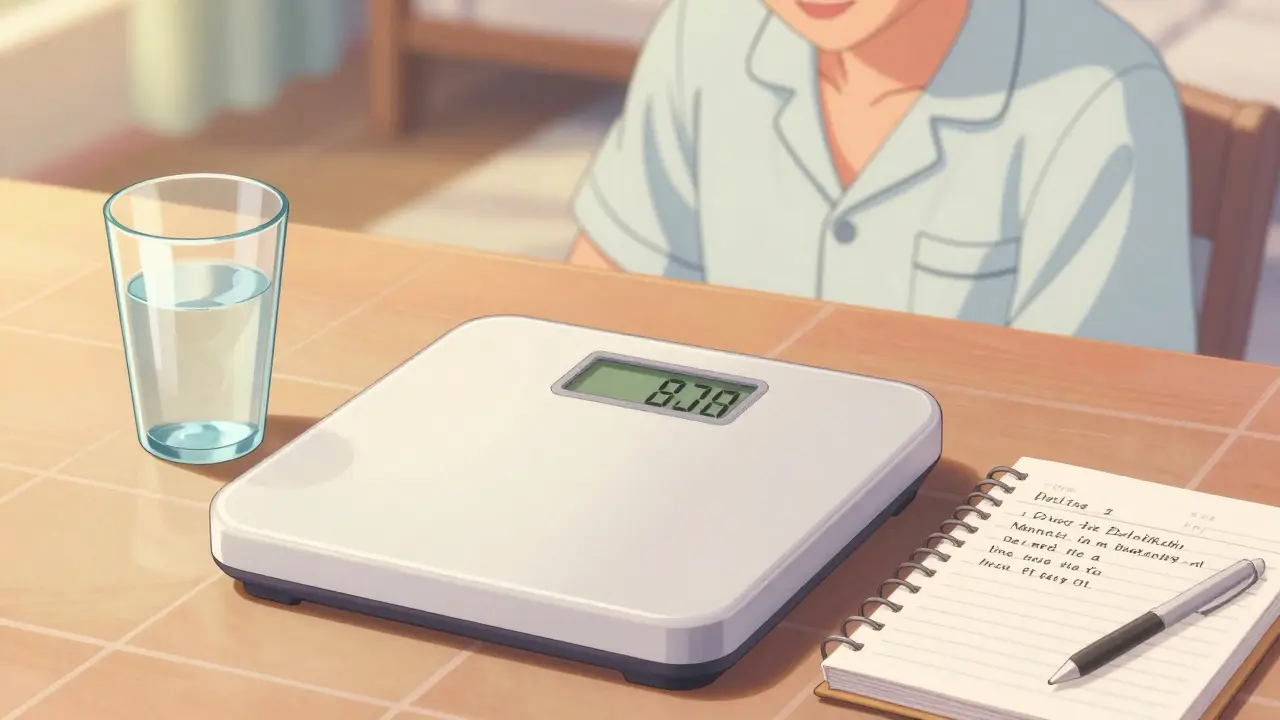
Since you can't see your internal fluid levels, the scale is your best tool. Weigh yourself every single morning after using the bathroom but before eating. This gives you a clean baseline of your body's fluid status.
- Steady Weight: You're likely in the "Goldilocks zone" of hydration.
- Sudden Drop (2+ lbs overnight): This is a sign of excessive diuresis. You may be too dehydrated and need to increase your fluid intake or call your doctor.
- Sudden Gain (2+ lbs overnight): This suggests you're retaining fluid, which could mean your medication isn't working or you're drinking too much.
Pairing weight checks with a simple urine log can help you find your personal balance. If you're producing significantly more urine than usual, try adding 200-300 mL of water for every 500 mL of extra output to keep things stable.
Food and Drink Interactions to Watch Out For
Certain things you consume can act as "natural" diuretics, compounding the effect of your medication and pushing you toward dehydration faster than you'd expect.
Caffeine, especially in amounts over 250 mg (about 2-3 cups of coffee), stimulates the kidneys to release more sodium and water. Similarly, Alcohol suppresses the antidiuretic hormone that tells your body to hold onto water. If you combine a prescription diuretic with a few drinks, the risk of severe dehydration can jump by 40-60%. This is why many patients experience extreme dizziness or fainting after a night of drinking while on water pills.
On the flip side, you need to be careful with potassium-rich foods if you're on potassium-sparing medications like spironolactone. While bananas and spinach are healthy, too much potassium combined with a drug that prevents potassium loss can lead to Hyperkalemia (excessively high potassium), which can cause dangerous heart rhythm issues.
Advanced Hydration Strategies
When water alone isn't enough, Oral Rehydration Solutions (ORS) can be a lifesaver. These aren't just sports drinks; they are formulated with a specific ratio of sodium, potassium, and glucose to pull water into your cells more efficiently. A professional-grade ORS typically provides about 1,000 mg of sodium and 200 mg of potassium per liter.
For those who struggle with tracking, new tech like smart cups can sync with health records to ensure you're hitting your targets without overshooting them. The real key to long-term success is the 4-to-6 week learning period. Most people struggle at first-drinking too much at once or ignoring the early signs of thirst-but once you calibrate your intake to your daily weight, the side effects usually vanish.
Can I drink too much water while on diuretics?
Yes. This is especially dangerous for people with heart failure. Overhydrating can lead to fluid buildup in the lungs (pulmonary edema), which can cause shortness of breath and lead to hospital readmission. Always follow the specific liter limit set by your doctor.
Why do I feel dizzy when I stand up?
This is often a sign of orthostatic hypotension caused by low blood volume (hypovolemia). When you're dehydrated, there isn't enough pressure to push blood to your brain quickly when you change positions. Increasing your fluids slightly or moving more slowly can help.
Do I need to avoid salt entirely?
Not necessarily, but you need a balance. While too much salt causes fluid retention (which diuretics are meant to fix), too little salt combined with a diuretic can lead to hyponatremia (low blood sodium), which causes confusion and lethargy. Your doctor will tell you if you need a specific sodium limit.
How often should I have my electrolytes checked?
Generally, you should get a blood test within the first week of starting a new diuretic. If you're stable, every 3 to 6 months is typical. However, if you're on high-dose or combination therapy, your doctor might want to check your levels every two weeks.
Can coffee replace my water intake?
No. Because caffeine is a mild diuretic itself, it can actually increase the amount of fluid you lose. While a cup of coffee counts toward your total liquid intake, it doesn't hydrate you as effectively as plain water or an ORS.
Next Steps for Different Scenarios
If you're just starting a diuretic: Focus on the first six weeks. Keep a daily log of your weight and the number of glasses of water you drink. This data is gold for your doctor to help fine-tune your dose.
If you have chronic kidney disease: Do not increase your fluid intake without a direct order from your nephrologist. Your kidneys may not be able to handle the extra volume, regardless of the diuretic effect.
If you experience sudden muscle cramps: Try an electrolyte-replacement solution rather than just plain water. Focus on potassium and magnesium, but check with your doctor first if you are on a potassium-sparing medication.
dwight koyner
April 8, 2026 AT 04:53The emphasis on daily weight monitoring is absolutely critical for patients on loop diuretics. Many individuals underestimate how quickly fluid shifts can occur, and a two-pound fluctuation is often the most reliable early warning sign before clinical symptoms like dyspnea appear. It is also worth noting that taking these medications in the morning, rather than evening, helps prevent nocturia and subsequent sleep disruption, which further aids in overall recovery and cardiovascular stability.
Jamar Taylor
April 9, 2026 AT 05:17Keep pushing through that learning curve, everyone! The first few weeks are the hardest, but once you nail down your routine with the scale and your water bottle, you're going to feel like a whole new person! You've got this!
Daniel Trezub
April 9, 2026 AT 21:21Funny how everyone just trusts the 'standard' 2 liters rule without questioning it. In reality, the metabolic rate and sweat loss in different climates make these generic numbers pretty useless. I mean, sure, the post is fine, but it totally ignores the role of humidity in fluid loss. Just a thought.
Ethan Davis
April 10, 2026 AT 02:40Typical. They tell you to trust the scale and the pills, but they never mention why these 'water pills' are being pushed so hard by the big pharma giants in the first place. It's all about creating a cycle of dependency where you're constantly balancing electrolytes just to stay upright. They want us dizzy and confused so we don't notice the real patterns. Wake up!
charles mcbride
April 11, 2026 AT 13:16This is a really great way to look at a tricky situation. It's all about finding that sweet spot for your own body. Stay positive and keep tracking those numbers, it'll pay off in the long run!
Vivek Hattangadi
April 13, 2026 AT 11:40I totally agree with the point about ORS! I've seen so many people just drink plain water and wonder why they still feel exhausted. Adding those salts back in makes a world of difference. If anyone is struggling with the taste of professional ORS, you can usually find some decent alternatives at the pharmacy that are a bit more palatable while still hitting those sodium and potassium targets. It's all about working with your body's chemistry to get back on track!
Sarabjeet Singh
April 13, 2026 AT 18:34Very useful information. Consistency is key here.
Christopher Cooper
April 15, 2026 AT 04:40The connection between hypovolemia and orthostatic hypotension is a fascinating physiological response. It really makes one wonder if there are non-pharmacological ways to stabilize blood volume more effectively, perhaps through specific dietary mineral adjustments. I appreciate the precision in explaining how different diuretics target different parts of the kidney, as the distinction between the thick ascending limb and the distal convoluted tubule is often overlooked in general health advice. This provides a solid foundation for understanding why some meds feel more 'aggressive' than others.
Rupert McKelvie
April 16, 2026 AT 07:32Spot on. Just keep at it and you'll find the balance. It takes a bit of patience, but the results are well worth the effort.