

When you're flying across time zones, your body doesn't just get jet lag - your meds do too. Missing a dose by a few hours because you lost track of time can mean the difference between staying healthy and ending up in a hospital. This isn't about forgetting your pills. It's about timing them right when the clock changes under your feet.
Most people think antibiotics are the main concern when traveling overseas, but the real issue isn't antibiotics - it's antimalarials and antiretrovirals. Antibiotics are usually taken for short courses, and timing across time zones rarely causes problems. But if you're taking daily pills to prevent malaria or control HIV, getting the schedule wrong can lead to treatment failure, drug resistance, or even life-threatening illness.
Why Timing Matters More Than You Think
Medications don’t work on your local time - they work on your body’s internal clock and drug levels in your blood. If you take your antimalarial at 8 a.m. in London, then land in Nairobi at 6 p.m. local time (3 hours ahead), your body still thinks it’s 3 p.m. That means your next dose is due in just 5 hours, not the usual 24. Take it too early? You risk side effects. Too late? You leave yourself unprotected.
The same goes for HIV meds. Drugs like dolutegravir can handle a 12-hour delay. But protease inhibitors? They need to be taken within 4-6 hours of the usual time. Miss that window, and the virus can start replicating again. In one documented case, a traveler missed doses during a 16-hour flight from London to Sydney and saw their viral load jump from undetectable to 1,200 copies/mL within six weeks.
Antimalarials: The Real Travel Risk
There are three main antimalarials used for prevention: Atovaquone-proguanil (Malarone), doxycycline, and mefloquine. Each has different rules.
Malarone is the most popular because it’s well-tolerated. But it’s also the most finicky. You must take it with food - preferably fatty food - or your body absorbs less than half the dose. A 2008 study showed taking it with a fatty meal boosts absorption by 300-400%. If you take it on an empty stomach during a long flight and then vomit, you’ve lost protection. And if you miss a dose while in a malaria zone? You must continue taking it for four full weeks after you resume, not just the usual seven days.
Doxycycline is cheaper and easier to time. You can shift your dose by up to 8 hours without major risk. But it makes your skin sensitive to sunlight - a problem if you’re hiking in tropical heat.
Mefloquine is taken weekly, so timing is simpler. You can stick to your home time zone for up to 10 days without adjusting. But 1 in 8 people get serious side effects like anxiety, nightmares, or dizziness. It’s not worth the risk for most travelers.
For treatment (not prevention), artemether-lumefantrine is used. It’s a four-dose regimen over three days, with doses 8 hours apart. That’s nearly impossible to manage on a flight. You need to plan ahead: take the first two doses before boarding, and the next two after landing - but only if you can eat fat. No food? No effect.
Antiretrovirals: Precision Medicine on the Move
If you’re on HIV treatment, your regimen matters more than your passport. The CDC and WHO have clear guidelines, but they’re rarely explained well.
Integrase inhibitors like dolutegravir and raltegravir are forgiving. You can shift doses by up to 12 hours without danger. That’s great for long-haul flights. But if you’re on a protease inhibitor like darunavir or atazanavir, you have a 4-6 hour window. Go outside that, and resistance can develop.
What should you do? Start adjusting your dosing schedule three days before you leave. If you’re flying east (London to Singapore), shift your dose 1-2 hours earlier each day. If you’re flying west (New York to Tokyo), shift it 1-2 hours later. Don’t try to jump 8 hours in one day - your body needs time to adapt.
Use a pill tracker app like Medisafe (rated 4.7/5 on iOS). Set alarms for your home time zone - not local time - until you’ve adjusted. Many travelers set four alarms: one for departure, one for mid-flight, one for arrival, and one for the next day. One user on Reddit said, “I set alarms for every time zone I crossed. I slept through two, but the third woke me up. Saved my life.”
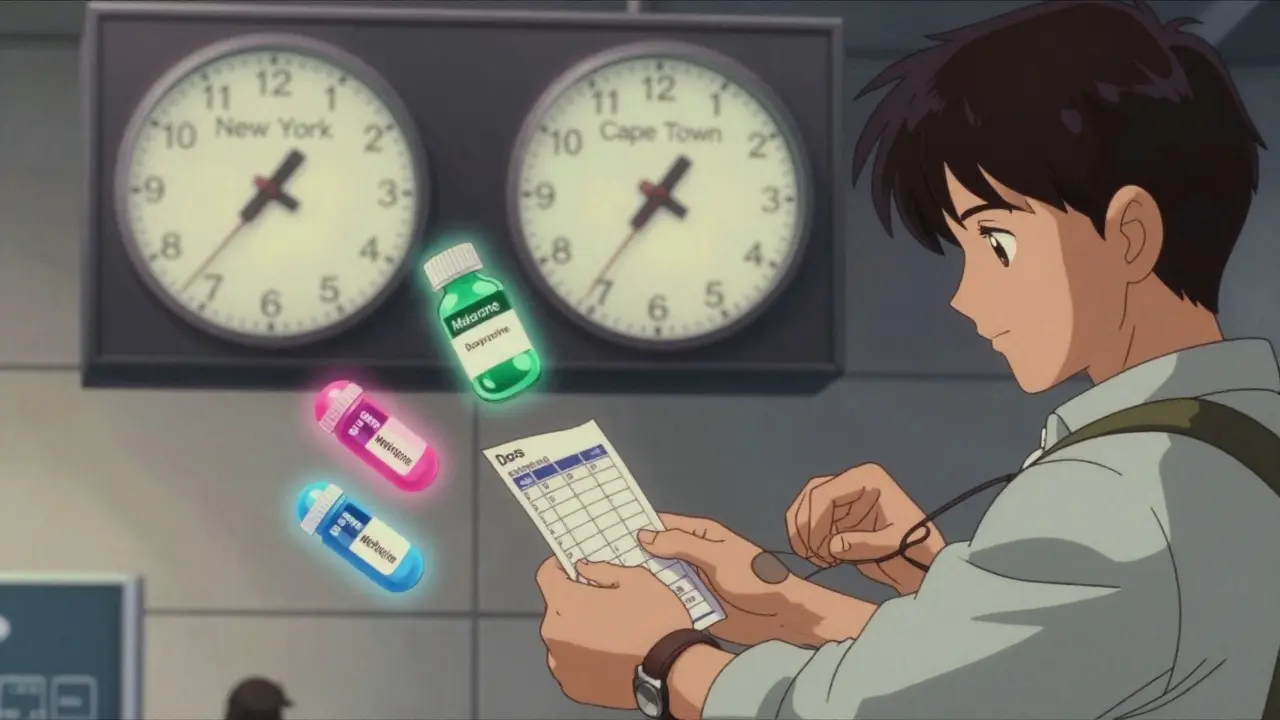
What to Do When You Miss a Dose
Missed a dose? Don’t panic - but don’t ignore it either.
- Malarone (prophylaxis): Take the missed dose as soon as you remember, even if it’s only 4 hours late. Then go back to your regular schedule. If you missed it during active malaria exposure, keep taking it for four more weeks after you return home.
- HIV meds (protease inhibitors): If you’re more than 6 hours late, skip it. Don’t double up. Take the next dose at the regular time. Double dosing can cause liver damage.
- HIV meds (integrase inhibitors): You have up to 12 hours. Take it if you remember within that window. If not, skip and resume normally.
For artemether-lumefantrine (treatment), missing a dose means restarting the full 3-day course. No shortcuts.
Travel Tools That Actually Work
There are apps, calculators, and even airline services that help.
The CDC launched its Malaria Prophylaxis Timing Calculator in February 2024. You plug in your flight details, destination, and medication, and it gives you a day-by-day schedule. In a Johns Hopkins pilot study, it cut timing errors by 63%.
Pharmacies like Walgreens now offer free pre-travel consultations. Bring your prescription and itinerary. They’ll print out a dosing chart with local times at each stop.
For long trips, some travelers now use long-acting injectables like cabotegravir/rilpivirine. One shot every two months - no daily pills, no time zone headaches. But it’s only available in 17 countries as of mid-2024, and it’s expensive.

Real Travel Scenarios: What to Do
Scenario 1: London to Bangkok (7-hour time difference, eastbound)
- Pre-travel: 3 days before departure, shift your Malarone dose from 8 a.m. to 10 a.m., then 12 p.m., then 2 p.m.
- Flight: Take your dose with a snack on the plane - even if it’s not mealtime. Pack nuts or cheese.
- Arrival: Take your next dose at 2 p.m. local time. Resume normal schedule.
Scenario 2: New York to Cape Town (6-hour difference, westbound)
- Pre-travel: Shift your dolutegravir dose from 9 p.m. to 7 p.m., then 5 p.m., then 3 p.m.
- Flight: Take your dose during the flight at 3 p.m. your home time - even if it’s 1 a.m. local time.
- Arrival: Wait until 3 p.m. local time for your next dose.
Scenario 3: Sydney to Los Angeles (17-hour flight, crossing the date line)
- Take your dose 2 hours before departure.
- Take another dose 12 hours after the first - even if it’s 3 a.m. during the flight.
- Resume your normal schedule in Los Angeles the next day.
What Not to Do
- Don’t rely on hotel clocks. They’re often wrong.
- Don’t wait until you land to ask a local pharmacist for help. Many don’t know the guidelines.
- Don’t take antimalarials on an empty stomach. Ever.
- Don’t skip doses because you’re “too busy.”
- Don’t assume your doctor already told you everything. Most don’t get training on time zone timing.
Final Checklist Before You Fly
- Confirm your medication type and forgiveness window (ask your doctor or check the patient leaflet).
- Calculate your time zone shift - east or west, how many hours?
- Start adjusting your dose 72 hours before departure.
- Print a dosing schedule with local times for each stop.
- Carry extra pills - at least 10% more than needed.
- Bring snacks with fat (nuts, cheese, peanut butter) for Malarone or artemether-lumefantrine.
- Set phone alarms for your home time zone, not local time, until you’ve adjusted.
- Download the CDC Malaria Prophylaxis Timing Calculator.
Traveling with medication isn’t about being perfect. It’s about being prepared. The goal isn’t to never miss a dose - it’s to know exactly what to do when you do.
Can I take my antimalarial without food?
No. Atovaquone-proguanil (Malarone) and artemether-lumefantrine need fat to be absorbed properly. Taking them on an empty stomach reduces effectiveness by up to 70%. Always take them with a meal, a snack with cheese or nuts, or a glass of milk.
What if I forget my pills and can’t find a pharmacy abroad?
Carry at least 10% extra pills. If you run out, contact your embassy or a travel clinic. For HIV meds, skipping doses can lead to drug resistance. For antimalarials, you’re at high risk of infection. In an emergency, some countries may have generic versions, but never take someone else’s medication.
Do I need to adjust my HIV meds if I’m only gone for 3 days?
If you’re crossing fewer than 4 time zones, you can usually stick to your home schedule. But if you’re on a protease inhibitor and crossing more than 4 zones, even a short trip needs adjustment. When in doubt, shift your dose by 1-2 hours per day in the direction of travel.
Is it safe to take antimalarials while breastfeeding?
Malarone and doxycycline are considered safe during breastfeeding. Mefloquine is also approved but carries neuropsychiatric risks. Avoid atovaquone-proguanil if your baby is under 5 kg or weighs less than 11 pounds. Always check with your doctor - some antimalarials pass into breast milk in small amounts.
Can I drink alcohol while on antimalarials or HIV meds?
Alcohol doesn’t interfere with Malarone or doxycycline in normal amounts. But with HIV meds - especially protease inhibitors - alcohol can stress your liver. Avoid heavy drinking. It’s not about the interaction - it’s about your body already working hard to process the drugs.
McCarthy Halverson
January 11, 2026 AT 05:22Michael Marchio
January 12, 2026 AT 01:40Jake Kelly
January 12, 2026 AT 15:26Ashlee Montgomery
January 12, 2026 AT 17:10neeraj maor
January 14, 2026 AT 13:58Ritwik Bose
January 15, 2026 AT 14:19Paul Bear
January 17, 2026 AT 12:47lisa Bajram
January 19, 2026 AT 08:31Jaqueline santos bau
January 21, 2026 AT 07:30Kunal Majumder
January 22, 2026 AT 06:50Aurora Memo
January 23, 2026 AT 00:31chandra tan
January 24, 2026 AT 09:54Dwayne Dickson
January 25, 2026 AT 22:28Ted Conerly
January 26, 2026 AT 10:55Faith Edwards
January 27, 2026 AT 10:16