
Medication Side Effect Checker
Check Your Symptoms
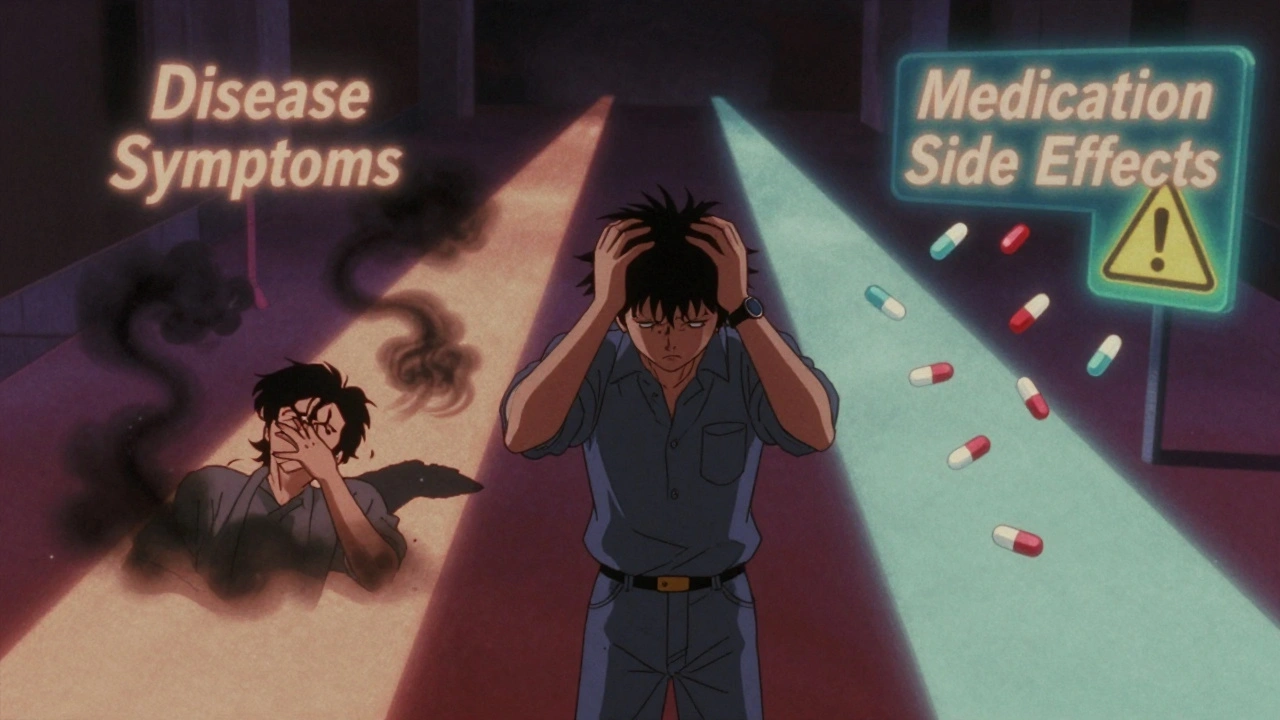
It’s one of the most common and dangerous confusions in healthcare: is this new feeling from your illness, or is it from your medicine? You start a new pill for high blood pressure, and suddenly you’re dizzy. You begin an antidepressant, and now you can’t sleep. You take a painkiller, and your stomach feels like it’s on fire. Is this your condition getting worse? Or is it the drug doing something it wasn’t supposed to?
Getting this wrong can cost you time, money, and even your health. About 1.3 million people in the U.S. end up in the emergency room every year because they didn’t know whether their symptoms were from their disease or their medication. And in 32% of chronic illness cases, patients and even doctors misattribute side effects as disease progression-leading to unnecessary tests, extra pills, and sometimes real harm.
What’s the Real Difference?
Let’s cut through the jargon. Disease symptoms are what your body is showing because of the illness itself. If you have depression, feeling tired, losing interest in things, and having trouble concentrating? Those are symptoms of depression. If you have arthritis, joint pain, stiffness, and swelling? Those are symptoms of arthritis.
Side effects are what your body does in response to the medicine. They’re not the illness-they’re the drug’s side show. For example, if you take an SSRI like sertraline for depression and suddenly can’t have sex, that’s a side effect. If you take lisinopril for blood pressure and get a dry, nagging cough, that’s a side effect. If you take ibuprofen and get an upset stomach? Also a side effect.
The key? Side effects are usually predictable. Doctors know these things happen. That’s why they tell you: “You might feel a little sleepy at first,” or “Some people get nausea for the first week.” Disease symptoms don’t come with a warning label. They just show up as part of the condition.
Timing Is Everything
One of the clearest ways to tell the difference is when the symptom showed up.
- If you started a new medication last week and now you’re nauseous, dizzy, or having trouble sleeping? That’s likely a side effect.
- If you’ve been on the same medicine for six months and suddenly feel worse? That’s more likely your disease changing.
Most side effects show up within 1 to 4 weeks of starting a drug. Some happen fast-like a rash or swelling within hours (that’s a red flag for allergy). Others creep in slowly: weight gain from antidepressants, dry mouth from antihistamines, or fatigue from blood pressure meds.
Here’s a quick timeline to remember:
- Hours to 2 days: Immediate reactions (allergies, dizziness from blood pressure meds)
- 3 days to 4 weeks: Most common side effects (nausea, insomnia, dry mouth, headache)
- Months to years: Long-term effects (bone loss from steroids, weight gain from antipsychotics)
If your symptom matches this timeline, it’s probably the medicine. If it’s been years since you started the drug and now you’re having new problems, think disease progression-or maybe a new drug you added.
Dose Matters
Side effects usually get worse when you take more of the drug. If you doubled your dose of a sleep aid and now you’re groggy all day? That’s a classic side effect. If you lowered your blood pressure pill and your dizziness went away? That’s another sign it was the medication.
Disease symptoms don’t care about dosage. Your arthritis won’t suddenly get better because you took less painkiller. Your depression won’t lift just because you skipped a pill. The disease keeps doing what it’s doing, regardless of how much medicine you’re on.
This is why doctors sometimes lower your dose to test things out. If your symptom fades when you cut back, it’s likely the drug. If it stays the same? Probably the illness.
Common Side Effects vs. Common Disease Symptoms
Some symptoms show up in both. Fatigue. Headaches. Trouble focusing. That’s why it’s so easy to mix them up.
Here’s a real-world comparison:
| Symptom | More Likely Side Effect | More Likely Disease Symptom |
|---|---|---|
| Fatigue | Antihistamines, blood pressure meds, opioids | Depression, hypothyroidism, chronic fatigue syndrome |
| Insomnia | SSRIs, stimulants, corticosteroids | Anxiety, bipolar disorder, sleep apnea |
| Headache | Antibiotics, blood pressure drugs, withdrawal from caffeine | Migraine, high blood pressure, tension headaches |
| Nausea | Antibiotics, chemo, NSAIDs, SSRIs | Stomach flu, gallbladder disease, pregnancy |
| Weight gain | Antidepressants, steroids, antipsychotics | Hypothyroidism, Cushing’s syndrome, insulin resistance |
| Cognitive fog | Anticholinergics, benzodiazepines, some blood pressure meds | Depression, dementia, chronic stress |
Notice how some side effects look exactly like the diseases they’re meant to treat? That’s the trap. Antidepressants can cause fatigue. But fatigue is also a core symptom of depression. So how do you know?
What to Do When You’re Not Sure
Don’t guess. Don’t stop your meds on your own. Don’t just power through it. Here’s what works:
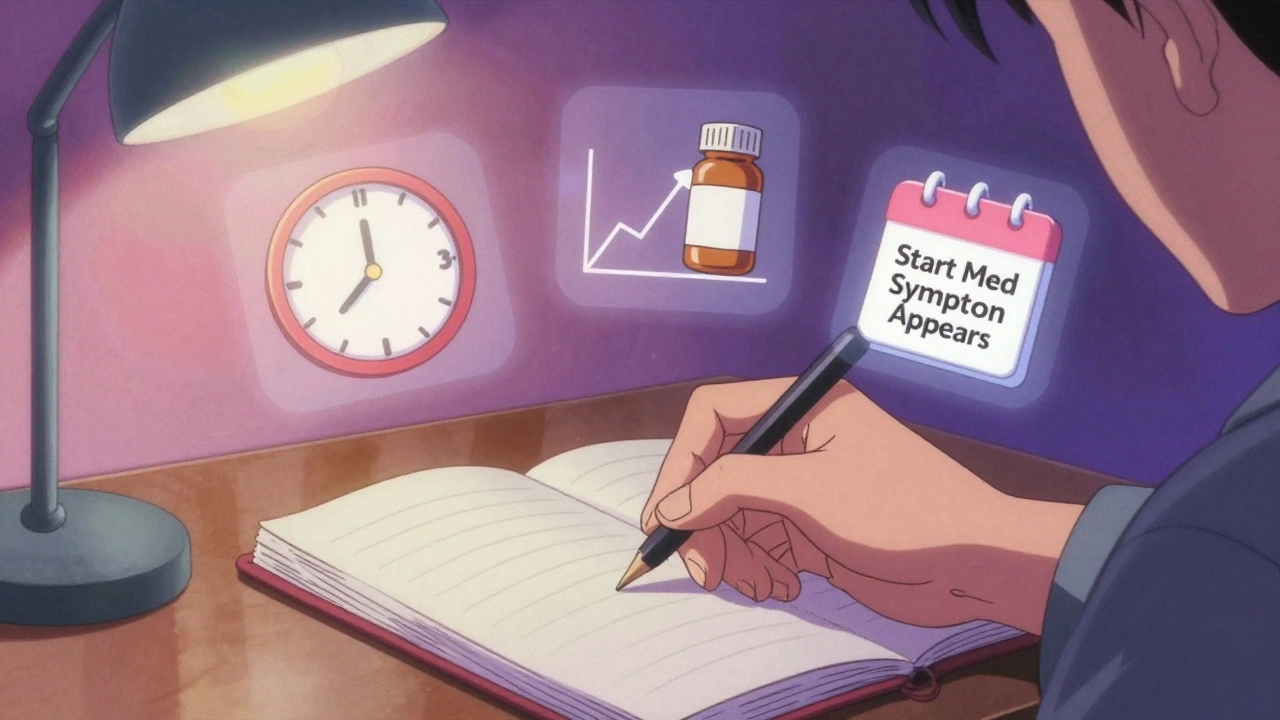
- Keep a symptom diary. Write down: what you took, when you took it, what symptom you felt, how bad it was (1-10), and how long it lasted. Do this for 2 weeks. You’ll start seeing patterns. If every time you take your pill at 8 a.m., you get a headache by noon? That’s not your disease.
- Ask yourself: Did this start after a new drug? If you’ve been on your meds for years and nothing changed until last month when you added a new pill? That’s your suspect.
- Check for drug interactions. Taking 5 or more medications? You’re at higher risk. A 2021 study found 35% of people on 5+ drugs had symptoms that were actually caused by drug interactions, not their original illness.
- Try a “drug holiday” with your doctor’s help. This means stopping the suspected drug for a few days (only if safe!) to see if symptoms fade. If they do, then come back on it. If they return? That’s your answer. This method works 85% of the time-but never do this without your doctor’s approval.
Patients who keep detailed logs are 41% more likely to correctly identify side effects, according to a 2022 study in Patient Education and Counseling. That’s not small. That’s life-changing.
Red Flags: When It’s Not a Side Effect-It’s an Emergency
Not all side effects are mild. Some are dangerous. Here’s when to call 911 or go to the ER:
- Sudden swelling of the face, lips, tongue, or throat
- Difficulty breathing or wheezing
- Severe rash with blisters or peeling skin
- High fever with stiff neck or confusion
- Fast, irregular heartbeat with chest pain
- Uncontrollable vomiting or diarrhea
These aren’t side effects. These are allergic reactions or serious adverse events. They’re not normal. They’re not going away on their own. Get help immediately.

What Your Doctor Should Be Doing
Good doctors don’t just hand you a prescription and hope for the best. They talk about side effects before you start. They give you written info. They schedule follow-ups. They ask: “How are you feeling since you started this?”
But not all do. That’s why you need to be your own advocate. Ask:
- “What are the most common side effects of this drug?”
- “Which ones should I call you about right away?”
- “Could any of my other meds be making this worse?”
- “Is there a different drug with fewer side effects?”
MedShadow.org found that patients who got clear written info about side effects were 28% less likely to end up in the ER because they panicked over normal reactions.
Technology Can Help
There are tools now that make this easier:
- Medisafe, MyTherapy: Apps that remind you when to take pills and let you log symptoms. They show you graphs linking meds to symptoms.
- AI tools like MedAware: Used in hospitals, these analyze your records and flag possible side effects before you even notice them.
- Pharmacogenomic testing: A simple saliva test that tells you if your body is likely to react badly to certain drugs. Covered by most insurance now for antidepressants, pain meds, and blood thinners.
One 2023 study showed that people who used these tools identified side effects 34% faster than those who didn’t.
Bottom Line
You’re not crazy. You’re not imagining things. And you’re not failing at managing your illness if you’re unsure what’s what. This is hard. Even doctors struggle with it.
But you can get better at it. Start tracking. Ask questions. Don’t assume every new feeling is your disease. Give yourself permission to suspect the medicine.
Side effects aren’t a sign you’re doing something wrong. They’re a sign your body is reacting to a chemical. And once you learn to spot them, you can talk to your doctor, adjust your treatment, and finally feel like yourself again.
Don’t suffer in silence. Don’t take extra pills to fix what’s already broken. Figure out what’s really going on-and take back control of your health.
Lawrence Armstrong
December 11, 2025 AT 17:05Been on lisinopril for 3 years. Started getting that dry cough around month 2. Thought it was allergies. Turns out? Classic side effect. Doctor never mentioned it. Now I know to ask about side effects before taking anything. 🙌
Audrey Crothers
December 12, 2025 AT 06:22OMG YES THIS. I took Zoloft and thought I was getting worse at depression until I realized I couldn't orgasm anymore and my stomach felt like a washing machine. My doctor was like 'oh yeah that happens' like it was normal. IT ISN'T NORMAL. I felt so alone. 🤍
Laura Weemering
December 12, 2025 AT 09:12It's not merely pharmacological... it's ontological. The body, as a phenomenological site of suffering, becomes indeterminate when the pharmakon is introduced-simultaneously cure and poison. The symptom, then, is not a signifier of disease, but a semiotic rupture in the therapeutic contract...
...which is why I stopped taking my meds. I don't trust the system. They profit from confusion. I'm not sick. I'm just... aware.
Robert Webb
December 13, 2025 AT 16:33I've been helping patients navigate this for over 15 years, and honestly? The biggest issue isn't the medicine-it's the lack of communication. Doctors rush through scripts. Patients are scared to ask questions. We need to normalize asking: 'What could this do to me?' not just 'What does this fix?'.
One of my patients kept thinking her fatigue was her MS flaring-until she realized it only happened after she started her new cholesterol med. She dropped the dose, and her energy came back. No new MRI, no new meds. Just a conversation.
And yes, tracking symptoms is the single most powerful tool. I give everyone a free printable log. It's not fancy, but it works. You'd be amazed how many people say, 'I didn't realize I only got headaches on Tuesdays after taking the pill.'
Also-drug interactions? Huge. People on five meds are basically playing Russian roulette with their biology. I wish pharmacists had more time to sit down with folks. Insurance doesn't pay for that, though.
And don't get me started on how rarely doctors check for genetic sensitivity. I had a guy on a blood thinner who kept bleeding out-turns out he had a CYP2C9 variant. Saliva test would've caught it. He almost died because no one thought to test.
So yes, this post? Spot on. But the real fix isn't just awareness-it's systemic change. We need better time, better tools, better training. And patients need to stop feeling guilty for asking questions.
You're not being difficult. You're being smart.
Stacy Foster
December 14, 2025 AT 13:47THIS IS ALL A LIE. Big Pharma wants you to think side effects are normal so you keep taking the poison. They know the real cause of your symptoms is toxins in the water, 5G, or the government's secret mind control chips. They don't want you to know the truth. I stopped ALL meds and went keto + colloidal silver. My migraines vanished. Coincidence? I think not.
Nathan Fatal
December 15, 2025 AT 13:26The distinction between disease and drug effect is philosophically fascinating. The body doesn't distinguish-only the mind tries to categorize. But if a pill alters your perception of fatigue, is the fatigue still 'yours'? Or is it now a pharmacological construct?
Still, pragmatically, tracking symptoms is the only way to reclaim agency. I keep a simple log: med, time, symptom, intensity. After two weeks, patterns emerge. The body remembers. The mind forgets.
And yes-dose matters. Lowering a statin from 40mg to 20mg didn't just reduce my muscle pain-it restored my sense of self. The disease was still there. But I was no longer a casualty of treatment.
Reshma Sinha
December 16, 2025 AT 06:43As someone who's been managing diabetes for 12 years, I can't tell you how many times I blamed my low energy on my condition-until I realized my blood pressure med was making me feel like a zombie. Once we switched, I had energy to play with my kids again. Don't suffer in silence-ask your pharmacist. They're the unsung heroes.
Donna Anderson
December 17, 2025 AT 06:40i had this thing where i was so tired all the time and thought it was my adhd getting worse but then i realized i was taking the same antidepressant for 5 years and it was just... worn out my system? switched meds and now i feel like a human again. why does no one tell you this?!
nikki yamashita
December 17, 2025 AT 22:26This is everything. I thought my brain fog was my anxiety. Turns out it was my beta blocker. I cut the dose in half and boom-clarity. Thank you for saying this out loud. 💪
sandeep sanigarapu
December 19, 2025 AT 14:24Excellent summary. In India, many patients self-medicate without understanding side effects. This information must be shared widely. Simple, clear, and life-saving.
Adam Everitt
December 19, 2025 AT 19:54so like... if you get a headache after taking ibuprofen is that the medicine or your stress? i dont know anymore. my head hurts just thinking about it lol
Levi Cooper
December 20, 2025 AT 17:28Why do Americans rely on pills for everything? In my country, we use food, rest, and discipline. You take a pill for a headache? Pathetic. Your body is weak. Stop blaming the medicine. Fix your lifestyle.
Ashley Skipp
December 20, 2025 AT 22:45Why do doctors not warn you about this? I was on Lexapro for 2 years and no one told me it could cause weight gain and brain fog. Now I'm 50 pounds heavier and can't focus at work. My doctor just shrugged. I'm done with the system.
wendy b
December 21, 2025 AT 09:54While the article presents a utilitarian framework for symptom attribution, it fails to account for the epistemological limitations of pharmacovigilance protocols under neoliberal healthcare structures. The reliance on patient self-reporting as a primary diagnostic tool is statistically unreliable and ethically fraught, particularly when cognitive impairment is comorbid with the condition under treatment. Moreover, the promotion of pharmacogenomic testing as a panacea ignores the socioeconomic disparities in access to such technologies, thereby reinforcing structural inequities in medical care. One must question whether the solution lies in individual vigilance-or systemic reform.