
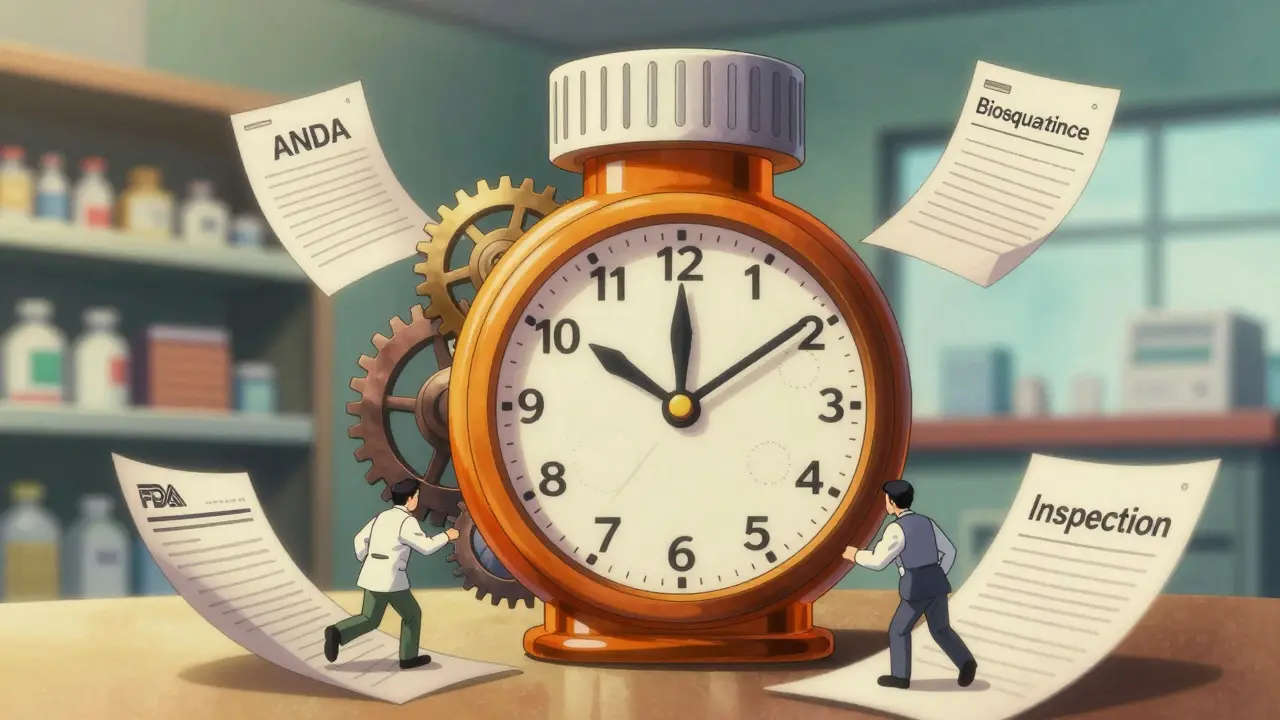
When a generic drug hits the shelves at half the price of the brand-name version, most people don’t think about the years of paperwork, inspections, and scientific reviews that got it there. But behind every affordable pill is a clock - one that ticks slowly, sometimes for over a year, unless the FDA moves fast. If you’re a patient waiting for a cheaper version of your medication, or a manufacturer trying to bring a generic to market, understanding how long the FDA takes to approve these drugs isn’t just helpful - it’s critical.
What’s the standard timeline for FDA generic approval?
The FDA’s goal for a standard generic drug application - called an Abbreviated New Drug Application, or ANDA - is 10 months after the application is officially accepted. This isn’t the total time from when you first submit the paperwork. It’s the clock that starts only after the FDA confirms your application is complete enough to begin review.
Before that 10-month clock even begins, there’s a 60-day filing review. During this phase, the FDA checks if your ANDA has all the required sections: chemistry data, manufacturing details, bioequivalence studies, labeling, and more. If something’s missing - say, incomplete stability data or unclear dosage form specifications - you’ll get a refusal to file letter. That means you start over. No clock. No progress.
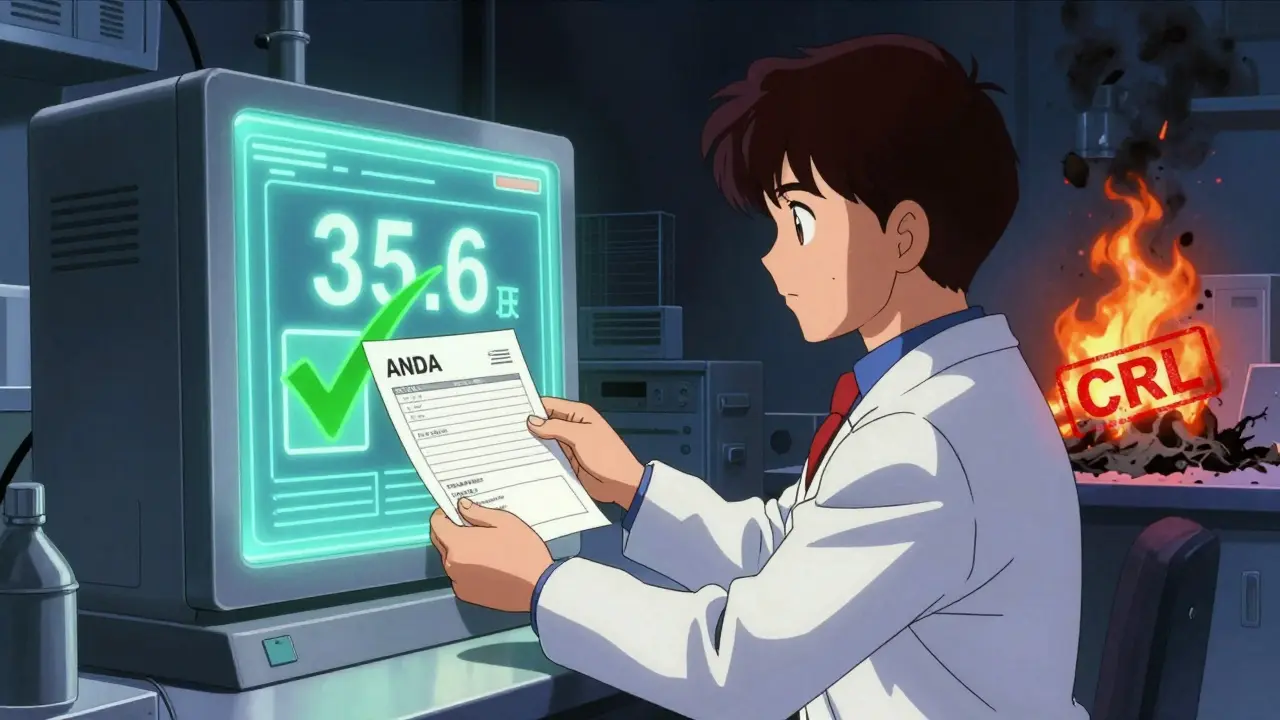
Once accepted, the 10-month review period kicks in. The FDA’s own data from 2025 shows the average time to approval is now down to about 35.6 days for the median case. That sounds fast. But here’s the catch: that number only reflects applications that pass on the first try. About 42% of applications get a complete response letter (CRL) after the initial review. That means the FDA found issues - maybe a manufacturing flaw, a bioequivalence gap, or an inspection delay - and you have to fix them.
Why do some approvals take years while others take months?
Not all generic drugs are created equal. A simple tablet of ibuprofen? That’s straightforward. The FDA has reviewed hundreds of versions. The process is routine. But a complex inhaler, a topical gel with a special delivery system, or an injectable with multiple active ingredients? Those are different.
Complex generics take longer because proving they work the same way as the brand drug isn’t just about matching blood levels. It’s about matching how the drug behaves in the body - how it’s absorbed, how it’s released, even how it feels when injected. The FDA has dedicated teams just for these tricky products. Since 2023, their focus has cut approval times for complex generics by 22%.
Real-world examples show the gap. One manufacturer reported a standard oral tablet generic approved in 278 days. Another spent 1,087 days getting approval for a nasal spray generic - nearly three years. Why? The spray’s device design required extra testing. The FDA needed to see that every dose delivered the same amount of medicine, every time. That’s not a delay. That’s due diligence.
What speeds up the process?
The FDA has tools to move faster - and they’re using them. One big change? The Commissioner’s National Priority Voucher (CNPV) program. Announced in late 2025, this lets the agency fast-track certain high-need generics. Instead of 10 months, approval can happen in just 1 to 2 months. These are drugs for conditions with shortages, no existing generics, or where patient access is urgently needed - like epinephrine injections or doxycycline suspensions for children.
Another game-changer? Artificial intelligence. The FDA is now using AI to scan ANDAs for common errors, flag missing data, and even predict inspection needs. In pilot programs, AI reduced review times for standard generics by 15.8%. That’s not magic - it’s efficiency. Reviewers spend less time hunting for typos and more time evaluating science.
Rolling reviews are also helping. Instead of waiting to submit the entire 1,000-page application, companies can send parts as they’re ready - chemistry data now, manufacturing info later. The FDA reviews each piece as it arrives. This keeps the process moving, even if one section is delayed.
How do priority reviews work?
Priority review isn’t a separate track like it is for brand-name drugs. The FDA doesn’t have a formal “priority generic” designation. But they do prioritize certain applications based on public health need. If a drug is in short supply, or if there’s only one manufacturer making it, the FDA bumps it to the front of the line. No formal application change. No extra fee. Just a decision - based on need.
That’s why first generic approvals - the very first version of a brand drug to be copied - are getting special attention. In 2025, the number of first generic approvals is ahead of 2024’s pace. The FDA sees these as critical for lowering prices fast. And they’re moving faster to approve them.
What slows things down?
Even with improvements, bottlenecks remain. The biggest one? Inspections. The FDA must inspect every manufacturing site - in the U.S. or overseas - before approving a generic. If the site fails an inspection, the application is paused. No approval until the issue is fixed and the site is reinspected. Some manufacturers report delays of 6-12 months just waiting for an inspection slot.
Another problem? Incomplete response letters. When the FDA sends a CRL, it’s not always clear what’s wrong. Some letters are vague. Companies spend months guessing what the agency wants. One survey found 29% of manufacturers say inconsistent review standards make planning impossible.
And then there’s the human factor. The FDA has a finite number of reviewers. Even with AI and better tools, they’re still reviewing thousands of applications a year. If your application is messy, or if you submit it right before a holiday, you might wait longer.
Who’s getting approvals fastest?
The big players - Teva, Viatris, Sandoz - aren’t just big because they make more drugs. They’re big because they’re better at navigating the system. They hold pre-submission meetings with the FDA. They use the same reviewers year after year. They know what the agency expects.
These companies have the lowest average approval times. Teva, with 18.3% of the generic market, consistently gets approvals faster than smaller firms. Why? They submit cleaner applications. They fix issues on the first try. They don’t wait until the last minute to start inspections.
Small companies? They’re catching up. Fee waivers are available for small businesses, and the FDA offers guidance sessions. But without the resources to hire regulatory experts or run multiple pilot batches, their timelines are still longer.
What’s next? The future of FDA generic approvals
The FDA’s next goals, under GDUFA III (2023-2027), are ambitious: 90% of standard ANDAs approved by their goal date, and 75% of priority ones too. They’re aiming for a median approval time of just 20 days for standard generics by 2027. That’s not a typo. That’s the target.
Is it realistic? Maybe. The agency has shown it can move fast when it needs to. But it’s not without risk. The Congressional Budget Office warned that rushing approvals could mean cutting corners on quality. One expert from the Center for Science in the Public Interest put it bluntly: “Speed without safety is just noise.”
The FDA says they’re not cutting corners. They’re using better tools - AI, data analytics, risk-based inspections - to work smarter. And so far, the data backs them up. Between 2020 and 2024, median approval times dropped by 18.7%. Generic drugs saved the U.S. healthcare system $1.7 trillion over the last decade. That’s not luck. That’s progress.
What can manufacturers do to get approved faster?
If you’re submitting an ANDA, here’s what actually works:
- Submit a clean application. 68% of manufacturers say quality matters more than speed. Fix the chemistry, get the manufacturing right, and the FDA will move faster.
- Use pre-submission meetings. Talk to the FDA before you file. Ask what they expect. Avoid surprises.
- Start inspections early. Don’t wait until after submission. Schedule your site inspection as soon as your process is ready.
- Don’t rush complex products. If your drug is tricky, invest in extra testing upfront. It’s cheaper than multiple CRLs.
- Apply for priority status if eligible. If your drug treats a shortage or has no generic, make sure the FDA knows.
There’s no shortcut. But there is a path - and it’s clearer than ever.
Why does this matter to you?
If you’re a patient, faster approvals mean lower prices sooner. Generic drugs make up 90% of all prescriptions in the U.S. but cost only 23% of what brand drugs do. Every month the FDA saves on approval time is another 10,000 people who can afford their meds.
If you’re a pharmacist, it means fewer stockouts. Fewer patients calling because their cheap version isn’t available.
If you’re a manufacturer, it means planning with confidence. Knowing the clock ticks at 10 months - not 18 - helps you invest, hire, and launch.
The FDA isn’t perfect. But it’s getting better. And the numbers prove it.
How long does the FDA take to approve a generic drug?
The FDA targets a 10-month review period for standard generic drug applications (ANDAs) after the application is accepted. The median approval time in 2025 was about 35.6 days, but this only applies to applications that pass on the first try. About 42% of applications receive a complete response letter, which adds 3-6 months per review cycle. Complex generics can take over a year.
What is the difference between a standard and priority generic review?
The FDA doesn’t have a formal priority review category for generics like it does for brand-name drugs. Instead, it prioritizes certain applications based on public health need - such as drugs in shortage or with no existing generic. These can be approved in as little as 1-2 months under the new Commissioner’s National Priority Voucher program. Most generics follow the standard 10-month review clock.
Why do some generic approvals take years?
Complex generics - like inhalers, injectables, or topical products with special delivery systems - require more testing to prove they work the same as the brand drug. Delays also happen due to failed manufacturing inspections, incomplete applications, or multiple rounds of feedback from the FDA. One nasal spray generic took 1,087 days to approve because of device testing requirements.
Can AI really speed up FDA generic approvals?
Yes. The FDA has been using AI to scan applications for missing data, flag common errors, and predict inspection needs. In pilot programs, AI reduced review times for standard generics by 15.8%. It doesn’t replace reviewers - it helps them focus on science instead of paperwork.
What percentage of generic applications get approved on the first try?
As of Q2 2025, about 57.7% of ANDAs received approval without a complete response letter. That means 42.3% were sent back for corrections, which typically adds 3-6 months per cycle. Improving application quality is the single biggest way to avoid delays.
How much does it cost to submit a generic drug application?
The user fee for a standard ANDA in fiscal year 2025 is $138,400. Small businesses and first-time applicants may qualify for fee waivers, but these represent less than 5% of all submissions. The fee covers the cost of review and helps fund the FDA’s faster approval initiatives.
Aboobakar Muhammedali
December 20, 2025 AT 00:09I remember when my dad needed that generic epinephrine pen and we waited six months just to get it
It’s not just about money - it’s about breathing easy
Thank god the FDA’s moving faster now
Still wish inspections weren’t such a nightmare though
Laura Hamill
December 20, 2025 AT 10:55AI? LOL
They’re just letting China make all the pills now and calling it ‘efficiency’
Watch your blood pressure med turn into chalk next year 😈
Alana Koerts
December 21, 2025 AT 13:56Median 35.6 days? That’s meaningless without the standard deviation
And where’s the data on post-market adverse events since 2023?
Also, 42% CRL rate means the system is broken
Not ‘improved’
Dikshita Mehta
December 23, 2025 AT 01:23For anyone applying for an ANDA - don’t skip the pre-submission meeting
Even if you’re a small startup
I helped a friend submit last year and we got approved in 112 days because we asked the FDA what they wanted before writing a single page
It’s not magic - it’s just communication
And yes, inspections are brutal but schedule them early
Like, 6 months before you even think about submitting
pascal pantel
December 23, 2025 AT 05:11The 10-month goal is a fantasy
Let’s be real - the FDA is a bureaucratic black hole
AI? Please
They’re just automating the same lazy reviews with better UI
And don’t get me started on GDUFA III targets - 20 days? That’s regulatory capture disguised as innovation
Quality control is being sacrificed for vanity metrics
Gloria Parraz
December 23, 2025 AT 07:25If you’re a patient reading this - please know you’re not alone
There are people fighting for you behind the scenes
And if you’re a manufacturer - don’t give up
Even if it takes 18 months, you’re changing lives
Every generic pill approved is someone’s dignity restored
Keep going
Sahil jassy
December 24, 2025 AT 19:40Bro the inspections are the real villain
I know a guy in Bangalore whose plant got flagged for a tiny dust issue
Took 9 months to get back in
Meanwhile, 3000 diabetics couldn’t get their metformin
Fix inspections not paperwork
Janelle Moore
December 26, 2025 AT 07:24AI scanning applications? That’s just the first step
Next they’ll be using facial recognition on inspectors to see if they’re ‘biased’
And don’t tell me this isn’t part of the Great Replacement
Generic drugs are just the beginning
Soon your insulin will be made by robots controlled by WHO
Chris porto
December 26, 2025 AT 18:16It’s interesting how we treat drug approval like a race
But medicine isn’t about speed - it’s about trust
What happens when we optimize for efficiency and forget about safety?
Maybe the real question isn’t how fast the FDA moves
But whether we should be asking them to move faster at all
Danielle Stewart
December 28, 2025 AT 03:40As someone who works in pharma compliance, I can confirm: clean applications win.
One company submitted a 1,200-page document with zero typos, perfect labeling, and pre-approved inspection schedules.
Approved in 89 days.
Another submitted the same drug three months later with inconsistent batch numbers and got a CRL.
It’s not the FDA - it’s the applicant.
Stop blaming the system. Fix your submission.
jessica .
December 28, 2025 AT 17:19the fda is just letting indians make all the pills now
they dont even test them
thats why so many people are getting sick
its all a scam
you think they care about you?
nope
Ryan van Leent
December 30, 2025 AT 07:0918.3% market share? Teva’s the real monopoly here
They’ve got the FDA on speed dial
Meanwhile, small companies get buried under CRLs
And you call this ‘fair competition’?
It’s corporate capture with a side of bureaucracy
And don’t give me that ‘they’re better at it’ crap
They just have more lawyers