
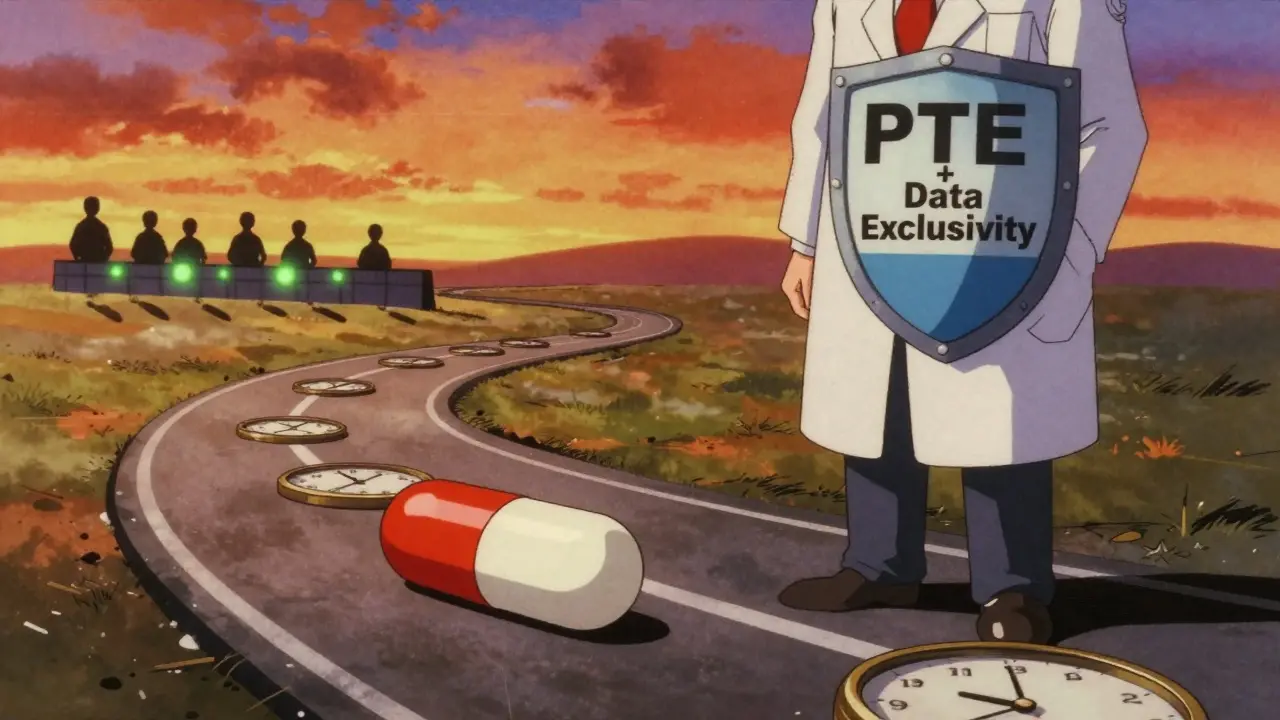
When a brand-name drug hits the market, it doesn’t stay alone for long. Somewhere down the line, a cheaper version will appear. But not right away. The delay isn’t random-it’s built into the law. Different countries have different rules about how long a drug company can keep generics out, and those rules shape who gets medicine, when, and at what price.
How Long Do Patents Last? It’s Not What You Think
You’ve probably heard that drug patents last 20 years. That’s true-but only on paper. The real clock starts ticking long before the drug even reaches shelves. It takes an average of 10 to 12 years just to get a new drug approved. Clinical trials, safety reviews, manufacturing setup-all of it eats up time. By the time the FDA or EMA gives the green light, a drug might only have 6 to 10 years left on its patent. That’s not enough to recover the $2.3 billion it typically costs to bring a new drug to market, according to Tufts Center for the Study of Drug Development.
That’s why countries added extra layers. In the U.S., the FDA can extend patent life through Patent Term Extension (PTE). The max extension is 5 years, but the total protected time after approval can’t go beyond 14 years. In the EU, they use Supplementary Protection Certificates (SPCs). Same goal: add up to 5 years. But here’s the catch-the combined time of patent + SPC can’t exceed 15 years from the drug’s first marketing authorization. Both systems were designed to fix a broken clock, not to create endless monopolies.
The Hidden Rules: Exclusivity Beyond Patents
Patents aren’t the only tool keeping generics away. There’s something called data exclusivity. This isn’t about patents at all. It’s about protecting the clinical trial data the original company spent millions to generate. No one else can use that data to get their generic approved for a set number of years. Think of it as a legal wall around the science, even if the patent has expired.
The U.S. gives 5 years of data exclusivity for a new chemical entity (NCE). That means no generic can even apply for approval using the brand’s data for half a decade. The EU? They use an 8+2+1 system: 8 years of data protection, then 2 years where generics can’t be sold even if approved, and a possible 1-year bonus if the drug shows significant clinical improvement. Canada and Japan follow similar models-8 years data, 2 to 4 years market protection.
And then there are special cases. Orphan drugs-medicines for rare diseases-get 7 years in the U.S. and 10 years in the EU. Pediatric studies? Add 6 months to any existing exclusivity. These aren’t loopholes. They’re incentives. But they add up.
Why the U.S. Is a Wild West for Generics
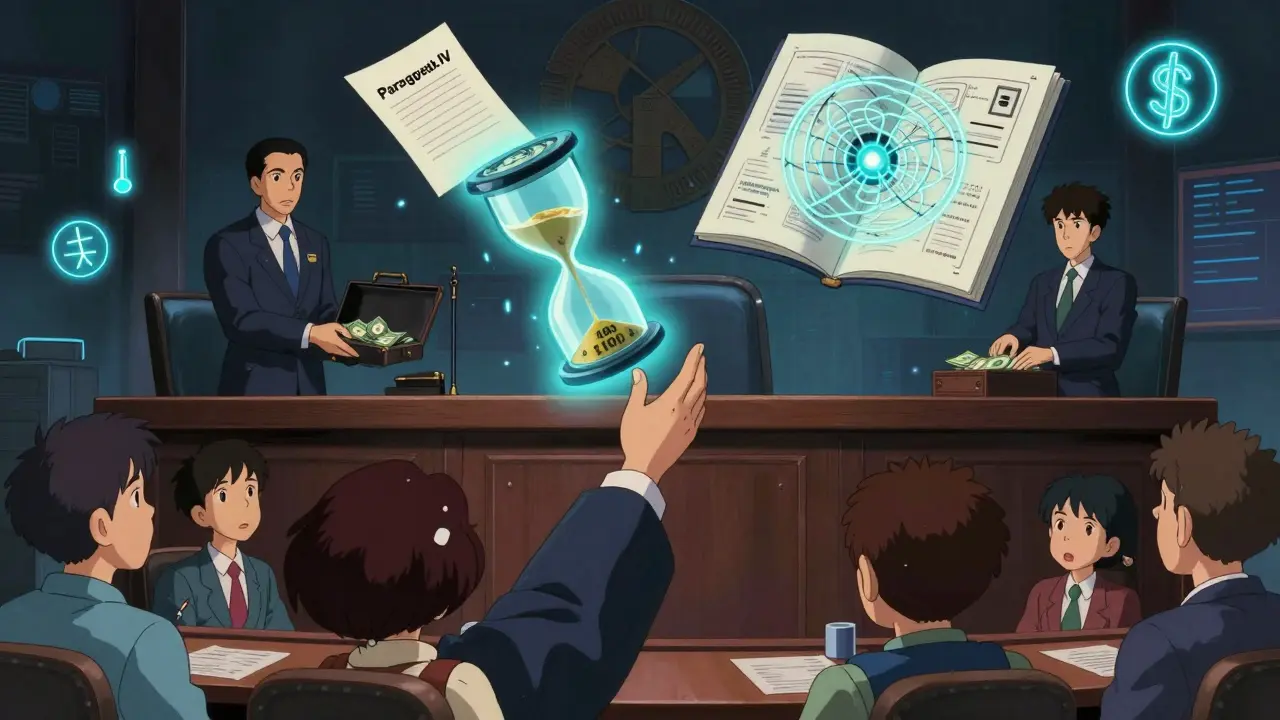
The U.S. has one unique feature that changes everything: the 180-day exclusivity period for the first generic company to successfully challenge a patent. This is part of the Hatch-Waxman Act of 1984. If you file a Paragraph IV certification saying a patent is invalid or won’t be infringed, and you win in court, you get a 6-month head start on the market. No other generics can enter during that time.
It sounds fair-reward the challenger. But it’s led to some strange outcomes. Brand companies sometimes pay the generic maker to delay launch. These "pay-for-delay" deals were common until the Supreme Court ruled them suspicious in 2013 (FTC v. Actavis). Still, they happen. The FTC estimates these deals cost consumers $3.5 billion a year in higher drug prices.
Another quirk: the Orange Book. It’s a public list of patents linked to brand-name drugs. But here’s the problem-some companies list dozens, even hundreds, of patents on minor changes like pill shape, coating, or dosage timing. The average drug now has 142 patents listed, according to Teva’s CEO. Generic makers have to wade through all of them. One failed challenge can delay entry by years.
Europe’s Predictable, But Slower, Path
The EU doesn’t have a Paragraph IV system. No court battles for generics to get a head start. No 180-day reward. Instead, they rely on clear timelines: data exclusivity, then market exclusivity. It’s more predictable, but slower. Generics can’t even file until the data exclusivity period ends. And even after filing, they can’t sell for another 2 years.
That’s why generic entry in Europe often lags behind the U.S. by 12 to 18 months. But it also means fewer legal games. No "patent thicket" of 100+ patents. No pay-for-delay settlements. The system is simpler, but less aggressive in driving down prices fast.
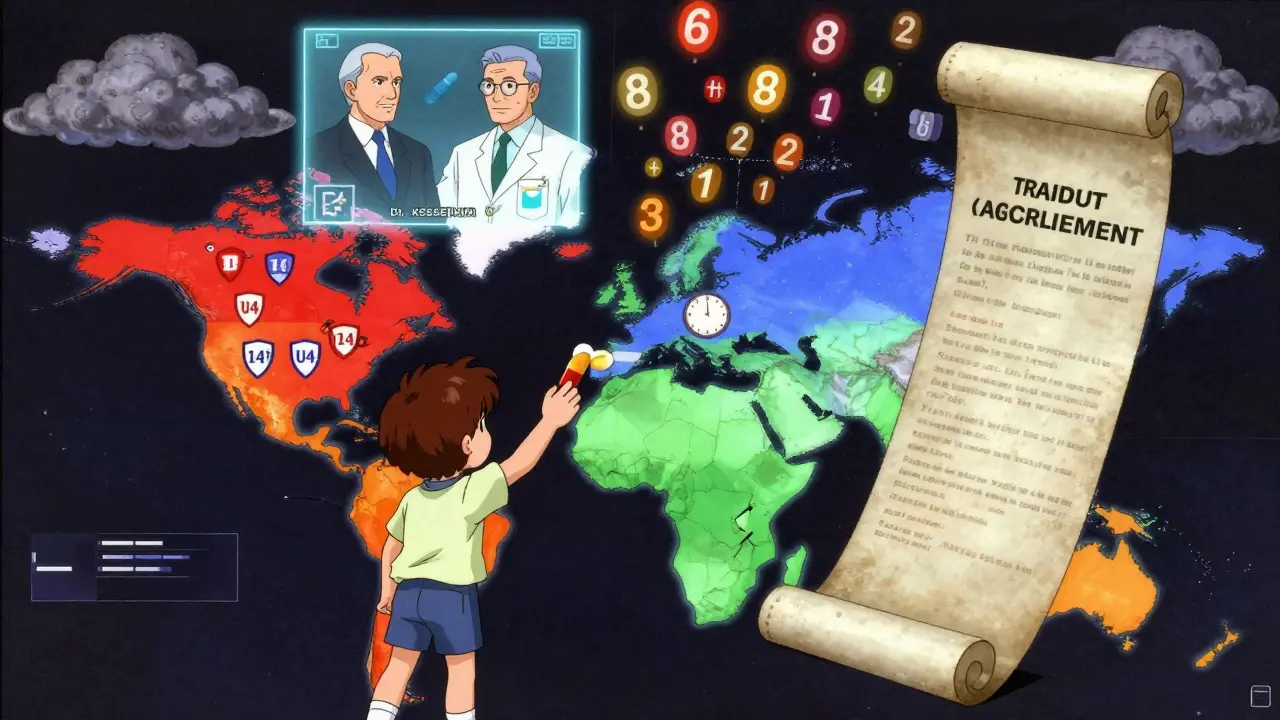
And there’s another layer: trade agreements. The EU has signed deals with countries like Canada and South Africa that include data exclusivity rules stronger than their own laws. In South Africa, this has delayed HIV drug generics by up to 11 years after patents expired, according to Health Action International.
Global Patchwork: How Other Countries Compare
It’s not just the U.S. and EU. Every major market has its own twist.
- Japan: 8 years data exclusivity, 4 years market exclusivity. They’re now trying to speed things up after criticism that generics enter too slowly.
- China: Extended data exclusivity from 6 to 12 years in 2020. A big shift aimed at attracting innovation-but it’s slowing generic access.
- Brazil: 10 years of data protection since 2021. Still catching up to global standards.
- Low-income countries: Many have no data exclusivity laws. But they often lack the infrastructure to produce or distribute generics. WHO reports that essential medicines reach generic status 19.3 years after launch in low-income nations, versus 12.7 years in high-income ones.
What’s clear? The rules aren’t just about science-they’re about power. Countries with strong patent systems and deep legal resources (like the U.S. and EU) can negotiate better terms. Smaller nations often get locked into trade deals that copy Western rules, even if they hurt access.
Who Wins? Who Loses?
On one side, drugmakers argue they need this protection. Merck says its cancer drug Keytruda’s effective market life was stretched from 8.2 to 12.7 years thanks to patent strategy and exclusivity. That extra time, they say, funded future research.
But the flip side is real. Patients wait longer for affordable versions. Pharmacists report that 78% saw delays in generic availability for three or more drugs in 2023. The Multiple Myeloma Research Foundation says orphan drug exclusivity helped bring 12 new treatments since 2003. But Health Action International says the same system blocked HIV drugs in Africa for over a decade.
Experts are split. Dr. Aaron Kesselheim from Harvard says originator companies now pile on an average of 38 extra patents per drug-far beyond what’s needed. Dr. Ellen ‘t Hoen calls data exclusivity in trade deals a "stealth barrier" to medicine access.
Meanwhile, the financial stakes are huge. EY estimates $356 billion in brand drug sales will face generic competition between 2023 and 2028. When generics arrive, prices drop 80-90% in under a year. That’s why companies fight so hard to delay entry.
What’s Changing?
The system is under pressure. In 2023, the U.S. reintroduced the Preserve Access to Affordable Generics and Biosimilars Act-aimed at banning pay-for-delay deals. The EU is proposing to cut data exclusivity from 8 to 5 years for some drugs. Japan’s PMDA is streamlining its patent system to cut delays.
But the core structure isn’t going away. The International Federation of Pharmaceutical Manufacturers & Associations says 97% of its members believe current rules are "essential" for innovation. The question isn’t whether exclusivity should exist-it’s how long, how fair, and who pays the price for it.
How long does patent protection last for generic drugs in the U.S.?
The base patent term is 20 years from filing, but because drug development takes 10-12 years, the effective protection is usually only 6-10 years after approval. The U.S. allows a Patent Term Extension (PTE) of up to 5 years, but the total protected time after approval can’t exceed 14 years. Data exclusivity adds another 5 years for new chemical entities, meaning generics often can’t enter until 10-15 years after launch.
What is the difference between a patent and data exclusivity?
A patent protects the chemical formula or method of making the drug. It’s a legal monopoly enforced by courts. Data exclusivity protects the clinical trial data used to prove safety and effectiveness. Even if the patent expires, no generic can use that data to get approved for a set number of years. You can have data exclusivity without a patent, and vice versa.
Why do some countries delay generic entry even after patents expire?
Many countries, including the EU, Canada, and Brazil, have data exclusivity rules that prevent generic manufacturers from using the original company’s clinical data to get approval-even after patents expire. This creates a legal barrier that can last 8-12 years beyond patent expiry. Trade agreements often lock these rules in place, even in low-income countries that can’t afford to challenge them.
Can a generic drug enter the market before the patent expires?
Yes, but only under specific conditions. In the U.S., a generic company can file a Paragraph IV certification claiming a patent is invalid or won’t be infringed. If they win in court, they get 180 days of exclusivity. In the EU, generics can apply after data exclusivity ends, but can’t sell until market exclusivity expires-even if the patent is gone. No country allows a generic to enter before *all* protections expire.
How do pay-for-delay deals work?
A brand-name drugmaker pays a generic company to delay launching its cheaper version. The payment isn’t for development-it’s to avoid competition. The FTC says these deals cost U.S. consumers $3.5 billion a year. Courts now treat them as potentially anti-competitive, but they still happen, especially when the brand has multiple patents and the generic can’t afford a long legal battle.
Chris Beckman
March 5, 2026 AT 08:02So let me get this straight-patents last 20 years, but by the time the drug’s approved, half that’s already gone? And then they get another 5 years? That’s not fixing a broken clock, that’s gluing the hands in place. I’ve seen prescriptions where the brand version costs $800 a month and the generic’s $12. Why does it take 15 years to get there? It’s not science-it’s greed with a law degree.
Richard Elric5111
March 7, 2026 AT 05:51One must interrogate the epistemological foundations upon which pharmaceutical exclusivity is predicated. The notion that intellectual property rights must be extended beyond their nominal term in order to incentivize innovation presupposes a utilitarian calculus that neglects the moral imperative of equitable access to therapeutic agents. The patent system, as currently constituted, functions not as a catalyst for discovery, but as a rent-seeking apparatus, institutionalized through legislative capture by corporate actors.
Betsy Silverman
March 7, 2026 AT 13:02I work in a pharmacy and see this every day. People skip doses because they can’t afford the brand, even when the generic’s just around the corner. It’s heartbreaking. And the 180-day exclusivity thing? It’s supposed to help, but it just turns into a waiting game where the big companies pay off the first generic to stall. It’s like they’re playing chess with people’s health.
Ivan Viktor
March 8, 2026 AT 11:45So the U.S. has a 180-day head start for generics and Europe doesn’t? Yeah, that explains why my meds are cheaper here. Not that I’m complaining. But let’s be real-this whole system is a circus. One country’s trying to speed things up, the other’s got a 2-year waiting room after approval. Who designed this? A committee of lawyers on espresso?
Zacharia Reda
March 9, 2026 AT 12:15Wait, so if you challenge a patent and win, you get 6 months of no competition? That’s like winning a race and then being given a head start so no one else can even try. Sounds fair until you realize that 6 months is often enough to make back the entire R&D cost. And then the brand company files 142 patents? That’s not innovation-that’s legal spam. Someone needs to audit that Orange Book like it’s a tax return.
Jeff Card
March 9, 2026 AT 18:44I’ve got a friend with multiple myeloma. She got access to a new drug thanks to orphan drug exclusivity-saved her life. But then her insurance wouldn’t cover the generic for another 7 years because of data exclusivity. I get why companies need to make money. But when the same system that helped her also blocked HIV meds in Africa? That’s the real tragedy. It’s not about right or wrong-it’s about who gets to be saved.
Matt Alexander
March 11, 2026 AT 18:05Simple breakdown: Patent = protects the formula. Data exclusivity = protects the clinical trial results. Even if the patent’s expired, no generic can use the original company’s data to get approved. So they have to do their own expensive trials. That’s why generics take longer. It’s not about patents-it’s about paperwork.
Gretchen Rivas
March 11, 2026 AT 18:26China extended data exclusivity to 12 years. That’s a huge shift. It might help innovation, but it’ll hurt access for millions. Trade deals are where this gets scary-low-income countries get forced into rules they can’t afford to challenge. It’s not about health. It’s about power.
Stephen Vassilev
March 13, 2026 AT 16:15Have you considered that the 180-day exclusivity is a Trojan horse? It incentivizes litigation, yes-but it also creates a perverse incentive for generic manufacturers to collude with brand companies, knowing they can be paid to delay entry. The FDA’s Orange Book is a labyrinth of patents on trivial modifications-pill coatings, buffer agents, release profiles. This is not innovation. This is a legal fiction engineered to extend monopolies. And when you add trade agreements that export these rules to nations with no capacity to resist? That’s not policy. That’s colonialism with a FDA stamp.
Mike Dubes
March 15, 2026 AT 04:45Look, I get that drug companies need to make money. I really do. But when a company files 140 patents on a single drug just to keep generics out? That’s not protecting innovation-that’s gaming the system. And don’t even get me started on pay-for-delay. It’s like paying someone not to show up to your birthday party. We need to cut the red tape, not add more. The science is there. Let people get the meds.
Deborah Dennis
March 16, 2026 AT 19:32And yet, nobody talks about how the FDA’s approval process is a joke. Ten years to approve a drug? That’s not science-it’s bureaucracy on a 5-year vacation. If we cut the red tape, generics could hit the market in 3 years. But no, let’s keep the system bloated so Big Pharma can milk it for decades. Pathetic.
Diane Croft
March 18, 2026 AT 18:28It’s not about whether exclusivity should exist-it’s about how long it lasts. We need to find the sweet spot: enough to reward innovation, but not so much that it kills access. There’s a balance. And we’re way off it.
Lebogang kekana
March 20, 2026 AT 12:45In South Africa, we waited 11 years after the HIV patent expired for generics to come in. People died. Not because we didn’t have the money to buy them-but because the trade deals said no. This isn’t economics. It’s a death sentence written in legalese. The world is watching-and we are not silent anymore.
Chris Beckman
March 21, 2026 AT 05:10Wait, you think the FDA’s slow? Try getting a generic approved in a state with 30 different pharmacy boards. I’ve seen pharmacies refuse to switch to generics because of ‘formulary restrictions.’ It’s not the patent-it’s the middlemen. Every step adds a cost. And someone’s always getting paid to keep it that way.