
It’s easy to think that if something is natural, it’s safe-especially when it comes to food, vitamins, or herbal supplements. But the truth is, even a simple apple or a daily multivitamin can turn a life-saving medication into something dangerous-or useless. Drug interactions aren’t just rare side effects. They’re common, often silent, and sometimes deadly. And they happen more often than you think.
How Drug Interactions Really Work
Drug interactions aren’t magic. They’re chemistry. When you take a pill, your body doesn’t just let it do its job. It tries to break it down, move it around, and get rid of it. That process can be messed up by what you eat, drink, or take as a supplement. There are two main ways this happens.First, there’s pharmacodynamic interaction. That’s when two things affect your body in similar or opposite ways. For example, if you take a blood thinner like warfarin and eat a big plate of spinach, the vitamin K in the greens fights against the drug’s effect. Your blood starts clotting again-right when you don’t want it to. Or if you take St. John’s wort for mood and also an SSRI antidepressant, both boost serotonin. Too much serotonin? That’s serotonin syndrome. Shaking, fever, fast heartbeat. Could land you in the ER.
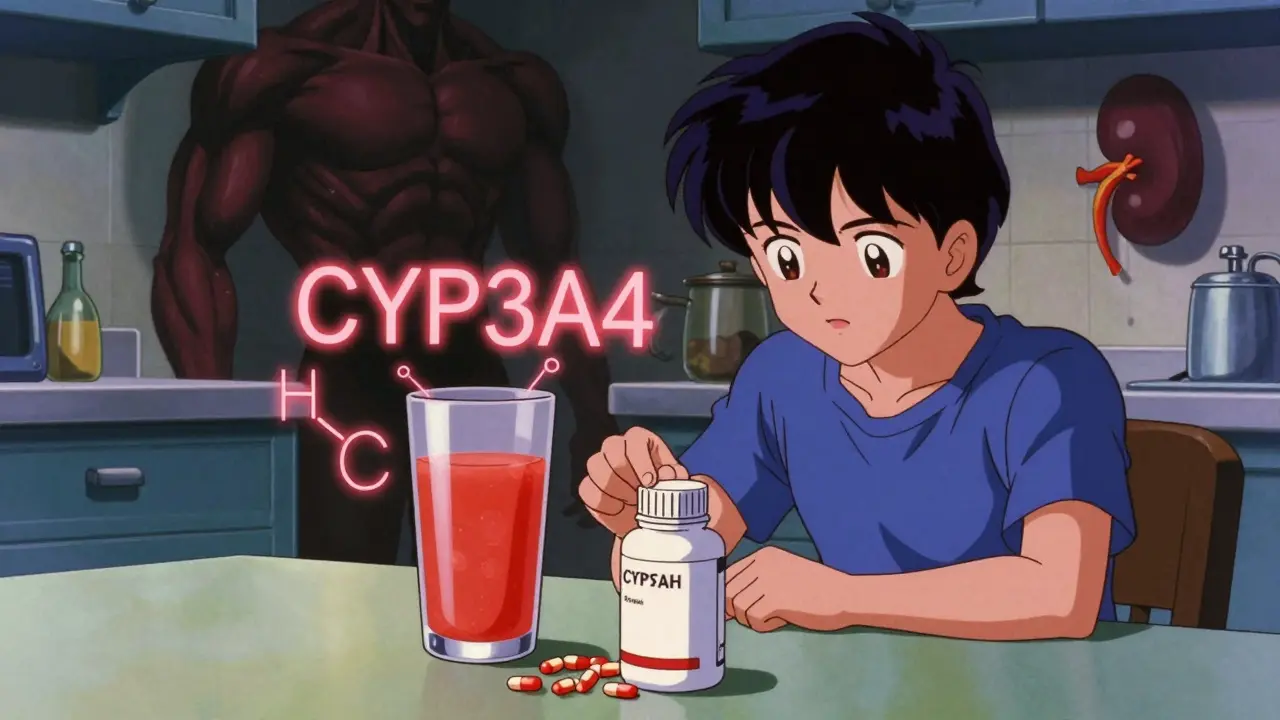
Second, there’s pharmacokinetic interaction. This is about how your body processes the drug. The liver uses enzymes-especially the CYP3A4 system-to break down about half of all prescription medications. Some foods and supplements can shut this system down or turn it on full blast. St. John’s wort is one of the worst offenders. It cranks up CYP3A4 so hard that drugs like cyclosporine (for organ transplants), birth control pills, and even some HIV meds get cleared from your body too fast. In two weeks, your medicine might be working at half strength-or not at all.
The Most Dangerous Foods
You don’t need to give up your favorite foods. But you do need to know which ones can turn your meds into time bombs.Grapefruit is the classic example. It’s not just citrus-it’s a chemical bomb. The furanocoumarins in grapefruit permanently block the CYP3A4 enzyme in your gut. That means drugs like simvastatin (a cholesterol-lowering statin) get absorbed like crazy. One study found grapefruit juice can spike simvastatin levels by up to 15 times. That’s not a little bump. That’s a jump from 0.15 cases of muscle damage per 100,000 people to 1.57. Rhabdomyolysis. Muscle breakdown. Kidney failure. All from a glass of juice.
Then there’s vitamin K. It’s in spinach, kale, broccoli, Brussels sprouts. It’s good for your bones. Bad for warfarin. If you eat a salad one day and nothing green the next, your INR (a blood test that measures clotting) swings like a pendulum. A 2018 study showed that just 150 grams of cooked spinach-a normal serving-could cut warfarin’s effect by 30-40% in 24 hours. That’s not a risk. That’s a red flag.
Green tea? High in vitamin K. Cranberry juice? Documented in 28 case reports to cause dangerous bleeding with warfarin. Even a single glass pushed INR levels above 8.0. Normal is 2.0-3.0. Above 8.0? You’re at risk of internal bleeding. And no, you don’t have to be on warfarin for this to matter. Other blood thinners like apixaban or rivaroxaban aren’t immune either.
Supplements That Can Kill (or Just Make You Sick)
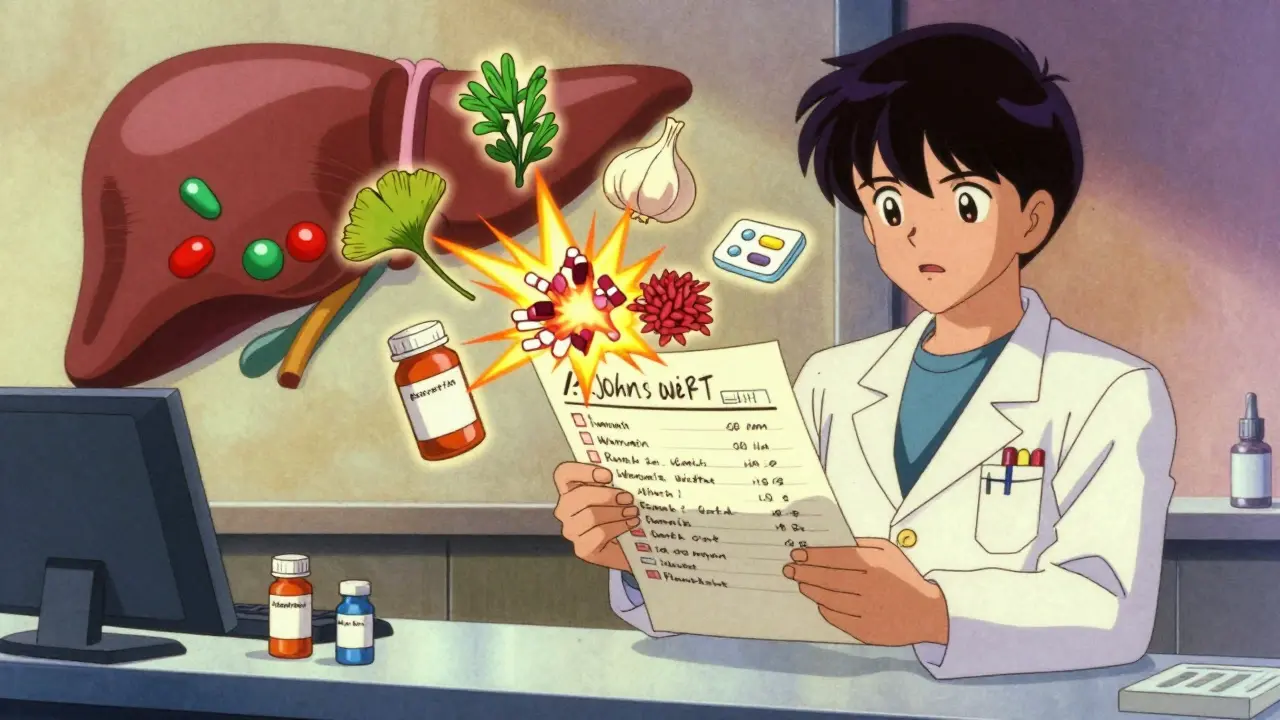
Supplements aren’t regulated like drugs. That means they don’t have to prove safety before they hit the shelf. And they don’t have to warn you about interactions.St. John’s wort? It’s sold as a natural mood booster. But it interacts with over 50% of prescription drugs. It can tank your HIV meds by 40-80%, leading to drug resistance. It can make your birth control fail. It can turn your antidepressant into a serotonin overdose. And it doesn’t just affect one drug-it affects a whole class.
Ginkgo biloba? People take it for memory. But it thins the blood. Combine it with aspirin, clopidogrel, or warfarin, and bleeding risk jumps. One study showed it can increase bleeding time by 30-50%. That’s not a theory. That’s a documented fact. There are real cases of brain bleeds linked to ginkgo and blood thinners.
Garlic supplements? Same story. At least 32 case reports of bleeding when garlic was taken with warfarin or heparin. Not just nosebleeds. Internal bleeding. During surgery. After a fall. Even after a simple tooth extraction.
Red yeast rice? Sounds healthy, right? It’s literally a natural statin. If you’re already taking a prescription statin like atorvastatin, adding red yeast rice is like doubling your dose. No one tells you that. But the risk? A 2.3-fold increase in muscle damage. That’s not a gamble. That’s a guarantee of harm.
Coenzyme Q10? Some take it for heart health. But it might make statins less effective. And if you’re on a statin for a reason, that’s not a trade-off you want to make.
Why No One Talks About This
You’d think doctors would ask. But they rarely do. A 2022 study in JAMA Internal Medicine found that 70% of patients don’t tell their doctor about supplements. Why? Because they think it’s harmless. Or they forget. Or their doctor never asks.Pharmacists are better at catching this. But even they can’t read your mind. If you walk into a pharmacy and say, “I’m on metformin,” and they don’t ask what else you take, you’re at risk. The American Pharmacists Association says pharmacist-led reviews cut adverse events by 22%. That’s huge. But only if you tell them everything.
The FDA says 23% of serious supplement-related hospitalizations between 2013 and 2019 were from interactions. And only 29% of supplement labels even mention possible interactions. Prescription labels? 100%. That’s not a gap. That’s a canyon.
What You Can Do Right Now
You don’t need to become a pharmacist. But you do need to be smart.- Make a list. Write down every pill, capsule, tea, powder, or drop you take. Include over-the-counter meds like ibuprofen or antacids. Include vitamins. Include herbal teas. Update it every time you see a doctor or pharmacist.
- Bring it to every appointment. Don’t assume they’ll ask. Hand them the list. Say, “I want to make sure none of these clash.”
- Check before you buy. Use the FDA’s free drug interaction checker or MedlinePlus. Type in your medication and the supplement. If it says “major interaction,” don’t take it.
- Be consistent. If you’re on warfarin, eat about the same amount of vitamin K every day. Don’t go from spinach salad every day to no greens for a week. Stability beats extremes.
- Ask your pharmacist. They’re the experts. And they’re paid to catch this stuff. If you’re picking up a new prescription, ask: “Is there anything I shouldn’t eat or take with this?”
What’s Being Done
The system is waking up. The FDA is pushing for new rules to test drug interactions with common supplements before approval. The National Institutes of Health is funding 12 clinical trials right now on echinacea, black cohosh, and saw palmetto. AI tools like IBM Watson are scanning millions of medical notes to predict new interactions-87% accurate so far.But the real change? It’s not in labs. It’s in conversations. It’s when a patient says, “I take turmeric for my knees,” and the doctor says, “That’s smart. But you’re on blood pressure meds. Let’s check.”
By 2027, experts estimate that better screening could prevent 300,000 adverse events every year. That’s 300,000 people who won’t end up in the hospital because of a supplement they didn’t think mattered.
Final Thought
Medication safety isn’t about avoiding pills. It’s about understanding how your whole body works-food, drink, herbs, and all. A supplement isn’t a harmless habit. It’s a chemical actor in a complex system. And if you don’t know what it’s doing, you’re playing Russian roulette with your health.Don’t assume. Don’t guess. Don’t hope. Ask. Write it down. Talk to your pharmacist. Your life might depend on it.
Can grapefruit really make my medication dangerous?
Yes. Grapefruit contains chemicals that block an enzyme in your gut (CYP3A4) that breaks down many drugs. This causes the drug to build up in your blood. For statins like simvastatin, levels can spike 15 times higher, raising the risk of muscle damage and kidney failure. Even one glass can have this effect. Other drugs affected include some blood pressure meds, anti-anxiety pills, and immunosuppressants. If you take any prescription drug, check if grapefruit is listed as an interaction.
Are herbal supplements safer than prescription drugs?
No. Herbal supplements are not regulated like prescription drugs. They don’t have to prove safety or effectiveness before being sold. Many contain active chemicals that interact with medications. St. John’s wort, for example, can cut the effectiveness of birth control, HIV meds, and antidepressants. Ginkgo can cause bleeding when taken with blood thinners. Just because something is natural doesn’t mean it’s safe-especially when mixed with other drugs.
Why don’t supplement labels warn about interactions?
Because they don’t have to. Under U.S. law, dietary supplements are treated like food, not drugs. That means manufacturers aren’t required to test for interactions or list warnings. Only 29% of supplement labels include any interaction notice, compared to 100% of prescription labels. This gap leaves patients unaware of serious risks. The FDA is pushing for change, but until then, you need to check interactions yourself.
Can I just stop taking my supplement if I’m on medication?
Not without talking to your doctor. Some supplements, like vitamin D or magnesium, may be necessary for your health. Stopping suddenly could cause other problems. The goal isn’t to eliminate everything-it’s to find safe combinations. For example, if you take warfarin, you don’t need to avoid spinach entirely. Just keep your intake consistent. A pharmacist or doctor can help you adjust safely.
Do all supplements interact with all medications?
No. Most supplements don’t interact with most drugs. But the ones that do can be very dangerous. The risk isn’t in taking supplements-it’s in taking the wrong ones with the wrong meds. For example, vitamin C has very few interactions. But St. John’s wort, ginkgo, garlic, and red yeast rice have well-documented, serious risks. Always check your specific combination, not just assume it’s safe.
What should I do if I think I’m having a drug interaction?
Stop the supplement or food immediately and contact your doctor or pharmacist. If you have symptoms like unexplained bruising, bleeding, chest pain, confusion, muscle pain, fever, or rapid heartbeat, go to the emergency room. These could be signs of serious interactions like bleeding, serotonin syndrome, or muscle breakdown. Don’t wait. Bring your list of everything you’ve taken-prescription, OTC, and supplements.
Is it safe to take supplements if I’m healthy?
If you’re healthy and not taking any medications, most supplements are low-risk. But if you ever start a prescription-like for blood pressure, cholesterol, depression, or infection-you need to re-evaluate. Many people assume supplements are only risky for the sick. That’s false. A healthy person on statins, blood thinners, or antibiotics can still have a dangerous interaction. Always check before starting a supplement, no matter how healthy you feel.
Can my pharmacist check my interactions for free?
Yes. Most pharmacies offer free medication reviews. Bring your list of everything you take-including vitamins, herbs, and over-the-counter drugs. Pharmacists are trained to spot interactions. They use databases that track thousands of combinations. This service can prevent hospitalizations and save you money. Ask for a “medication therapy review.” It’s quick, free, and potentially life-saving.
How often should I update my medication list?
Every time you see a doctor, pharmacist, or start a new medication or supplement. Even if you think it’s minor. A new vitamin, a pain reliever you bought online, a herbal tea you started for sleep-all of it matters. Keep the list on your phone, in your wallet, and on your fridge. Update it weekly if you’re adding or stopping anything. Small habits prevent big emergencies.
Are there any apps or tools I can use to check interactions?
Yes. The FDA’s Drug Interaction Checker and MedlinePlus are free and reliable. You can type in your prescription and supplement, and it will tell you the risk level: minor, moderate, or major. Many pharmacy apps also have built-in interaction checkers. Don’t rely on Google or random websites. Use trusted sources backed by medical data. If the tool says “major interaction,” don’t ignore it.
Chris Bird
March 10, 2026 AT 18:14Man, I thought my turmeric was just helping my knees. Turns out it’s probably messing with my blood pressure med. I’m gonna grab my list tonight and check every damn thing I’m taking. Scary stuff.
Never thought a spice could be this dangerous.
David L. Thomas
March 11, 2026 AT 07:02The CYP3A4 system is the real MVP here. It’s not just grapefruit-it’s the whole damn citrus family, plus St. John’s wort, even some antibiotics. The liver’s got a billion substrates and co-factors, and we’re just throwing random phytochemicals into the mix like it’s a chemistry set. And no one’s regulated? That’s not negligence. That’s systemic abandonment of pharmacovigilance.
We need mandatory interaction labeling. Period.
Mike Winter
March 12, 2026 AT 19:08It’s fascinating how we’ve built a culture where ‘natural’ equals ‘safe’-as if evolution didn’t craft toxins to keep animals from eating certain plants.
St. John’s wort? It’s literally a selective serotonin reuptake inhibitor, just not FDA-approved. We treat herbs like tea, not pharmacology. But chemistry doesn’t care about your intentions. It just reacts.
Shourya Tanay
March 14, 2026 AT 05:16The pharmacokinetic interactions are the silent killers. Most people think side effects come from the drug itself. But no-it’s the body’s metabolism being hijacked. CYP3A4 induction can turn a life-saving transplant med into a useless placebo.
And the worst part? No one tells you. You’re just handed a prescription and told ‘take it daily.’ No conversation. No context. Just a pill and a prayer.
LiV Beau
March 15, 2026 AT 01:10OMG I JUST REALIZED I’VE BEEN DRINKING CRANBERRY JUICE WITH MY WARFARIN 😱
THANK YOU FOR THIS POST!! I’M CALLING MY PHARMACIST TOMORROW!! 🙌❤️
Also, anyone else keep their med list on their fridge? I have a sticky note that says ‘DON’T FORGET THE GINKGO’ and I’m pretty sure it’s been there for 3 years 😅
Denise Jordan
March 16, 2026 AT 08:01So… you’re telling me I can’t have my grapefruit smoothie with my statin? Like, I’m not even on the meds for a reason I care about. Just because my dad had heart issues? I’m fine. I’m 28. I eat kale. I’m gonna ignore this.
Gene Forte
March 18, 2026 AT 07:13This is one of the most important public health messages in decades. Medication safety isn’t about compliance-it’s about awareness. We’ve turned healthcare into a transaction: pill, payment, done.
But the body is an ecosystem. Every herb, every tea, every vitamin is a variable in a complex equation. And we’re treating it like a light switch.
Education-not fear-is the answer. Start with your pharmacist. Ask. Listen. Document.
Kenneth Zieden-Weber
March 18, 2026 AT 18:55So let me get this straight: You’re saying I can’t take my ‘natural energy boost’ with my blood pressure meds?
Bro. That’s just a fancy word for ‘I’m too lazy to sleep.’
Also, if your supplement label doesn’t say ‘may cause death,’ it’s probably fine. I mean, look at the FDA-they’re basically a glorified candy store inspector.
Bridgette Pulliam
March 19, 2026 AT 02:11I’ve been a nurse for 18 years. I’ve seen people come in with bleeding ulcers from ginkgo + aspirin. I’ve seen kidney failure from red yeast rice stacked on simvastatin.
And every time, the patient says, ‘But my cousin takes it and she’s fine.’
It’s not about cousin. It’s about enzyme kinetics. And your cousin? She’s lucky. Not smart.
Randall Walker
March 19, 2026 AT 22:33Why do we even have supplements? If you’re healthy, you don’t need them. If you’re not, you should be under a doctor. So why are we letting people walk into CVS and buy ‘immune boosters’ like they’re buying chips?
It’s capitalism. And it’s killing us. Quietly. Slowly. With no warning label.
Miranda Varn-Harper
March 20, 2026 AT 11:56While I appreciate the technical depth of this post, I must point out that the majority of these ‘dangerous interactions’ are statistically negligible when compared to the harm caused by pharmaceutical monopolies, insurance denials, and physician burnout. We are pathologizing normal human behavior while ignoring systemic failures. The real danger is not St. John’s wort-it is a healthcare system that profits from dependency.
Donnie DeMarco
March 22, 2026 AT 01:39yo so i been takin red yeast rice cause my doc said ‘it’s like a lil statin’ and now i read this and i think i mighta turned my quads into jelly
also i thought ginkgo was for ‘brain fog’ but now i’m scared i’m gonna wake up with a hole in my head
anyone else feel like we’re all just lab rats with grocery lists?
Tom Bolt
March 23, 2026 AT 12:05Let me be clear: This isn’t about supplements. This is about corporate greed. The FDA knows. The pharmaceutical companies know. And they let this happen because if people knew how dangerous their meds were when mixed with anything, they’d stop taking them.
And then? No profits.
So they hide it. They silence it. They make you feel stupid for asking.
Wake up.
You’re being manipulated.
Adam Kleinberg
March 24, 2026 AT 17:50Did you know that 90% of ‘herbal remedies’ are just ground-up plants with no active ingredient? They’re placebo in a bottle. And now you’re terrified of grapefruit? You’re falling for the fear-mongering industrial complex. The real threat? Prescription drug overuse. Not your turmeric latte.
Also, vitamin K? It’s not evil. It’s essential. You’re blaming the messenger.