
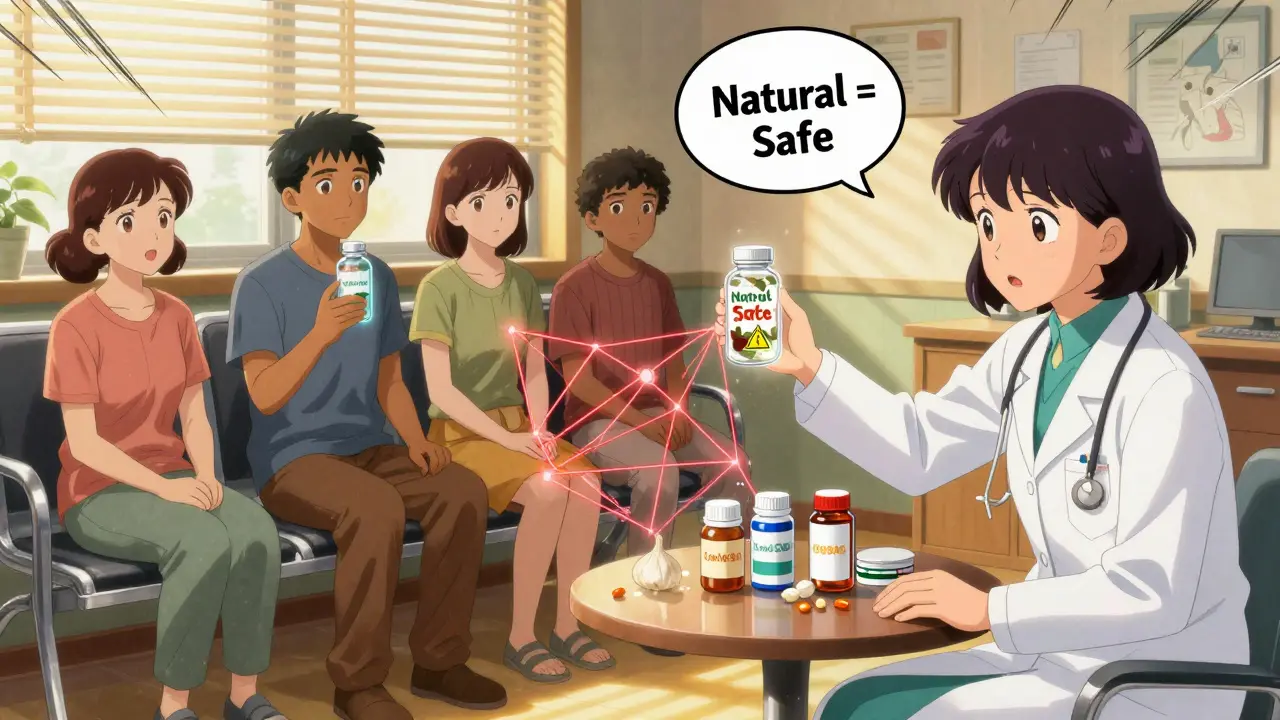
Every year, millions of people in the U.S. take dietary supplements-vitamins, herbs, probiotics, fish oil, or plant extracts-thinking they’re harmless because they’re "natural." But here’s the truth: supplements aren’t safe just because they’re sold on a shelf next to cereal. And if you don’t tell your doctor about them, you could be putting your health at serious risk.
What You’re Taking Might Be Interacting With Your Medications
St. John’s wort, for example, is a popular herbal remedy for mild depression. But it can cut the effectiveness of birth control pills, blood thinners like warfarin, and even some antidepressants by up to 57%. That’s not a rumor. That’s from a 2021 review in Drug Metabolism Reviews. People take it because they trust "natural" labels. They don’t realize their pharmacist doesn’t know they’re taking it-and their doctor might not either. Ginkgo biloba? Often used for memory or circulation. But it can thin your blood. If you’re on aspirin or clopidogrel, combining it with ginkgo can lead to dangerous bleeding. A case study in the AMA Journal of Ethics described a patient who ended up in the ER after combining ginkgo with warfarin. He didn’t think his doctor needed to know about "natural" stuff. He was wrong. Even something as common as garlic supplements can interfere with HIV medications. Glucosamine and chondroitin? They might affect blood sugar levels in people with diabetes. Echinacea? It can mess with immune-suppressing drugs after organ transplants. These aren’t edge cases. These are documented, repeatable interactions.Why Don’t People Tell Their Doctors?
The numbers are shocking. Only 33% of people who take herbal or dietary supplements tell their conventional healthcare provider. That’s according to a 2019 study in the Journal of Family Medicine and Disease Prevention. Even worse: among people with chronic conditions like high blood pressure or diabetes-people who are most at risk-only 51% disclose their supplement use. Why? Several reasons. Many believe supplements aren’t "real medicine," so they don’t count. Others fear being judged. "My doctor rolled her eyes when I mentioned turmeric," one patient told a Reddit thread in 2023. Another said, "I didn’t want to sound like one of those people who think essential oils cure cancer." Then there’s the provider side. Most doctors aren’t trained to ask. Medical students get less than three hours of formal education on supplements during their entire four-year program. A 2023 study in Academic Medicine confirmed it. So if your doctor doesn’t ask, you assume it’s not important.What Happens When You Don’t Disclose
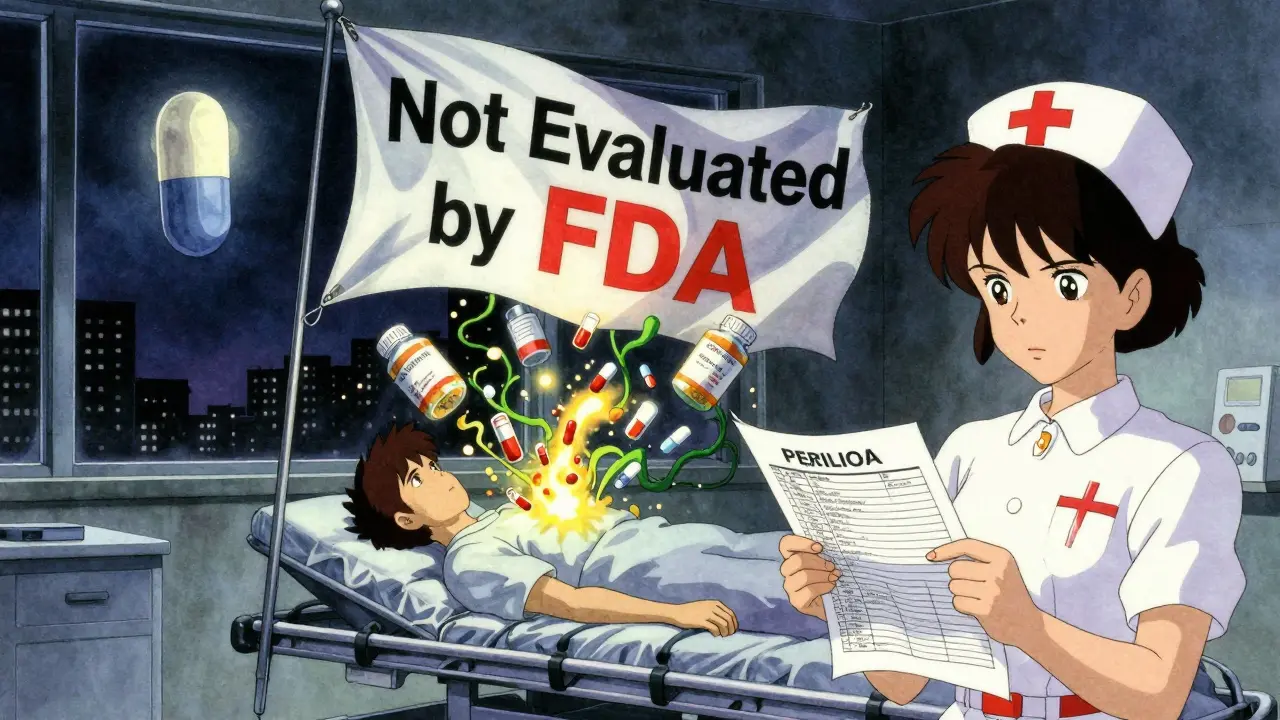
It’s not just about interactions. It’s about missing the full picture. Imagine you’re on a beta-blocker for heart rhythm. You start taking CoQ10 because you read it helps heart health. You feel better-so you don’t mention it. Your doctor increases your beta-blocker dose, thinking your condition is worsening. But the real reason you felt better? The CoQ10. Now you’re on too much medication. Side effects kick in: dizziness, fatigue, low blood pressure. You go back to the ER. They don’t know why. You didn’t tell them about the supplement. That’s not hypothetical. That’s the kind of scenario that leads to 23,000 emergency room visits every year in the U.S. because of dietary supplements, according to a 2015 JAMA study. And here’s the kicker: the FDA doesn’t approve supplements before they hit the market. Under the Dietary Supplement Health and Education Act (DSHEA) of 1994, companies don’t need to prove safety or effectiveness. They just need to slap on a disclaimer: "This product is not intended to diagnose, treat, cure, or prevent any disease." That’s it. No testing. No oversight. No accountability until something goes wrong.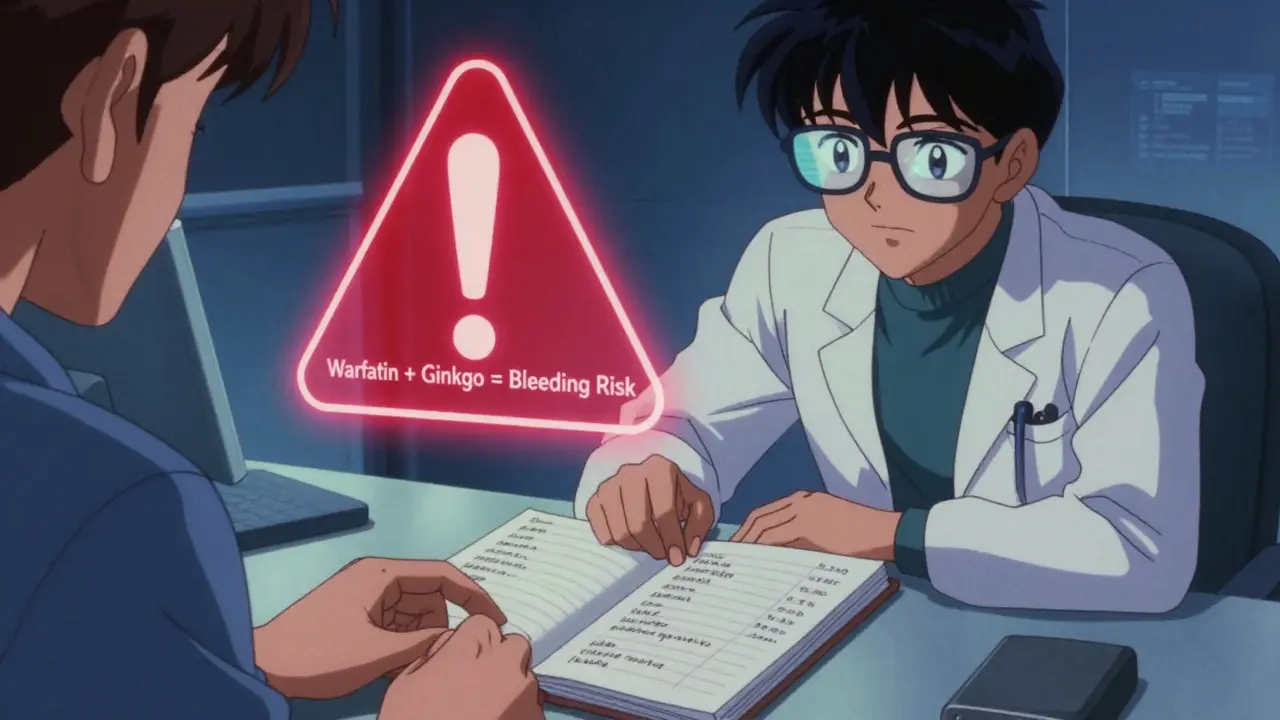
What You Should Do
You don’t need to stop taking supplements. But you do need to talk about them-openly and honestly. Start by making a list. Write down:- The exact name (e.g., "Panax ginseng," not just "ginseng")
- The dosage (e.g., 500 mg, twice daily)
- The reason you take it
- How long you’ve been taking it
How Providers Are Starting to Change
Change is slow-but it’s happening. The American Hospital Association now requires supplement screening during hospital admissions in 87% of its member hospitals. Epic Systems, the biggest electronic health record platform, is rolling out a new supplement module in mid-2024 that will automatically flag dangerous interactions with 1,200 common supplements. Some clinics are using a simple three-step approach that’s already boosted disclosure rates from 28% to 67%:- Ask open-ended questions: "What supplements or natural products are you using to manage your health?"
- Document them like prescriptions-in the same section of your chart.
- Give patients a printed supplement log to fill out before each visit.
What to Look for on Labels
Not all supplements are created equal. Look for:- A "Supplement Facts" panel-this is required by law.
- The exact botanical name (e.g., "Valeriana officinalis," not just "valerian root").
- The FDA disclaimer: "This statement has not been evaluated by the Food and Drug Administration. This product is not intended to diagnose, treat, cure, or prevent any disease."
Where to Get Reliable Info
The National Institutes of Health’s Office of Dietary Supplements has a free, science-backed database. So does the Natural Medicine Database, used by hospitals and pharmacists to check interactions. You don’t need to be an expert. Just type in the supplement name and your medication-and see if there’s a warning. And remember: just because something is sold in a health food store doesn’t mean it’s safe. Just because it’s organic doesn’t mean it won’t interact with your prescription. "Natural" doesn’t mean harmless.Final Thought: Your Safety Is Your Responsibility
You wouldn’t hide a new prescription from your doctor. Don’t hide your supplements either. They’re medicine, even if they’re not wrapped in a blister pack. Your care team can’t help you if they don’t know what you’re taking. And the stakes are higher than you think. A 2022 editorial in JAMA Internal Medicine called the failure to disclose supplement use "one of the most significant yet underrecognized patient safety issues in modern medicine." You’re not being dramatic. You’re being smart.Do I really need to tell my doctor about vitamins and supplements?
Yes. Even common ones like vitamin D, fish oil, or garlic pills can interfere with medications. For example, vitamin K can reduce the effect of blood thinners like warfarin. St. John’s wort can make birth control, antidepressants, or HIV drugs stop working. Your doctor can’t protect you from interactions if they don’t know what you’re taking.
What if my doctor says supplements aren’t important?
Some providers still dismiss supplements because they weren’t trained on them. But you have the right to be heard. Say: "I’ve read that these can interact with my meds, and I’d like to be safe." If they still won’t listen, ask for a referral to a pharmacist or integrative medicine specialist. Your health is worth advocating for.
Are natural products always safer than prescription drugs?
No. Just because something is "natural" doesn’t mean it’s safe. Many prescription drugs come from plants-like morphine from poppies or aspirin from willow bark. The difference is, pharmaceuticals are tested for safety, dosage, and interactions. Supplements aren’t. A 2022 FDA report found that 1 in 4 supplements tested contained unlisted drugs or toxic contaminants.
Can supplements cause liver damage?
Yes. Green tea extract, weight-loss supplements containing usnic acid, and certain herbal blends have been linked to acute liver injury. The FDA’s adverse event database received over 16,000 supplement-related reports in 2022-a 32% increase since 2019. Most cases involved people who didn’t tell their doctors what they were taking.
How do I know if a supplement brand is trustworthy?
Look for third-party seals like USP, NSF International, or ConsumerLab. These organizations test products for purity, strength, and contamination. They don’t guarantee effectiveness, but they do confirm the label matches what’s inside. Avoid brands that make miracle claims or don’t list ingredients clearly.
Should I stop taking supplements before surgery?
Yes. Many supplements-like ginkgo, garlic, ginger, and high-dose vitamin E-can increase bleeding risk. Others, like kava or valerian, can interfere with anesthesia. Always tell your surgeon and anesthesiologist about everything you take, even if you think it’s harmless. Most recommend stopping all supplements 1-2 weeks before surgery.
Colin Pierce
January 28, 2026 AT 07:40I used to think fish oil and vitamin D were harmless. Then I got my INR sky-high after starting them while on warfarin. My cardiologist had to adjust my dose twice. Now I bring my supplement list to every appointment-no shame. It’s not about being paranoid, it’s about being smart.
Kevin Kennett
January 29, 2026 AT 00:58Look, I get it-people think ‘natural’ = safe. But if you’re popping ginkgo while on blood thinners, you’re playing Russian roulette with your brain. And yeah, doctors don’t ask enough. But that’s on us too. If you’re not volunteering this info, you’re complicit in your own risk. Stop being lazy. Your life isn’t a TikTok trend.
Jess Bevis
January 29, 2026 AT 17:16St. John’s wort + birth control = bad. Plain.
Howard Esakov
January 30, 2026 AT 11:40Oh wow, a *medical article* that actually makes sense? 🤯 I’m shocked. I mean, I’ve been telling my friends for years that ‘natural’ is just a marketing ploy designed to exploit the gullible. 🧠💊 And if your doc doesn’t know about your ‘herbal cocktails,’ you’re basically self-administering a clinical trial. 😏
Kathy Scaman
January 31, 2026 AT 08:42I started taking turmeric after my knee surgery and told my PT about it. She was like, ‘Oh cool, that’s actually legit for inflammation!’ But then I asked my primary if it’d mess with my blood pressure med and she was like, ‘Huh, good you asked.’ So yeah-just say it. No big deal.
Anna Lou Chen
February 1, 2026 AT 02:55The entire paradigm of biomedicine is predicated on a Cartesian reductionism that pathologizes embodied wisdom-yet here we are, pathologizing the very epistemologies that predate pharmaceutical capitalism. 🌿 The ‘supplement’ is not an object, but a rupture in the hegemony of institutionalized pharmacopoeia. You’re not just taking ashwagandha-you’re resisting the biopolitical apparatus that commodifies healing. But also, yeah, check for CYP450 interactions. 🤓
Lance Long
February 2, 2026 AT 13:08Hey, I know it’s scary to bring up supplements with your doctor. I used to feel the same way-like I’d sound like a woo-woo. But once I started saying, ‘I’m taking this because I think it helps, and I want to make sure it’s safe,’ the tone changed. They actually listened. You’re not annoying. You’re being responsible. Keep going.
fiona vaz
February 4, 2026 AT 05:47I’ve been a nurse for 18 years. I’ve seen people end up in the ER because they didn’t mention their garlic pills. I’ve also seen people avoid meds because they thought ‘natural’ was better. Both are dangerous. Just tell your provider. It’s not judgment-it’s teamwork.
Sue Latham
February 4, 2026 AT 15:54Oh my god, I knew it. People are so clueless. I had a friend take kava for anxiety and then got hospitalized because it messed with her liver and her antipsychotic. She didn’t tell her psychiatrist because she thought he’d laugh. He didn’t laugh. He looked at her like she’d just admitted to feeding her cat Xanax. 🙄
John Rose
February 4, 2026 AT 18:38This post is an excellent summary of a systemic issue in healthcare. The disconnect between patient behavior and provider training is alarming. I’d like to see standardized screening protocols integrated into EHRs across all primary care practices. The data supporting harm from undisclosed supplement use is robust and reproducible. Transparency is not optional-it’s clinical best practice.
Lexi Karuzis
February 5, 2026 AT 13:20Mark Alan
February 6, 2026 AT 12:33USA BEST! We don’t need no fancy European rules! Supplements are freedom! 🇺🇸🔥 If your body can’t handle a little green tea extract, maybe you’re just weak. Also, my cousin’s cousin’s dog got cured of cancer with CBD oil and a crystal. So there. 🤘
matthew martin
February 8, 2026 AT 11:20My grandma takes 12 different things-turmeric, magnesium, elderberry, omega-3s, a ‘detox tea’ she buys off Instagram. I made her a little card with names, doses, and why she takes each. She brings it to her appointments now. She says the nurse actually smiled and said, ‘Finally, someone who knows what they’re on.’ Sometimes the simplest fix is the most powerful.
Jeffrey Carroll
February 8, 2026 AT 19:51While the article presents compelling evidence regarding supplement-drug interactions, it would benefit from a more nuanced discussion of regulatory disparities between countries. For instance, the European Medicines Agency maintains a more rigorous framework for botanical medicinal products under Directive 2004/24/EC. The U.S. approach under DSHEA remains uniquely permissive, and this structural difference warrants deeper contextual analysis in public health discourse.