
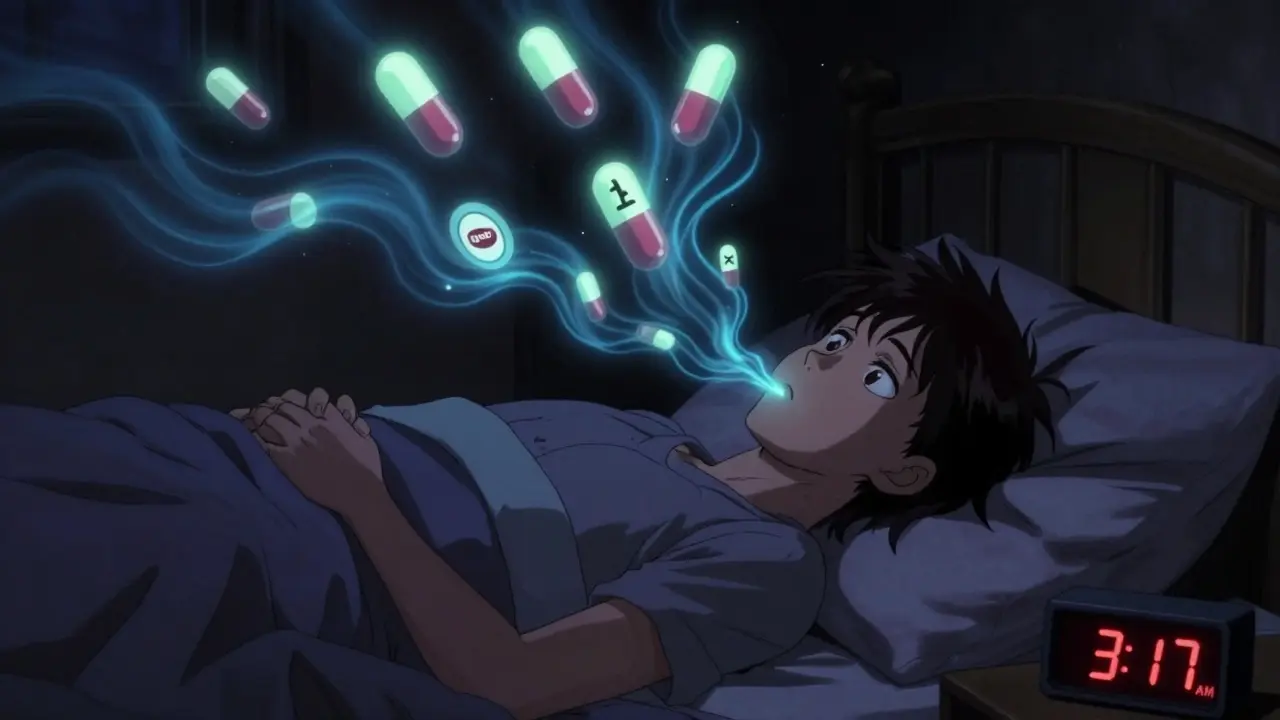
Putting together multiple sedating medications might seem like a quick fix for insomnia, anxiety, or chronic pain-but it’s one of the most dangerous things people do without realizing it. Every year, over 1.3 million emergency room visits in the U.S. are tied to bad drug combinations, and nearly 128,000 deaths come from prescription drug interactions. The problem isn’t rare. It’s common, silent, and often ignored until it’s too late.
Why Mixing Sedatives Is More Dangerous Than You Think
When you take one sedating drug-like an opioid for pain or a benzodiazepine for anxiety-it slows down your brain. Add another, and instead of doubling the effect, you get something worse: a synergistic crash. That means the combined impact isn’t just 1 + 1 = 2. It’s more like 1 + 1 = 5.
This happens because most sedatives work on the same brain chemical: GABA. GABA tells your brain to chill out. Opioids, benzodiazepines, sleep aids like Ambien, and even alcohol all crank up GABA’s effect. When you mix them, your brain gets overwhelmed. It stops sending signals to keep you breathing. That’s when things go deadly.
Research from JAMA Internal Medicine found that people taking both opioids and benzodiazepines had a 154% higher risk of overdose than those taking opioids alone. The odds of dying? Jumped to more than 2.5 times higher. In 2020, 16% of opioid overdose deaths also involved benzodiazepines. These aren’t rare cases. They’re predictable.
The Most Dangerous Combinations
Not all drug mixes are equal. Some are far deadlier than others.
- Opioids + Benzodiazepines: This is the deadliest combo. It shuts down your breathing center in the brainstem. UCLA Health says this pair is behind 30% of all prescription drug deaths. The FDA issued its first warning on this in 2016-and still, millions of people get both prescribed.
- Alcohol + Sleep Medications: A single glass of wine with Ambien can cut your reaction time by 70%. That’s not just drowsiness. That’s being half-asleep while standing up. It’s why so many falls, car crashes, and unexplained injuries happen at night.
- SSRIs + MAOIs: These aren’t sedatives, but they’re often mixed by accident. Together, they can trigger serotonin syndrome-a condition where your brain gets flooded with serotonin. Symptoms? Shaking, high fever, confusion, seizures. It kills in hours if untreated.
Even over-the-counter stuff can be risky. Cold medicines with diphenhydramine (like Benadryl), herbal sleep aids like valerian, or even some antihistamines can add up. People don’t think of them as drugs-but they’re CNS depressants too.
Warning Signs You Can’t Ignore
Most overdoses don’t happen suddenly. They creep in. You start feeling “off,” but you chalk it up to stress or aging. Here’s what to watch for:
- Shallow or slow breathing-fewer than 12 breaths per minute
- Blue lips or fingertips-a sign your body isn’t getting enough oxygen
- Unresponsiveness-you can’t wake someone up with their name, a shake, or a loud noise
- Gurgling sounds-like they’re drowning in their own saliva
- Confusion or extreme drowsiness-not just tired, but unable to stay awake or answer simple questions
If you see even one of these in yourself or someone else, call 999 immediately. Don’t wait. Don’t hope it passes. This isn’t a bad night’s sleep. This is respiratory failure.
Who’s Most at Risk-and Why
Older adults are hit hardest. The American Geriatrics Society’s Beers Criteria lists 19 dangerous sedative combinations to avoid in people over 65. Why? Their bodies process drugs slower. Their brains are more sensitive. And they’re more likely to be on multiple prescriptions.
But it’s not just seniors. People with chronic pain, anxiety, or PTSD often get prescribed opioids, benzodiazepines, and sleep aids all at once. A 2022 study found that 42% of patients who overdosed on sedative combinations had gotten prescriptions from three or more doctors in six months. That’s “doctor shopping”-not always intentional. Sometimes, they just forgot they’d been given the same drug twice.
Women are more likely to be prescribed these drugs. In fact, 41% of older women take potentially dangerous sedatives compared to 27% of men. Why? Anxiety and insomnia are more commonly diagnosed in women-and doctors still reach for pills before exploring alternatives.
Why Doctors Miss the Signs
It’s not just patients. The system is broken.
Electronic health records should flag dangerous combinations. But a 2020 study in JAMA Network Open found that only 17.3% of dangerous drug pairs triggered alerts in major systems. That means 8 out of 10 risky mixes fly under the radar.
Doctors aren’t trained to think in terms of cumulative sedation. There’s no standard way to measure how much “sedative load” a patient has. One doctor prescribes an opioid. Another prescribes a muscle relaxant. A third gives a sleep aid. None of them see the full picture.
And when patients don’t tell their doctor about OTC meds, supplements, or alcohol use-because they don’t think it matters-the risk goes unnoticed.
What You Can Do to Stay Safe
Here’s the practical stuff: what to ask, what to track, and what to demand.
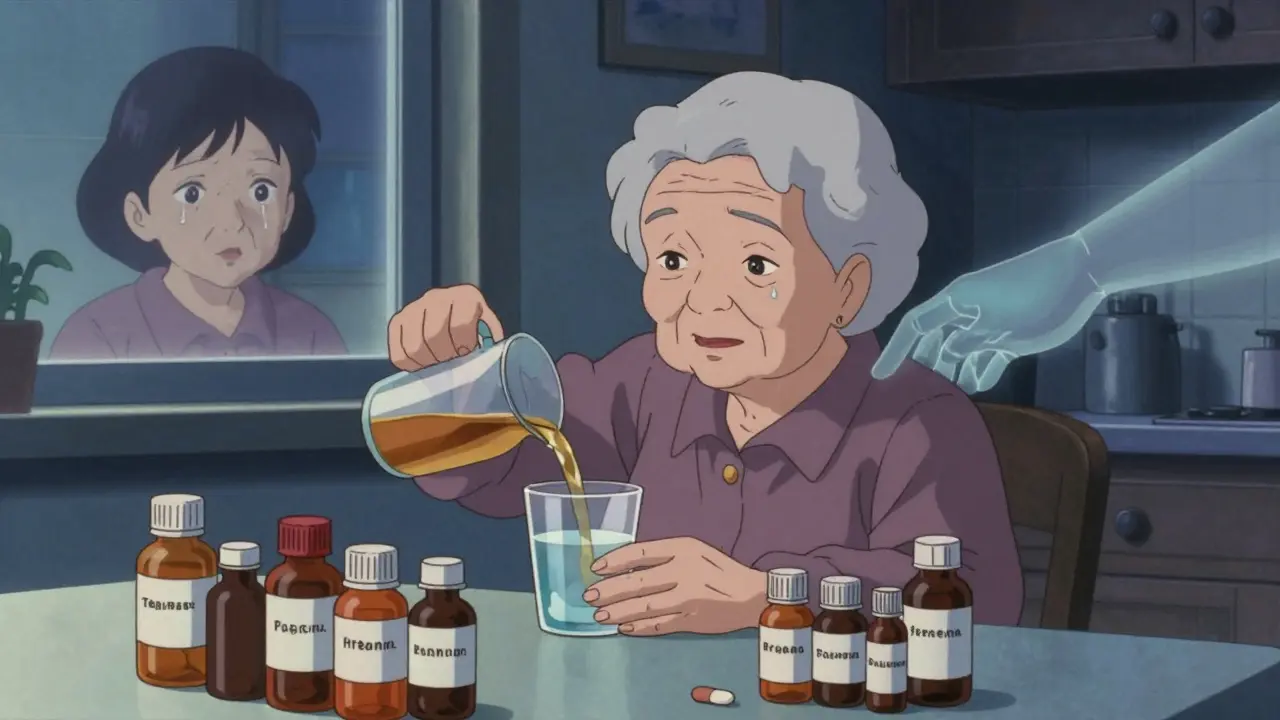
- Keep a full medication list-including every pill, patch, supplement, and even cough syrup. Bring it to every appointment.
- Ask: “Is this the only way to treat this?” For anxiety, is there therapy? For sleep, is there CBT-I? For pain, could physical therapy help?
- Know your morphine milligram equivalents (MME). If your opioid dose is above 50 MME per day, the CDC says your overdose risk doubles. Ask your pharmacist to calculate it.
- Never mix alcohol with any sedative. Not even “just one drink.”
- Get a medication review every 3 months if you’re over 65 or on three or more sedating drugs. The START criteria says you need one.
- Use one pharmacy. It helps them catch duplicates and interactions.
If you’re on a combination that’s been working for years-don’t quit cold turkey. Talk to your doctor about tapering. Reduce one drug at a time. Cut by 10-25% every 1-2 weeks. Do it slowly. Do it with support.
The Road Ahead
There’s hope. The FDA now requires boxed warnings on all opioid and benzodiazepine packages. All 50 states now require electronic prescriptions for controlled substances, which include automatic checks for dangerous pairs. The NIH is investing $127 million to develop genetic tests that can predict who’s most vulnerable to sedative overdose.
But technology won’t fix this alone. Real change needs patients to speak up, doctors to listen, and systems to stop treating drugs as separate problems. A pill for pain. A pill for sleep. A pill for anxiety. They’re not separate. They’re layers of the same risk.
Every time you take a sedative, ask: Do I really need this? And what else am I taking that could make it deadly?
Can you die from mixing just two sedating medications?
Yes. Even two sedating medications can be fatal. The combination of opioids and benzodiazepines, for example, can suppress breathing to the point of death-even at normal prescribed doses. The risk isn’t about how many pills you take, but how they interact. One opioid and one benzodiazepine is enough to cause respiratory arrest, especially in older adults or people with lung conditions.
Are over-the-counter sleep aids safe to mix with prescription drugs?
No. Many OTC sleep aids like diphenhydramine (Benadryl, ZzzQuil) or doxylamine (Unisom) are CNS depressants. Mixing them with prescription sleep medications, anti-anxiety drugs, or painkillers can cause dangerous sedation. People often think “natural” or “non-prescription” means safe-but that’s not true. These can add up just like prescription drugs.
Why do some people feel fine mixing sedatives while others overdose?
It depends on age, weight, liver function, genetics, and how long they’ve been taking the drugs. Older adults, people with liver disease, or those with certain gene variants (like CYP2D6 or CYP3A4) process drugs slower. That means even small doses build up. Also, tolerance varies-someone who’s been on these drugs for years may not feel the effect as strongly, but their body still can’t handle the combined toxicity. That’s why overdoses can happen unexpectedly.
Is it safe to combine sedatives if a doctor prescribed them?
Not necessarily. Just because a doctor prescribed it doesn’t mean it’s safe. Many dangerous combinations are still prescribed because doctors aren’t always aware of the full interaction risk. The FDA and CDC recommend avoiding opioid-benzodiazepine combinations unless absolutely necessary-and even then, with close monitoring. Always ask: “Why this combo? Is there a safer alternative?”
What should I do if I suspect someone is overdosing on sedatives?
Call 999 immediately. Don’t wait. Try to keep them awake and in a side-lying position to prevent choking. If they’re not breathing, start CPR if you’re trained. Naloxone (Narcan) can reverse opioid overdoses but won’t work on benzodiazepines or alcohol. Emergency responders will need to know exactly what drugs were taken. If possible, bring the pill bottles.
Can I stop taking sedatives on my own if I’m worried about the risks?
No. Stopping sedatives suddenly-especially benzodiazepines or opioids-can cause seizures, severe anxiety, or life-threatening withdrawal. If you’re concerned, talk to your doctor about a safe tapering plan. Reduce one drug at a time, slowly, under supervision. Never stop cold turkey.
Prateek Nalwaya
February 18, 2026 AT 17:24Man, this post hit me right in the gut. I’ve seen friends go from ‘just trying to sleep’ to full-blown polypharmacy nightmares-no one ever warned them it wasn’t just ‘taking a little something’ but stacking dynamite.
One guy was on oxycodone, Xanax, and nightly Benadryl because ‘it helps me dream.’ He didn’t even realize his wife had to nudge him awake every morning. That’s not laziness. That’s chemical suffocation.
And yeah, the GABA synergy thing? That’s the silent killer. It’s not about dosage-it’s about how your brain just… gives up. Like a server overload with no crash log.
I’m not even scared of opioids alone anymore. It’s the combo platters that get people. Like ordering fries, soda, and dessert and then wondering why you can’t breathe.
Also, why do we still let doctors prescribe this like it’s a menu? ‘Would you like your anxiety pill with a side of sleep aid and painkiller?’ No. Just… no.
People think ‘natural’ means safe. Valerian root? It’s a GABA booster. So is kava. So is alcohol. So is that ‘chill’ CBD tincture you bought online.
We need a red flag system that screams when you’re hitting 3+ CNS depressants. Not a pop-up. A siren.
And why isn’t every pharmacy automatically checking interactions? We have AI that recommends cat food based on fur color-but can’t flag a lethal combo?
Also, why are women still getting these scripts more? Not because they’re more anxious. Because we’ve been taught to medicate feelings instead of fixing environments.
Let’s stop normalizing this. It’s not self-care. It’s self-erasure.
Agnes Miller
February 20, 2026 AT 00:25thank you for this i’ve been scared to say anything bc i’m on 3 of these and i thought i was fine… but now i’m gonna call my dr and ask for a med review. i didn’t know about the 19 combos for over 65. scary stuff.
Geoff Forbes
February 20, 2026 AT 05:56Oh please. Another fearmongering article from the medical industrial complex. You people act like any combination is a death sentence. My uncle took lorazepam and hydrocodone for 12 years and he’s 82 and still golfing. People die from bad decisions not from prescriptions. Also, why are you blaming doctors? Patients lie about alcohol use ALL THE TIME. It’s not the system’s fault it’s yours.
Jonathan Ruth
February 21, 2026 AT 00:56Let’s be real here. This isn’t about medicine. This is about control. The FDA wants you dependent on their system. They don’t want you weaning off. They want you on a treadmill of prescriptions so they can bill insurance. The ‘1.3 million ER visits’ stat? That’s inflated. It includes people who took 10 benzos and went to the ER because they were bored. The real danger is people who don’t know their own body. Stop infantilizing adults. You want safety? Learn your pharmacology. Don’t rely on a doctor who spends 7 minutes with you.
Philip Blankenship
February 22, 2026 AT 02:04Hey I just wanted to say this post really made me pause. I’ve been on a low dose of trazodone and melatonin for years, never thought twice about it. But then I read the part about alcohol and sleep meds cutting reaction time by 70% and I went, ‘huh… I do that.’
Like last week I had a glass of wine after my night pill and I woke up in the kitchen at 3am with no memory of walking there. Didn’t even fall. Just… wandered.
So I cut out the wine. Not because I’m scared-I’m chill-but because I realized I wasn’t fully present anymore. And that’s not peace. That’s autopilot.
Also, I started keeping a list. Paper list. In my wallet. I’m 42, not 80, but I’ve got 4 meds that could theoretically team up and ghost me. So now I show it to every doc. Even the dermatologist. He laughed. Then he asked if I’d ever tried light therapy for sleep.
Turns out he’s into that stuff. Who knew?
Anyway. Just saying: it’s not about fear. It’s about awareness. And sometimes awareness is just noticing you’re not really sleeping. You’re just… paused.
Oliver Calvert
February 23, 2026 AT 23:15One pharmacy rule is critical. I’ve seen patients get the same drug from two different doctors because they used different pharmacies. It happens all the time. Also, morphine milligram equivalents-most people don’t even know what that means. Ask your pharmacist. They’ll calculate it for free. No judgment. Just facts.
Kancharla Pavan
February 25, 2026 AT 09:25How is this even allowed? People are dying because we let weak-minded individuals self-medicate like children. You don’t need a PhD to understand that mixing sedatives is suicide with a prescription. And yet we have doctors who still write these combos like it’s a grocery list. The real tragedy is not the overdose-it’s the lack of moral backbone in our society. We prioritize comfort over courage. We medicate grief instead of facing it. We numb pain instead of healing it. This isn’t medicine. It’s spiritual laziness dressed in white coats. And until we stop treating the body like a machine and start treating the soul like a temple, this will keep happening. No more excuses. No more ‘it’s just one more pill.’ One more pill is one more step toward the grave.
PRITAM BIJAPUR
February 26, 2026 AT 01:18Peace. 🙏
Just read this and felt something shift inside.
It’s not about the drugs. It’s about the silence. The silence between doctor and patient. The silence when you don’t tell your mom you’re taking Ambien because ‘she’d worry.’ The silence when you drink because ‘one glass helps me sleep.’
We’ve turned healing into a transaction. Take pill. Feel better. Repeat.
But what if the real medicine is a walk at dawn? A conversation that lasts 3 hours? A therapist who doesn’t rush? A yoga mat gathering dust because ‘I don’t have time’?
These aren’t alternatives. They’re ancestors whispering: ‘You were never meant to be this tired.’
I’m not quitting my meds tomorrow. But I’m starting a journal. One line a day. ‘What did I feel today that I numbed?’
Maybe that’s the real overdose. Not the chemicals. The disconnection.
Dennis Santarinala
February 27, 2026 AT 13:34This is so important. I’ve been telling my mom for years to stop mixing her sleep aid with her blood pressure med. She says ‘it’s just melatonin’-but melatonin + beta-blocker = nightmare fuel. She’s 71. I’m so glad this article exists. I’m printing it out and putting it on her fridge next to the pill organizer. And I’m finally asking my own doctor: ‘Can we trim the list?’ I’ve got 5 sedating meds. I didn’t even realize. Thank you for not sugarcoating this. We need more of this.
Tony Shuman
February 28, 2026 AT 09:28Typical left-wing panic. They want you scared of everything. What about personal responsibility? If you’re stupid enough to mix alcohol with Xanax, you deserve what you get. Also, why are we blaming doctors? They’re just following guidelines. The real problem? The FDA and CDC are pushing a narrative to push people toward therapy and government-run health systems. It’s not about safety-it’s about control. And don’t get me started on the ‘women get more prescriptions’ nonsense. Women are more likely to report anxiety. That’s not bias. That’s data. Stop weaponizing gender.