

What Exactly Are Cataracts?
Cataracts are a natural part of aging for most people. They happen when the clear lens inside your eye slowly becomes cloudy, like a fogged-up window. This isn’t just blurry vision-it’s a gradual loss of clarity, contrast, and color. Colors start to look dull, glare from headlights or sunlight becomes unbearable, and reading small print gets harder, even with glasses. By age 80, more than half of all Americans either have cataracts or have had them removed. It’s not a disease you catch-it’s a change your eyes go through over time.
Why Does the Lens Cloud Up?
The lens of your eye is made mostly of water and protein. Over the years, those proteins start to clump together, scattering light instead of focusing it cleanly on the retina. This breakdown is driven by aging, but UV exposure, smoking, diabetes, and long-term steroid use can speed it up. Unlike other parts of your body, the lens doesn’t repair itself. Once the proteins clump, they stay clumped. There’s no eye drop, supplement, or diet that can reverse it. The only proven fix is surgery.
How Common Is Cataract Surgery?
Cataract surgery is the most common surgical procedure in the United States. About 3.8 million people have it done every year. It’s not a hospital stay-it’s usually a 15-minute outpatient procedure done with local numbing drops. Patients walk in, get treated, and walk out the same day. The success rate? Around 98% of people report being happy with the results. For most, vision improves dramatically within days. Colors pop again. Night driving becomes safe. Fine details come back into focus.
What Happens During the Surgery?
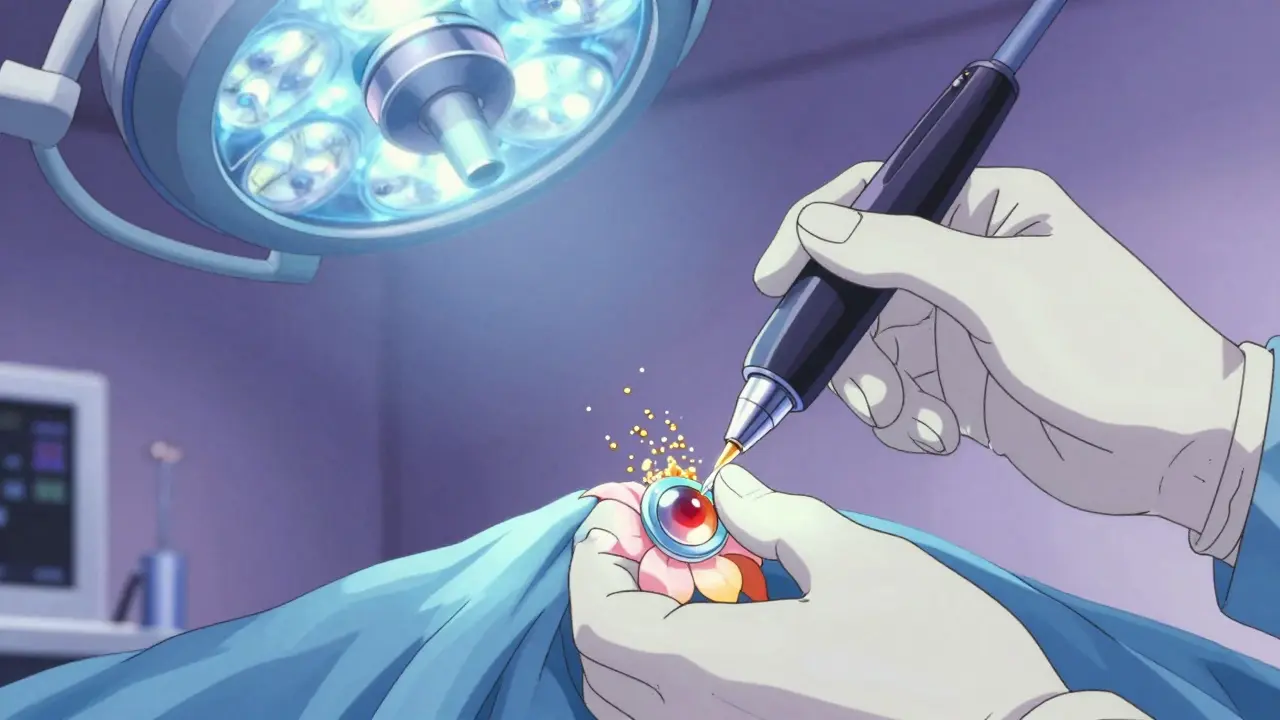
Modern cataract surgery is called phacoemulsification. A tiny ultrasound probe is inserted through a 2.2 to 2.8 millimeter incision in the side of your cornea. It breaks the cloudy lens into small pieces and suctions them out. Then, a foldable intraocular lens (IOL) is slipped into the same spot where your natural lens used to be. This new lens unfolds and stays in place permanently. The whole process takes less than 20 minutes. No stitches are needed because the incision is so small it seals on its own.
What Kind of Lens Will You Get?
Not all IOLs are the same. The most common type is a monofocal lens, which corrects vision for one distance-usually far away. That means you’ll likely still need reading glasses after surgery. If you want to reduce your dependence on glasses, you can choose a premium lens. Multifocal IOLs let you see at multiple distances, while toric IOLs correct astigmatism. Brands like Alcon’s PanOptix and Johnson & Johnson’s Tecnis Symfony offer advanced options. These premium lenses can cost between $2,500 and $4,500 per eye out-of-pocket, since insurance typically only covers the basic monofocal option.
What Can You Expect After Surgery?
Right after surgery, your vision will probably be blurry. That’s normal. Your eye needs time to heal. You might feel a scratchy or sticky sensation for a day or two. Most people notice better vision within 1 to 3 days. But full recovery? That takes time. Some clinics say four weeks. Others say six to eight. The truth? Vision keeps adjusting for months. Your brain has to relearn how to interpret the new signals coming from your eye. One patient described it like switching from an old TV to 4K-everything looks sharper, but your mind needs to catch up.
Recovery Rules: What Not to Do
After surgery, you’ll get specific instructions-but they all boil down to a few key rules. Don’t rub your eye. Don’t let water get in your eye for at least a week. No swimming, hot tubs, or saunas. Avoid heavy lifting, intense workouts, or bending over with your head below your waist for a few weeks. And absolutely no driving until your doctor says it’s safe. You’ll also need to use eye drops for several weeks: antibiotics to prevent infection and steroids to reduce swelling. Missing doses can delay healing or cause complications.
Can You Still Need Glasses After Surgery?
Yes. Even with the best lens, many people still need glasses for reading or fine work. That’s especially true with basic monofocal lenses. Premium lenses reduce this need, but they’re not perfect. Some patients still experience halos or glare at night. Others find their depth perception feels off at first. It’s not a failure-it’s just how the new lens works. Your brain adapts, but it takes time. If you’re still struggling after a few months, vision therapy can help. Special exercises train your eyes and brain to work together better, reducing eye strain and improving focus.

What Are the Risks?
Complications are rare-only 2 to 5% of cases. The most common issue is posterior capsule opacification, sometimes called a "secondary cataract." It happens when the membrane holding the new lens gets cloudy again. It’s not dangerous, and it’s easily fixed with a quick, painless laser procedure called YAG capsulotomy. Other risks include infection, swelling, or retinal detachment, but these are extremely uncommon. For healthy patients, the procedure is one of the safest in all of medicine, with a 99.5% safety rate based on over a million procedures.
Who Doesn’t Benefit as Much?
Not everyone sees perfect results. If you have other eye conditions like advanced glaucoma, diabetic retinopathy, or macular degeneration, cataract surgery won’t fix those problems. The cloudy lens might be removed, but the damage from other diseases stays. In these cases, vision improvement is limited. Your doctor will assess your overall eye health before surgery to set realistic expectations. For some, the goal isn’t perfect vision-it’s enough improvement to make daily life safer and easier.
What’s Next in Cataract Technology?
Technology keeps improving. New IOLs like Zeiss’s AT LISA tri 839MP, approved in early 2023, are designed for better intermediate vision-perfect for computer screens and reading menus. Researchers are also testing accommodating IOLs that can move and focus like a natural lens. These are still in clinical trials but could be available in the next few years. The global market for cataract devices is growing fast, expected to hit $6.32 billion by 2027. That means more innovation, more options, and better outcomes for patients.
Is It Worth It?
If cataracts are making it hard to drive at night, read, or enjoy your favorite hobbies, then yes-it’s absolutely worth it. The surgery is quick, safe, and life-changing for most. People often say they didn’t realize how much they’d been missing until after the surgery. Colors look brighter. Faces look clearer. The world feels sharper. It’s not just about seeing better. It’s about living better.
Can cataracts come back after surgery?
No, cataracts cannot return because the natural lens is removed. But sometimes the thin membrane holding the new lens becomes cloudy-a condition called posterior capsule opacification. This feels like a cataract coming back, but it’s easily fixed with a quick laser treatment that takes less than five minutes.
How long does it take to recover from cataract surgery?
Most people see better within 1 to 3 days, but full healing takes 4 to 8 weeks. Vision continues to adjust for months as your brain learns to interpret the new lens. Follow-up visits are scheduled to monitor healing and make sure there are no complications.
Will I still need glasses after cataract surgery?
It depends on the type of lens you choose. With a standard monofocal lens, you’ll likely need glasses for reading or close work. Premium multifocal or toric lenses can reduce or eliminate the need for glasses, but they’re more expensive and may not be covered by insurance.
Is cataract surgery painful?
No. The eye is numbed with drops, so you won’t feel pain. You might feel pressure or a sensation of movement, but not discomfort. After surgery, your eye might feel scratchy or gritty for a day or two, but this is mild and short-lived.
Can I have surgery on both eyes at once?
Usually not. Surgeons operate on one eye at a time, typically spacing procedures a few weeks apart. This lets the first eye heal and gives your doctor a chance to check the outcome before moving to the second eye. It’s safer and allows for better planning of your final vision goals.
What happens if I delay cataract surgery?
Delaying won’t damage your eye, but it will make daily life harder. As cataracts get worse, your vision gets blurrier, glare increases, and contrast drops. Advanced cataracts can also make surgery slightly more complex, though outcomes are still good. The best time to have surgery is when it starts affecting your safety or quality of life-not when it’s "ripe" or "ready."
Jan Hess
January 15, 2026 AT 07:52Used to dread driving at night now I can see street signs like they're neon
Best decision I ever made
Diane Hendriks
January 15, 2026 AT 15:29Tom Doan
January 17, 2026 AT 08:23Sohan Jindal
January 19, 2026 AT 05:25Frank Geurts
January 20, 2026 AT 00:21Annie Choi
January 21, 2026 AT 11:04Arjun Seth
January 21, 2026 AT 15:05Ayush Pareek
January 23, 2026 AT 06:14Nishant Garg
January 24, 2026 AT 05:08Nilesh Khedekar
January 25, 2026 AT 08:48Jami Reynolds
January 26, 2026 AT 02:40Iona Jane
January 27, 2026 AT 10:18