

When you’re on a blood thinner, the goal is simple: stop dangerous clots before they form. But if you take too much-or if something goes wrong-the same medicine that saves your life can start killing you. Internal bleeding doesn’t always come with a warning sign. Sometimes it’s just a dark stool, a bruise that won’t fade, or urine that looks like tea. By the time you feel weak or dizzy, it might already be too late. Knowing what to do in those first critical minutes can mean the difference between life and death.
What Happens When You Overdose on a Blood Thinner?
Blood thinners like warfarin (Coumadin), apixaban (Eliquis), dabigatran (Pradaxa), and rivaroxaban (Xarelto) work in different ways, but they all do one thing: slow down your blood’s ability to clot. Warfarin blocks vitamin K, which your body needs to make clotting proteins. DOACs (direct oral anticoagulants) directly block clotting factors like thrombin or factor Xa. It’s effective-but when the dose is too high, your blood just keeps flowing, even where it shouldn’t.
The danger isn’t just in taking a double dose. It’s in how long the drug stays in your system. Warfarin’s effects can last up to five days after the last pill. Even if you took your normal dose yesterday, today’s INR (a lab test that measures clotting time) could still be dangerously high. An INR over 3.0 is considered risky for most people. For someone with a mechanical heart valve, it’s over 3.5. When INR hits 8 or higher, spontaneous bleeding becomes likely.
Signs of Internal Bleeding You Can’t Ignore
Most people think of bleeding as something you see-a cut, a nosebleed. But internal bleeding hides. It’s silent until it’s severe. Here’s what to watch for:
- Black, tarry stools or blood in your stool
- Pink, red, or dark brown urine-this isn’t just from beets
- Coughing or vomiting blood, or material that looks like coffee grounds
- Unexplained bruising, especially large patches or bruises without injury
- Persistent bleeding from small cuts, gums, or nose that doesn’t stop after 10 minutes of pressure
- Heavy menstrual bleeding that’s new or much worse than usual
- Small red dots under the skin (petechiae)-they don’t fade when you press on them
- Severe headache, dizziness, confusion, or sudden weakness-could mean bleeding in the brain
- Sharp pain in your abdomen, back, or chest-could signal bleeding in the belly, spine, or around the heart
A 2023 survey by the National Blood Clot Alliance found that 78% of patients first noticed unusual bruising. But 62% waited days before seeking help. That delay is deadly.
What to Do Right Now If You Suspect an Overdose
If you or someone you know has taken too much of a blood thinner and shows any of these signs, don’t wait. Don’t call your doctor tomorrow. Don’t try to tough it out. Here’s what to do immediately:
- Call emergency services (999 in the UK, 911 in the US). Say: “I’m on a blood thinner and think I’ve overdosed-possible internal bleeding.”
- Do NOT take another dose. Even if you think you missed one, don’t double up.
- Stop all NSAIDs. No ibuprofen, no aspirin, no naproxen. These make bleeding worse.
- Write down what you took. Name of the drug, dose, and time taken. If you have the pill bottle, bring it.
- Stay calm and lie down. Elevate your legs slightly if you feel dizzy. Don’t move around unless you’re bleeding externally.
- Apply firm pressure to any external bleeding-gums, nose, cuts-for at least 10 minutes straight. Don’t peek.
Time matters. A 2022 study in the Journal of Thrombosis and Haemostasis showed patients who reached the ER within two hours of symptoms had a 97% survival rate. Those who waited six hours or more? Only 76% made it.
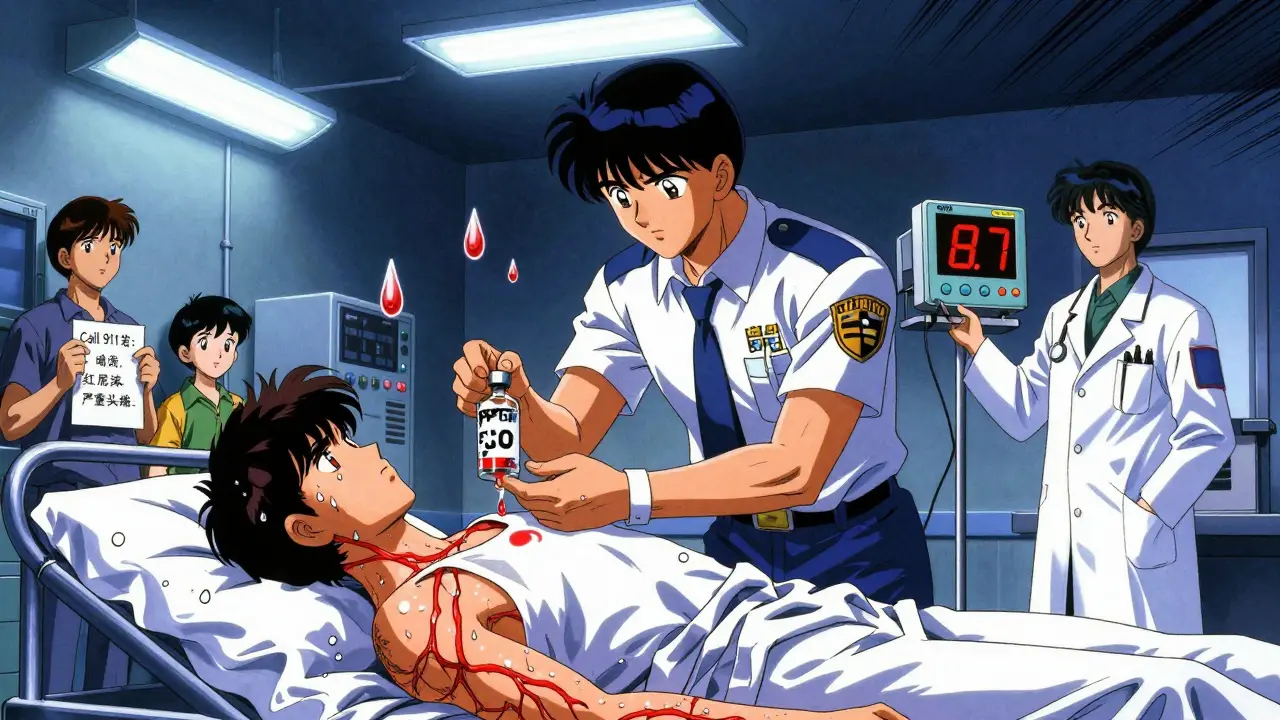
How Doctors Treat It
Emergency teams don’t guess. They act fast-and differently depending on the drug.
For warfarin overdose:
- If INR is high but no bleeding: Oral vitamin K (1-5 mg) is given to slowly reverse the effect. It can take 12-24 hours to work.
- If bleeding is active: They give 4-factor Prothrombin Complex Concentrate (PCC)-a concentrated blood product that restores clotting factors within minutes. It’s faster and safer than older options like Fresh Frozen Plasma (FFP).
- IV vitamin K (10 mg) is always given alongside PCC to prevent the effect from returning.
For DOACs (Eliquis, Xarelto, Pradaxa):
- For dabigatran (Pradaxa): Idarucizumab (Praxbind) reverses it in minutes. It costs around $5,000 per dose, but it works.
- For apixaban or rivaroxaban: Andexanet alfa (Andexxa) is the antidote. It’s not always available, but ERs with trauma centers keep it on hand.
- If no antidote is available: Activated charcoal may help if taken within an hour of overdose. After that? Supportive care-fluids, blood transfusions, monitoring.
There’s new hope on the horizon. In 2023, the FDA approved a Phase III trial for ciraparantag, a universal reversal agent that could work on all anticoagulants in under 15 minutes. It’s not available yet, but it’s coming.
Preventing Overdose Before It Happens
Most overdoses aren’t accidents. They’re preventable.
- Keep your INR in range. For most people, it’s 2.0-3.0. For mechanical heart valves, 2.5-3.5. Test weekly if you’re new to warfarin, monthly if stable.
- Use a pill organizer. One compartment per day. No guessing.
- Never switch brands. Generic warfarin isn’t always the same as brand-name. Even small differences in absorption can push your INR out of range.
- Know your drug interactions. Antibiotics, antifungals, and even St. John’s Wort can spike your INR. Always check with your pharmacist before starting anything new.
- Wear a medical ID. A bracelet or necklace that says “On Blood Thinner” could save your life if you’re found unconscious.
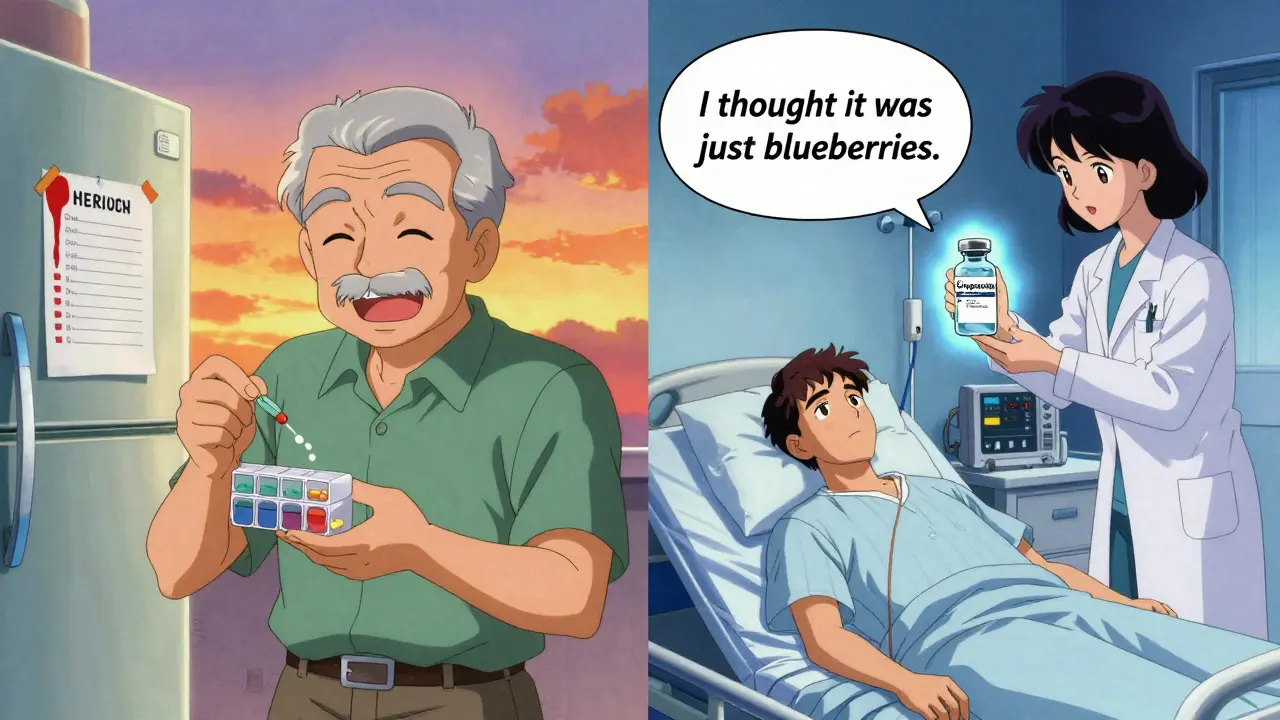
- Keep a bleeding checklist. Tape it to your fridge: “Call 999 if: bleeding lasts >10 mins, dark stool, red urine, severe headache, unexplained bruising.”
Why This Isn’t Just a “Medication Problem”
According to the CDC, anticoagulant-related adverse events are the second leading cause of serious medication errors in adults over 65. That’s not because people are careless. It’s because the system is complex.
Doctors don’t always explain the signs. Pharmacies don’t always warn about interactions. Patients forget. And when bleeding starts quietly-like a dark stool or a bruise-you assume it’s just aging.
The HAS-BLED score (used by doctors to assess bleeding risk) includes: Hypertension, Abnormal kidney/liver function, Stroke, Bleeding history, Labile INR, Elderly >65, Drugs/alcohol. If you score 3 or higher, you’re at high risk. That means you need more than a prescription-you need a plan.
Final Warning: Don’t Wait for a Crisis
A Reddit user named u/WarfarinWarrior wrote: “I thought my black stools were from blueberries. By the time I got to the ER, my hemoglobin was 6.2 g/dL. Normal is 12-16. I almost died.”
You don’t need to be a medical expert to save your life. You just need to know the signs. If you’re on a blood thinner, you’re already at risk. But you’re not helpless. The tools to prevent disaster are simple: know your numbers, recognize the symptoms, and act fast.
When in doubt-call emergency services. It’s better to be safe than sorry. And if you’re caring for someone on blood thinners? Make sure they have this information printed and taped to their fridge. Because in a crisis, seconds count.
Can I take aspirin if I’m on a blood thinner and have a headache?
No. Aspirin is an NSAID and increases bleeding risk. For headaches, use acetaminophen (paracetamol) instead. But even then, don’t take more than 3,000 mg per day without checking with your doctor. Never use ibuprofen, naproxen, or other painkillers unless your prescriber says it’s safe.
Is it safe to drink alcohol while on blood thinners?
Moderate alcohol (one drink per day for women, two for men) is usually okay, but heavy drinking is dangerous. Alcohol can interfere with how your liver processes warfarin, causing INR to spike unpredictably. It also irritates the stomach lining, increasing risk of internal bleeding. If you drink, be consistent-don’t binge. Tell your doctor how much you drink.
What should I do if I miss a dose of my blood thinner?
Don’t double up. If you miss a dose and remember within 12 hours, take it. If it’s been longer, skip it and take your next dose at the regular time. Never take two doses to make up for one. For warfarin, this can cause dangerous spikes in INR. For DOACs, missing a dose is less risky than doubling up. Always follow your doctor’s instructions-each drug has different rules.
Can I get a tattoo or piercing while on blood thinners?
It’s not recommended. Even minor procedures like tattoos, piercings, or dental work can cause prolonged bleeding. If you’re considering one, talk to your doctor first. They may temporarily pause your medication (under strict monitoring) or advise against it entirely. The risk of uncontrolled bleeding and infection is too high.
How often should I get my INR checked?
When you first start warfarin, you’ll need weekly tests until your INR is stable. Once stable, most people test every 4-6 weeks. If your dose changes, you’re sick, or you start a new medication, go back to weekly. Some patients use home INR monitors-devices you can buy for $200-$300. Studies show they reduce major bleeding by 34% because you catch changes early.
Are there any natural supplements that can increase bleeding risk?
Yes. Many supplements act like blood thinners. Garlic, ginger, ginkgo, fish oil (omega-3), vitamin E, and green tea can all increase bleeding risk. Even turmeric (curcumin) has anticoagulant effects. If you take any supplement, tell your doctor. Don’t assume “natural” means safe. Some herbal products can raise your INR just as much as a drug interaction.
Gabrielle Conroy
February 24, 2026 AT 12:23OMG this is so important!!! I just had my mom almost die from a warfarin mix-up last year 😭 She thought her dark stool was from beets too… I printed this out and taped it to her fridge with a big red sticker that says “CALL 911 IF THIS HAPPENS” 🚨 She’s now got a pill organizer, a medical ID bracelet, and I check in every morning. This post saved her life. Thank you!! 💖
Timothy Haroutunian
February 25, 2026 AT 07:29Look I get it, you’re trying to be helpful but let’s be real-this whole thing is just another example of how pharmaceutical companies and doctors make us terrified of our own meds. I’ve been on Xarelto for five years. I’ve never bled. I’ve never had a clot. I take it like a vitamin. And now you’re telling me to panic over a bruise? I’ve got bruises from my dog jumping on me. That’s not internal bleeding, that’s just life. Stop fearmongering. People don’t need to be told to call 911 every time they sneeze. The real danger is anxiety-induced hypochondria. And don’t even get me started on the $5,000 antidotes. This reads like a drug company ad disguised as medical advice.
Gwen Vincent
February 27, 2026 AT 01:22Thank you for writing this. I’m a nurse and I’ve seen too many patients come in too late. The quiet signs-like that tiny red dot under the skin-are so easy to dismiss. I tell my patients: if you’re on a blood thinner and something feels ‘off,’ it probably is. No shame in calling. No shame in going to the ER. I’ve had patients say, ‘I didn’t want to bother anyone.’ Honey, your life isn’t a bother. This list? It’s gold. I’m sharing it with my whole unit.
Stephen Archbold
February 27, 2026 AT 04:06just wanna say i was on warfarin for afib and my doc never told me about the INR range or how long it lasts. i thought once i took it it was done. then one day i got a black stool and thought i was dying. ended up in the er. they gave me pcc and vitamin k. i was scared outta my mind. now i have a checklist on my fridge and i check my INR at home. the home monitor was a game changer. also dont drink alcohol with it. i learned that the hard way. thanks for the info. its the kind of stuff docs dont tell you.
Haley Gumm
February 28, 2026 AT 07:54Wow. Just wow. So this is what happens when you actually care about patient outcomes instead of just pushing pills. I’ve been waiting for someone to say it: aspirin is not a headache cure if you’re on a blood thinner. And yes, turmeric is a blood thinner. And yes, ‘natural’ doesn’t mean ‘safe.’ And yes, you need to know your INR like your birthday. This is the kind of post that makes me believe medicine still has some good people in it. Thank you. From the bottom of my heart.
John Smith
March 1, 2026 AT 14:35So let me get this straight. You’re telling me I need to panic every time I get a bruise? I’m 72. I bruise when I look at a chair wrong. I’ve had three surgeries. I’ve been on Eliquis since 2019. I’ve never had a bleed. And now I’m supposed to call 911 because my knee looks a little purple? This isn’t medical advice. This is a horror movie script written by someone who’s never met a real patient. I’ll take my chances. And I’ll keep drinking my whiskey. Because apparently, according to you, that’s just as dangerous as the drug itself.
Shalini Gautam
March 3, 2026 AT 08:03I am from India and we have no access to these fancy antidotes. My uncle was on warfarin. When he bled internally, we took him to the hospital. They gave him vitamin K and blood transfusion. No PCC. No Praxbind. Just prayer and patience. We survived because we acted fast. This guide is useful but it assumes you live in a rich country. For the rest of us? Know the signs. Call early. Don’t wait. Don’t hope. Just go. That’s the real advice.
Natanya Green
March 3, 2026 AT 21:32Okay but the part about the tattoo?? I’ve been wanting a sleeve for YEARS. I’ve been on Xarelto for 3 years and my INR is always perfect. I’m not giving up my art because of a ‘maybe’! I’m gonna find a tattoo artist who knows what they’re doing. They’ve done 3 people on blood thinners already! They use a special technique-super shallow, no deep needles. I’m doing it. And if I bleed? I’ll call 911. But I’m not letting fear steal my joy. 🖋️🖤
Michael FItzpatrick
March 5, 2026 AT 12:02As someone who’s been a caregiver for a parent on warfarin for 12 years, I want to say this: the real hero here isn’t the drug. It’s the system of checks. The home monitor. The pill organizer. The fridge checklist. The family member who asks, ‘Did you take it today?’ That’s what saves lives. This post nails it. And yes, the antidotes are expensive-but the real cost is silence. If you’re reading this, share it. Print it. Tape it. Talk about it. This isn’t just medicine. It’s love in action.
Brandice Valentino
March 7, 2026 AT 00:11so like i was on pradaxa and my dr just said take it once a day and dont worry about it. no mention of idarucizumab. no mention of what happens if i vomit it up. no mention of the fact that i have to carry the bottle with me. i thought i was being responsible. turns out i was just naive. now i have a laminated card in my wallet that says: ‘ON PRADAXA. IF UNCONSCIOUS, SAY IDARUCIZUMAB.’ i also carry a spare pill. because i’m not dying because my doctor didn’t do their job. thanks for this. i wish i’d seen it sooner.