
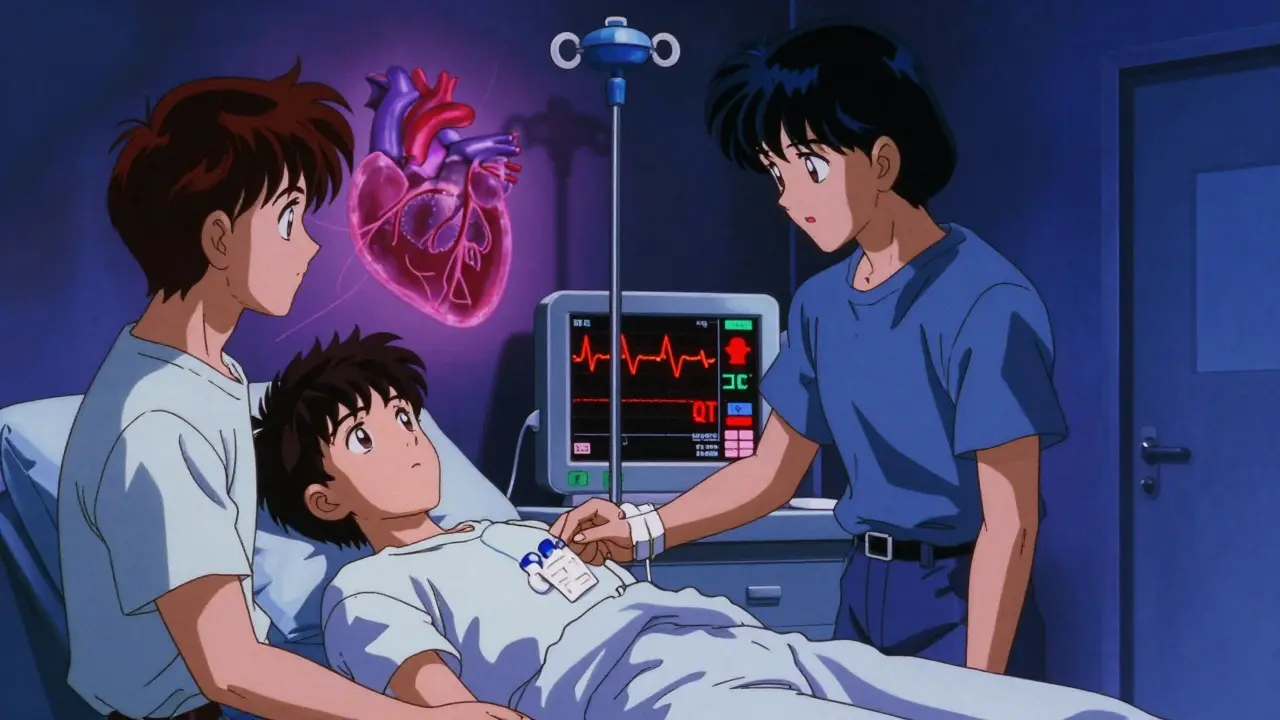
QT Prolongation Risk Calculator
This tool assesses your individual risk of QT prolongation when administering ondansetron based on clinical factors. Enter patient details to determine risk level and recommendations.
Risk Assessment
Antiemetics like ondansetron are lifesavers for cancer patients, post-op recovery, and severe nausea. But behind their effectiveness lies a quiet, dangerous side effect: QT prolongation. This isn’t just a footnote in a drug leaflet. It’s a real, measurable, and sometimes deadly risk that’s changed how hospitals give these drugs today.
What QT Prolongation Really Means
Your heart doesn’t just beat-it recharges between beats. That recharge time is measured as the QT interval on an ECG. When it stretches too long, your heart’s electrical system gets unstable. The most dangerous result? Torsades de pointes, a chaotic, life-threatening rhythm that can drop you into cardiac arrest without warning. It doesn’t happen often, but when it does, it’s often preventable.
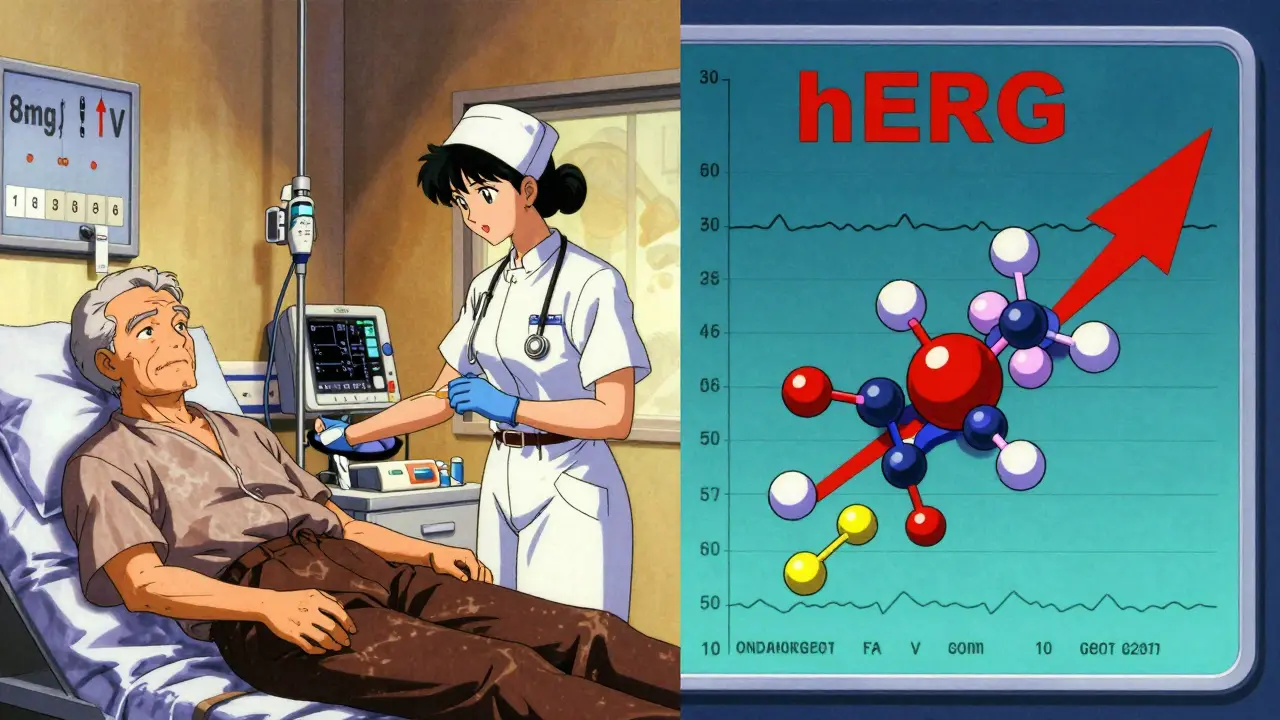
Ondansetron is one of the most common culprits. It blocks a specific potassium channel in heart cells (hERG), slowing down the heart’s recharge. That’s why the QT interval lengthens. A single 32 mg IV dose can stretch it by 20 milliseconds or more. For context: a normal QTc (corrected for heart rate) is under 450 ms in men and 470 ms in women. Push it past 500 ms, and your risk of dangerous rhythms spikes.
Why Ondansetron Is Different From Other Antiemetics
Not all antiemetics carry the same risk. Among the 5-HT3 blockers, ondansetron is the most notorious. Granisetron? Much safer. Palonosetron? Even better-its max QTc increase is under 10 ms. Dolasetron? The FDA pulled its IV form from the market in 2010 because it was too risky.
Even non-5-HT3 drugs like droperidol and prochlorperazine can prolong QT, but studies show ondansetron’s effect is more predictable and more common. A 2021 meta-analysis of 687 patients found that 14% developed measurable QT prolongation after ondansetron. That’s 1 in 7 people. And it’s not just about the dose-it’s who you are.
Who’s Most at Risk?
If you’re young, healthy, and getting ondansetron for morning sickness, your risk is low. But if you’re older, have heart failure, are on other QT-prolonging drugs (like certain antibiotics or antidepressants), or have low potassium or magnesium? You’re in danger.
Hospitals have seen this play out. A 2019 case series from Johns Hopkins found that 3 out of 15 elderly patients with existing heart issues developed QTc intervals over 500 ms after an 8 mg IV dose. That’s not a fluke-it’s a pattern. Nurses in oncology units report ECG abnormalities in nearly 1 in 5 patients. Emergency departments now routinely check ECGs before giving IV ondansetron to anyone over 60 or with a history of arrhythmia.
The FDA Warning That Changed Everything
In 2012, the FDA issued a hard-hitting Drug Safety Communication: "Do not use a single 32 mg IV dose of ondansetron." They also capped single IV doses at 16 mg. Why? Because the data was undeniable. A thorough QT study showed 32 mg caused a 20 ms QTc increase-twice the level linked to higher arrhythmia risk. Oral doses? Still safe up to 24 mg. The problem was IV use: fast, high, direct into the bloodstream.
Since then, prescribing habits shifted. A 2020 survey of 256 anesthesiologists found 78% lowered their doses. Many now use 4 mg or 8 mg instead of 16 mg. Some hospitals switched entirely to dexamethasone for low-risk nausea. Why? Because it works almost as well, with zero QT risk.
What Hospitals Do Now
Best practices have become routine in most U.S. hospitals. Here’s what they do:
- Check baseline ECG before IV ondansetron if the patient is over 60, has heart disease, or is on other QT-prolonging drugs.
- Correct low potassium (<3.5 mEq/L) or low magnesium (<1.8 mg/dL) before giving the drug.
- Limit IV dose to 8 mg for high-risk patients-half the old max.
- Monitor ECG for 4 hours after IV administration if QTc is over 440 ms at baseline.
- Require pharmacist sign-off on QTc calculations before high-dose use.
These aren’t suggestions-they’re protocols. A 2022 survey found 92% of U.S. hospitals now have formal rules around ondansetron use. That’s up from just 37% in 2011. The change didn’t happen overnight. It took years of near-misses, case reports, and nurse-led safety campaigns.
Alternatives That Are Safer
If you’re worried about QT prolongation, there are better options:
- Palonosetron: Preferred in cancer patients with heart risks. Causes less QT prolongation than ondansetron.
- Dexamethasone: A steroid. Works well for nausea, especially when paired with low-dose ondansetron. No QT risk.
- Aprepitant: Used for high-risk chemotherapy. Doesn’t touch the heart’s electrical system.
- Transdermal granisetron: Patch form. Minimal systemic absorption. Very low cardiac risk.
The National Comprehensive Cancer Network updated its guidelines in 2023 to recommend palonosetron over ondansetron for patients with cardiac history. That’s a major shift in oncology practice.
The Bigger Picture
Even with all the warnings, ondansetron is still the most prescribed antiemetic in the U.S.-18.7 million prescriptions in 2022. But IV use is down 22% since 2012. Why? Because clinicians learned the hard way. A single case of torsades can shut down a unit, trigger a lawsuit, and haunt a provider for years.
Research is moving forward. The NIH-funded QT-EMETIC trial is testing whether genetic testing (CYP2D6 poor metabolizers) can predict who’s most at risk. Early data suggests some people’s bodies process ondansetron too slowly, leading to dangerous buildup. Future dosing might be personalized-not just by weight or age, but by DNA.
What You Should Know
If you’re a patient:
- Ask: "Is IV ondansetron really necessary? Is there a safer option?"
- If you have heart disease, kidney failure, or take antidepressants, mention it before any anti-nausea shot.
- Don’t assume "it’s just for nausea" means it’s harmless.
If you’re a clinician:
- Never give 32 mg IV. Ever.
- Double-check ECGs. Don’t rely on automated QTc readings-they’re often inaccurate.
- Use 4-8 mg IV for most adults. Save 16 mg only for severe cases, and only after checking risk factors.
- When in doubt, use dexamethasone + low-dose ondansetron. It’s safer and just as effective.
Can I still use ondansetron safely?
Yes-but only if you follow current safety rules. Oral doses up to 24 mg are still considered safe. For IV use, stick to 4-8 mg for most patients. Avoid it entirely if you have a history of long QT syndrome, heart failure, or are on other QT-prolonging drugs. Always check electrolytes and ECG if you’re at risk.
Is ondansetron banned?
No. The FDA didn’t ban it. They banned the 32 mg IV dose and limited maximum single doses to 16 mg. Many hospitals now use even lower doses (4-8 mg) because the risk-benefit balance favors caution. Ondansetron is still widely used-just more carefully.
Why does IV ondansetron cause more QT prolongation than oral?
IV delivers the full dose instantly into your bloodstream, creating a spike in drug concentration. Oral doses are absorbed slowly, so the peak effect is lower and spread out. That’s why a 24 mg oral dose is safe, but a 32 mg IV dose can be dangerous.
What’s the difference between QT and QTc?
QT is the raw measurement from the ECG. QTc corrects it for heart rate. A fast heart rate can make QT look longer than it is. QTc is what doctors use to judge risk. Bazett’s formula is common, but Fridericia’s is more accurate-especially in patients with fast or slow heart rates.
Are there any antiemetics that don’t affect the QT interval?
Yes. Dexamethasone, metoclopramide (in low doses), and cannabinoids like dronabinol have minimal to no QT effect. For many patients, especially those with heart conditions, dexamethasone alone is now the first choice. It’s cheaper, safer, and nearly as effective for nausea control.
Final Thought
Medicine isn’t about avoiding risks-it’s about managing them. Ondansetron is still valuable. But its cardiac risk isn’t theoretical. It’s documented, measured, and preventable. The safest choice isn’t always the strongest dose. Sometimes, it’s the smallest one that works.
John Cena
February 21, 2026 AT 16:38Really appreciate this breakdown. I work in oncology and we’ve switched to granisetron for most cases now. The difference in QT risk is night and day, and honestly, patients don’t even notice the change. Less stress for everyone.
Irish Council
February 22, 2026 AT 06:32They’re hiding the real danger. Big Pharma knows ondansetron’s a ticking time bomb but keeps selling it because it’s cheap. The FDA didn’t ban it-they just capped it. That’s not safety, that’s damage control.
Freddy King
February 23, 2026 AT 22:15Let’s be real-the hERG channel blockade isn’t even the half of it. The real issue is polypharmacy. You got a 72-year-old on amiodarone, ciprofloxacin, and ondansetron? That’s not a treatment plan, that’s a clinical dumpster fire. The 14% QT prolongation stat? That’s just the tip of the iceberg. We’re not talking about isolated events-we’re talking about pharmacokinetic dominoes.
Laura B
February 24, 2026 AT 22:05This is such an important topic. I’ve seen so many patients get ondansetron for nausea after chemo and assume it’s harmless. The fact that hospitals now check ECGs before giving it? That’s a huge win. Knowledge is power, and this post just gave me a lot more of it.
Jayanta Boruah
February 26, 2026 AT 18:06It is imperative to underscore that the pharmacological modulation of the hERG potassium channel by ondansetron represents a class effect among 5-HT3 antagonists, albeit with differential potency. The FDA’s 2012 warning was predicated upon rigorous QT interval analysis derived from thorough QT studies, which demonstrated a dose-dependent prolongation exceeding the threshold of clinical concern. It is therefore not merely a matter of dosage reduction, but of strategic pharmacological substitution to mitigate arrhythmic risk.
Hariom Sharma
February 27, 2026 AT 03:13Man, I’m so glad we’re finally talking about this. My uncle almost went into cardiac arrest after getting IV ondansetron for chemo nausea. They didn’t even check his ECG. Now he’s on dexamethasone and feels way better. This stuff needs to be common knowledge.
Nina Catherine
February 27, 2026 AT 17:54Wait wait wait-so oral is fine but IV is risky? I thought IV was just faster… so if someone’s got morning sickness and gets the pill instead of the shot, they’re safer? That’s wild. I’m gonna tell my sister who’s pregnant.
Taylor Mead
March 1, 2026 AT 02:09Just had a patient last week get 16mg IV-no ECG, no history of heart issues. We got lucky. But reading this? Yeah, I’m double-checking every single time now. Thanks for the wake-up call.
Amrit N
March 2, 2026 AT 16:40My dad got ondansetron after surgery and had palpitations. They said it was stress. Now I’m wondering if it was this. Maybe we need a warning label on the bottle like cigarettes.
Robert Shiu
March 2, 2026 AT 17:42That’s such a valid point. My mom had the same thing. We didn’t know anything about QT risk. I’m so glad hospitals are starting to catch on. Maybe one day this will be standard for all meds, not just the scary ones.
Ashley Paashuis
March 2, 2026 AT 18:37It’s worth noting that the risk is not uniform across populations. Ethnicity, sex, and genetic polymorphisms in CYP enzymes can significantly alter metabolism. For example, East Asian populations may metabolize ondansetron more slowly, increasing exposure. This should be factored into clinical decision-making.
Liam Crean
March 4, 2026 AT 18:20So if you’re giving it to someone with low K+, you’re basically lighting a fuse. Why isn’t there a mandatory electrolyte check before administration? Seems like a no-brainer.
Marie Crick
March 6, 2026 AT 01:41This is why people die in hospitals. Not from cancer-from dumb drug decisions. They give this stuff like candy. Someone should get fired over this.
Scott Dunne
March 7, 2026 AT 20:47It’s a disgrace that the FDA only capped the dose instead of banning it outright. Ireland banned it years ago. The U.S. is always playing catch-up. This isn’t innovation-it’s negligence.