

Imagine walking into your factory floor on a Tuesday morning. You expect to review yesterday’s batch records and plan today’s production run. Instead, you see three people in suits standing at the main entrance, flashing badges. They aren’t there for a scheduled audit. They aren’t here to chat about next quarter’s projections. They are FDA investigators, and they have arrived without warning.
This is no longer just a scenario for domestic manufacturers in the United States. As of mid-2025, this surprise visit has become the new normal for foreign facilities supplying the U.S. market. The U.S. Food and Drug Administration (FDA) is the federal agency responsible for protecting public health by ensuring the safety, efficacy, and security of human and veterinary drugs, biological products, and medical devices; and by ensuring the safety of our nation's food supply, cosmetics, and products that emit radiation has fundamentally changed its approach to global oversight. Why? Because when companies know an inspector is coming, they clean up. And when they clean up, the FDA can’t see the real problems.
The Problem with Advance Notice
For decades, there was a double standard in how the FDA inspected manufacturing facilities. If you were based in the U.S., inspectors showed up unannounced. If you were in India, China, or Europe, you typically got weeks of notice. This allowed time to coordinate travel, arrange translators, and-let’s be honest-scrub the facility of any minor non-compliance issues.
The data showed this wasn’t working. Before the policy shift, the FDA found serious deficiencies more than twice as often during domestic unannounced inspections compared to announced foreign ones. When a facility has time to prepare, it hides the cracks. It organizes loose papers. It ensures every single employee is wearing their badge correctly. But does that mean the Quality Management System (QMS) is actually robust? Often, no.
Michael Rogers, the FDA Assistant Commissioner for Inspections and Investigations, put it bluntly in May 2025: "These inspections provide real-time evidence and insights that are essential for making fact-based regulatory decisions." The goal isn't to catch people out; it's to see the routine state of operations. If your processes are solid, a surprise visit shouldn't scare you. If your processes rely on last-minute fixes, you have a bigger problem than an inspection.
How an Unannounced Inspection Actually Works
You might wonder what happens in those first ten minutes. It’s scripted, but it’s intense. Here is the standard protocol:
- Identification: Investigators arrive and identify themselves. They display official credentials immediately.
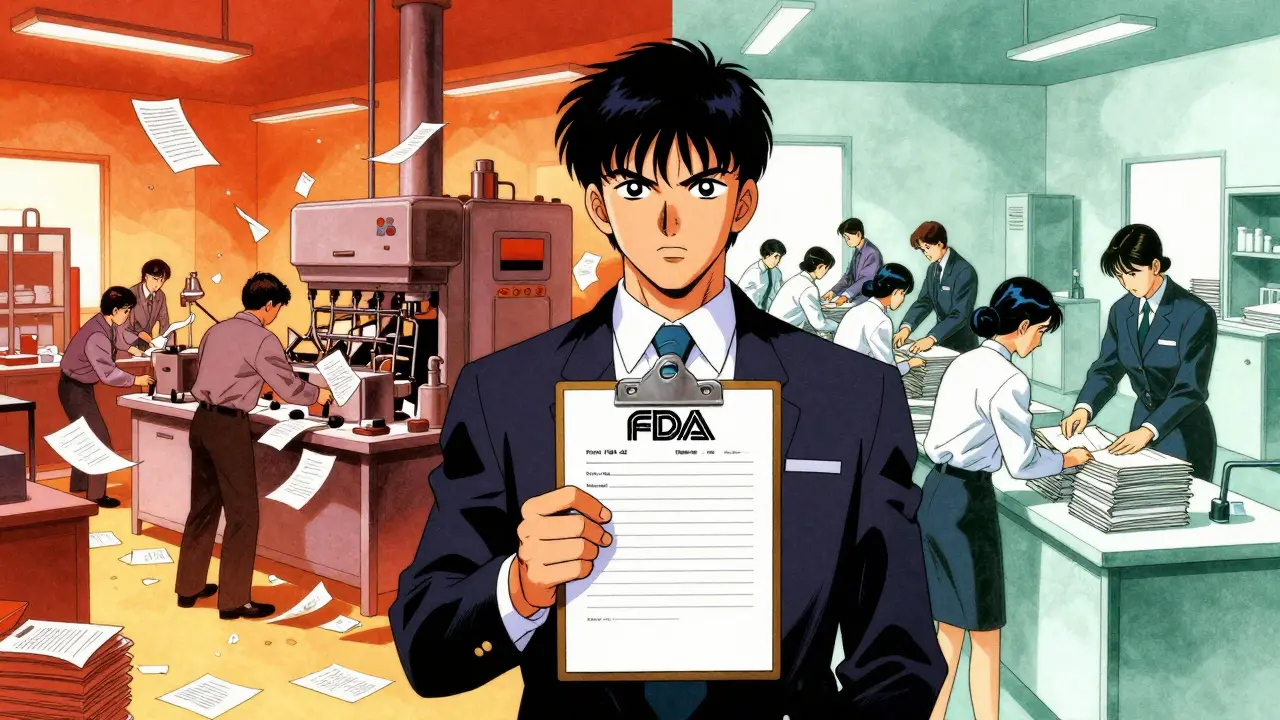
- Form FDA 482: They issue a Form FDA 482 is the official Notice of Inspection document issued by FDA investigators to the most responsible individual available at a facility upon arrival. This is handed to the most senior person available on-site. It officially starts the clock.
- Purpose Statement: They explain why they are there. Is it a routine surveillance inspection? A follow-up to a previous warning letter? Or a "for cause" investigation triggered by a consumer complaint?
- Tour and Review: They will ask to tour the facility and review specific records. They don't need permission to look at active manufacturing areas if they deem it necessary for public health safety.
The duration varies wildly. A small operation might take four hours. A complex pharmaceutical plant producing sterile injectables could take two weeks. It depends on the size of the firm, the complexity of the issues, and how easy it is to find the records they request.
The 2025 Policy Expansion: Closing the Gap
In May 2025, the FDA announced a major expansion of its unannounced inspection program to include foreign manufacturing facilities. This wasn't just a bureaucratic tweak; it was a response to growing concerns about global supply chain integrity. With roughly 40% of finished drugs and 80% of active pharmaceutical ingredients (APIs) consumed in the U.S. being manufactured overseas, the stakes are incredibly high.
Previously, the FDA ran pilot programs for unannounced inspections in countries like India and China. The results were telling. Facilities that had previously received advance notice suddenly faced the reality of immediate scrutiny. The policy change aims to create regulatory parity. Whether your factory is in New Jersey or Jiangsu, the expectation is now the same: maintain continuous compliance, not just inspection-day compliance.
| Feature | Pre-2025 Foreign Inspections | Post-2025 Global Standard |
|---|---|---|
| Notice Period | Weeks of advance notice common | Unannounced (surprise visits) |
| Primary Goal | Coordinate logistics and translation | Obtain authentic assessment of routine ops |
| Deficiency Rate | Lower (due to preparation time) | Higher (reveals true state of compliance) |
| Translator Arrangement | Facility arranged in advance | FDA provides or uses remote interpretation |
What Inspectors Are Really Looking For
When the door opens, what are they hunting for? It’s rarely about whether the breakroom coffee cup is dirty. They are looking for systemic failures in your Quality Management System (QMS) is a formalized system that documents processes, procedures, and responsibilities for achieving quality policies and objectives.
- Data Integrity: Can you produce the original batch record right now? Not a printed copy from yesterday, but the live electronic record? If you have to "duct-tape" your legacy software systems together to make them work, that’s a red flag.
- SOP Adherence: Do employees actually follow the Standard Operating Procedures (SOPs)? Or do they have "workarounds" that everyone knows about but nobody wrote down?
- Cleanliness and Control: In sterile manufacturing, can they access the cleanroom immediately? Is the gowning procedure followed perfectly under pressure?
- Record Falsification: This is the big one. Unannounced inspections are the best tool to catch bad actors who alter data after the fact. If the numbers don’t match the raw logs, you’re in trouble.
Greenlight Guru, a leading resource for medical device compliance, notes that relying on manual tools is dangerous during these visits. "You won't always have time to duct-tape your legacy system tools before they walk through your door," they warn. Your digital infrastructure needs to be robust enough to withstand immediate scrutiny.

Preparing for the Surprise: A Practical Guide
You can’t predict the day, but you can predict the method. How do you prepare for something that happens by surprise? By making compliance your daily habit, not a monthly chore. Here is how top-tier manufacturers stay ready:
- Create a Response Plan: Designate who answers the door. Who gathers the records? Who acts as the primary liaison? This should be drilled regularly, not decided in the moment.
- Mock Inspections: Conduct internal audits that mimic the chaos of an unannounced visit. Show up at 7 AM on a random Tuesday. Ask for records from six months ago. See how long it takes to retrieve them.
- Digital Readiness: Ensure your QMS software is cloud-based or easily accessible. If an investigator asks for a deviation report from last year, you should be able to pull it up in seconds, not hours.
- Language Solutions: For foreign facilities, the old excuse of "we need a translator" is gone. Work with agencies that offer rapid-response interpretation services, or ensure key personnel are fluent in English.
- Culture of Transparency: Train staff to answer questions honestly. If they don’t know the answer, they should say, "I will get that information for you," rather than guessing or hiding.
Parexel, a global healthcare solutions provider, emphasizes that developing a clear response plan is critical. The stress of a surprise visit can lead to mistakes. Preparation reduces panic.
The Impact on Global Supply Chains
This shift isn't just about punishment; it's about protection. The FDA states that this expanded approach marks "a new era in FDA enforcement-stronger, smarter, and unapologetically in support of the public health and safety of Americans."
For companies, this means higher costs in the short term. You need better software, better training, and potentially more staff dedicated to quality assurance. But it also levels the playing field. Companies that cut corners on quality used to have an advantage because they could hide behind advance notice. Now, those shortcuts are exposed faster.
There are still unanswered questions. Will the FDA continue to notify foreign Competent Authorities (the local regulatory bodies) before entering a facility? Historically, yes. This helped build diplomatic relations and ensured local support. Under the new strict unannounced policy, this coordination might be limited to post-inspection notifications. Lawyers at Hogan Lovells note this raises many legal and logistical questions that are still being resolved.
However, the direction is clear. The days of treating foreign inspections as a formality are over. If you manufacture products for the U.S. market, you must assume the FDA could walk through your door at any moment. Your quality system should be strong enough to welcome them.
Does the FDA give any warning before an unannounced inspection?
Generally, no. The entire point of an unannounced inspection is to catch the facility in its routine state. While there are rare exceptions for specific programs requiring specialized equipment or personnel, the standard practice since the 2025 policy expansion is zero advance notice for both domestic and foreign facilities.
What happens if I refuse entry to FDA investigators?
Refusing entry is a serious violation. The FDA is authorized to take regulatory action against firms that delay, deny, or limit an inspection. This can lead to seizure of products, injunctions, criminal penalties, and a permanent ban on exporting to the U.S. market. Always comply with the request to enter.
How long does a typical FDA inspection last?
It varies significantly. A simple inspection might take a few hours. Complex inspections involving detailed review of manufacturing records, clinical data, or sterile processing can last several days or even weeks. The duration depends on the facility size, product complexity, and any issues found during the initial tour.
What is Form FDA 482?
Form FDA 482 is the "Notice of Inspection." It is the official document presented by the investigator to the most responsible individual at the facility upon arrival. It signifies the start of the inspection and outlines the purpose of the visit.
Why did the FDA change its policy for foreign inspections in 2025?
The FDA found that advance notice for foreign facilities led to fewer serious deficiencies being found compared to domestic unannounced inspections. To ensure regulatory parity and protect public health, the agency eliminated the double standard, requiring all facilities supplying the U.S. to maintain continuous, verifiable compliance.