
REMS Timeline Simulator
Scenario Settings
Select your role and drug type to see how REMS affects the timeline.
Process Timeline & Impact
Configure settings and click "Simulate Process" to begin.
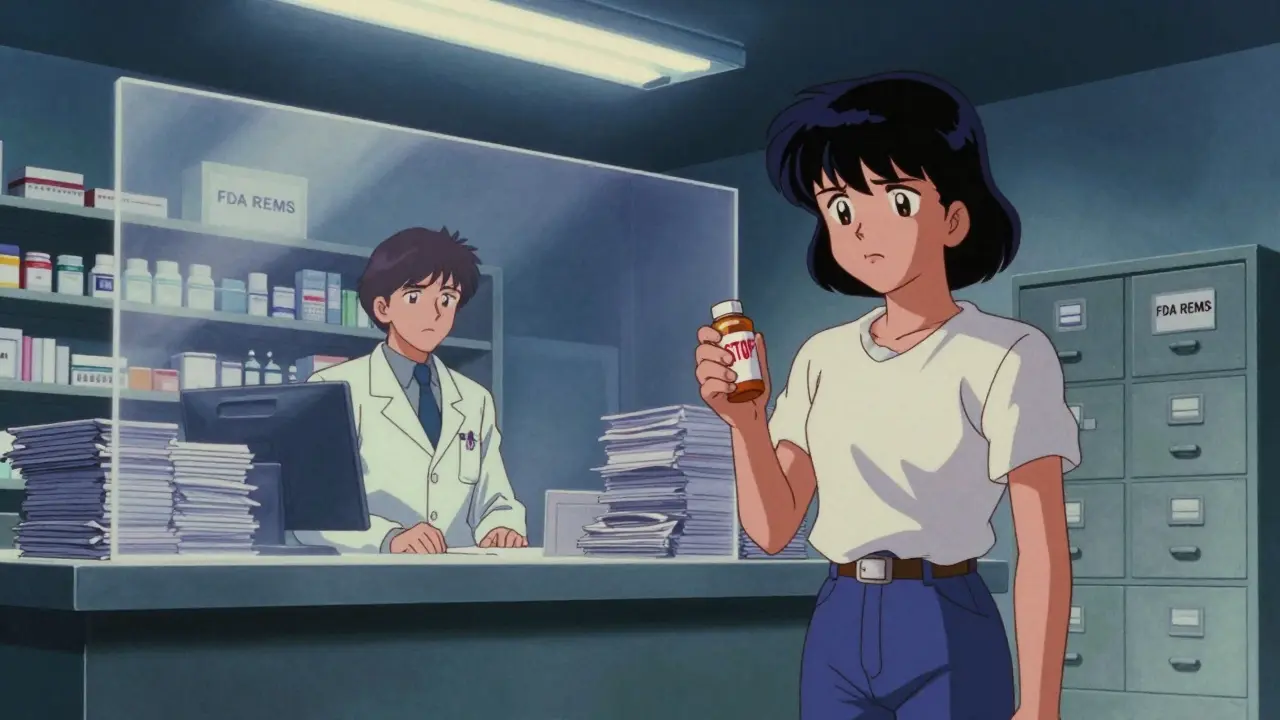
Have you ever waited days or even weeks to pick up a new prescription because the pharmacy said they needed "special authorization"? You weren't just dealing with insurance red tape. You were likely hitting a wall created by a Risk Evaluation and Mitigation Strategy (REMS), which is a formal program established by the U.S. Food and Drug Administration (FDA) to monitor and manage medications with significant safety risks. For patients, this often feels like an unnecessary hurdle. For doctors, it’s administrative headaches. But for the FDA, it’s a critical safety net designed to keep dangerous side effects from becoming public health crises.
Most of us take medicines without thinking twice about their hidden dangers. We trust that if the FDA approved it, it’s safe enough. And for about 95% of drugs on the market, standard labeling and routine monitoring are plenty. But then there are the outliers-the life-saving treatments for cancer, severe autoimmune diseases, or rare genetic conditions that carry serious, sometimes fatal, risks. These are the drugs that get slapped with a REMS requirement. Understanding how these programs work can help you navigate the system faster, whether you’re a patient trying to start treatment, a prescriber fighting paperwork, or just someone curious about why your medicine comes with so many rules.
What Exactly Is a REMS Program?
A REMS isn’t just a warning label. It’s a structured, legally binding agreement between the pharmaceutical company (the sponsor) and the FDA. The goal isn’t to eliminate all risk-no drug is risk-free-but to ensure that the benefits of the treatment outweigh the dangers by adding specific safeguards. Think of it as putting guardrails on a steep mountain road. The road is still dangerous, but the rails stop you from going off the edge.
The concept didn’t appear out of nowhere. While early versions existed in the 1980s for drugs like isotretinoin (Accutane), the modern REMS framework was codified in the Food and Drug Administration Amendments Act (FDAAA) of 2007. This law gave the FDA explicit authority to require these strategies either when a drug is first approved or later, if new safety data emerges. By October 2023, the FDA was managing 78 active REMS programs covering roughly 150 different medications. That’s a massive jump from just 34 programs back in 2015.
It’s important to note that REMS applies only to prescription drugs. Over-the-counter medications don’t qualify. Furthermore, it’s not applied uniformly across all drugs. The FDA uses a strict set of criteria to decide if a REMS is necessary. They look at how serious the potential adverse event is, how common it is in the target population, and whether the drug treats a serious condition where few alternatives exist. If a drug has a mild side effect profile, it won’t get a REMS. If it can cause birth defects, organ failure, or death, it likely will.
The Building Blocks: What Goes Into a REMS?
Not all REMS programs are created equal. Some are relatively simple, while others are complex logistical operations involving registries, specialized clinics, and real-time monitoring. According to FDA guidelines, every REMS must include two basic elements:
- Medication Guides: These are patient-friendly documents that explain the risks and proper use of the drug in plain language. You’ve probably seen these folded papers inside your prescription bottle.
- Communication Plans: These are strategies aimed at healthcare providers to ensure they understand the drug’s risks and know how to prescribe it safely.
However, for the highest-risk medications, the FDA requires a third, more rigorous component called Elements to Assure Safe Use (ETASU). This is where things get complicated for everyone involved. An ETASU might require:
- Prescriber Certification: Doctors must complete training and register before they can write the prescription.
- Patient Enrollment: Patients must sign agreements acknowledging the risks and agree to regular monitoring.
- Special Dispensing Settings: The drug can only be given in hospitals or certified clinics equipped to handle emergencies.
- Laboratory Monitoring: Regular blood tests or scans are required to check for toxicity.
Take Zyprexa Relprevv, an injectable antipsychotic, as an example. Because it carries a small but severe risk of post-injection delirium sedation syndrome-which can lead to coma-it cannot be prescribed for home use. Instead, it must be administered in a certified healthcare facility, and the patient must be observed for three hours afterward. This is a classic ETASU in action. It restricts access significantly, but it prevents potentially fatal outcomes.

Who Needs a REMS? Common Drug Categories
If you’re wondering why your specific medication has extra hoops, it’s likely because it falls into one of several high-risk therapeutic categories. As of late 2023, oncology (cancer) drugs dominate the landscape, accounting for nearly 37% of all active REMS programs. This makes sense; chemotherapy agents and targeted therapies are powerful enough to kill cancer cells but toxic enough to damage healthy tissue, bone marrow, or organs.
| Therapeutic Area | Example Medications | Primary Risk Managed | Typical REMS Requirement |
|---|---|---|---|
| Oncology | Clozapine, Thalidomide | Severe neutropenia, Birth defects | Blood monitoring, Pregnancy prevention |
| Dermatology | Isotretinoin (Accutane) | Severe birth defects | iPLEDGE registry, Contraception verification |
| Neurology | Zyprexa Relprevv | Post-injection delirium | Certified clinic administration |
| Immunology | T-cell therapies | Cytokine release syndrome | Specialized hospital setting |
Neurology and immunology follow closely behind. Drugs treating multiple sclerosis, rheumatoid arthritis, or severe psoriasis often suppress the immune system, leaving patients vulnerable to infections. To mitigate this, REMS programs often mandate regular lab work to ensure white blood cell counts stay within safe limits. If your labs slip below a certain threshold, the REMS portal locks you out, and you can’t get your next dose until your doctor intervenes.
The Hidden Cost: Access Barriers and Delays
Here’s the uncomfortable truth about REMS: while they save lives by preventing catastrophic side effects, they also delay care. A 2019 study published in JAMA Internal Medicine found that REMS programs increased the time to first prescription by an average of 5.4 days compared to non-REMS drugs. For a patient with aggressive cancer or a debilitating autoimmune flare, five days is an eternity.
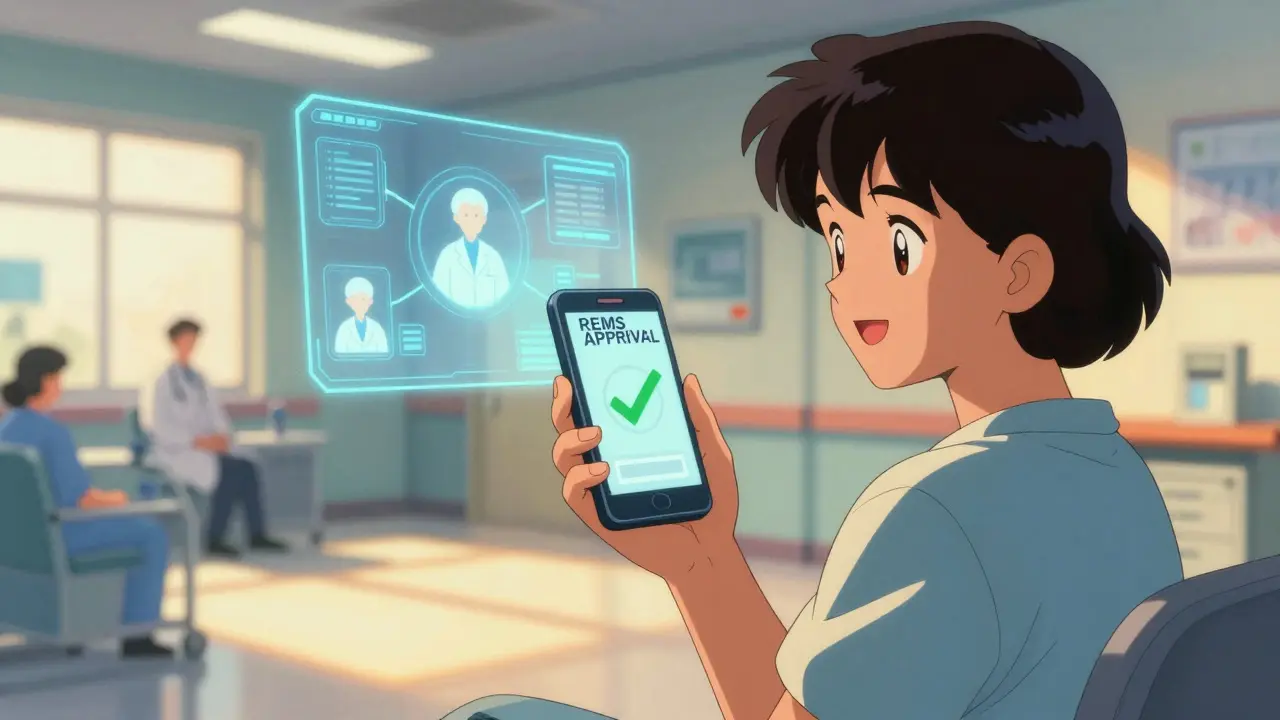
Why does this happen? It’s largely due to fragmentation. In 2023, a survey by the American Society of Health-System Pharmacists revealed that only 35% of REMS platforms had direct integration with electronic health records (EHRs). This means pharmacists and doctors often have to log into separate websites, verify identities, upload lab results manually, and wait for approval codes. One Reddit thread from September 2023 titled “REMS nightmare with Isotretinoin” highlighted how the iPLEDGE program-a REMS for acne medication-isotretinoin-requires multiple verification steps that frequently delay treatment by 3 to 7 days. For teenagers struggling with severe acne, this delay adds significant emotional distress.
Hospital pharmacists bear the brunt of this administrative burden. Data from Pharmacy Times in August 2023 showed that 73% of hospital pharmacists spend an additional 2 to 5 hours per week just managing REMS requirements. That’s time taken away from clinical consultations, medication reconciliation, and patient education. When systems don’t talk to each other, human error increases, and frustration mounts on all sides.
How REMS Differs From Global Standards
If you travel abroad, you might notice that drug safety regulations feel different. In the European Union, for instance, companies submit Risk Management Plans (RMPs) for almost all new medicines. These are proactive documents outlining how risks will be managed, but they rarely impose the same level of operational restriction as U.S. REMS programs.
In the U.S., REMS is selective and punitive. It’s applied only when the FDA determines that standard labeling isn’t enough. The 2016 SUPPORT for Patients and Communities Act expanded the FDA’s toolkit, allowing them to require special packaging or disposal systems to prevent misuse or environmental harm. However, unlike the EU’s broader approach, the U.S. model places the entire financial and operational burden on the pharmaceutical sponsor. Companies must develop, implement, and maintain these programs, spending an estimated $1.2 billion annually according to PhRMA data from 2022. Individual programs can cost anywhere from $500,000 for simple guides to over $15 million for complex ETASU setups.
Recent Changes and Future Outlook
The FDA isn’t blind to the problems. Recognizing that overly burdensome REMS programs can deny patients life-saving treatments, the agency has started streamlining processes. In Q3 2023, the FDA launched the REMS Integration Initiative, consolidating 22 of the 78 active programs onto a single platform to reduce administrative friction. Additionally, the updated REMS Assessment Template now explicitly asks sponsors to evaluate whether their requirements create unnecessary barriers for underserved populations.
We’re also seeing the first signs of REMS programs ending. In August 2023, the FDA approved the “sunset” of the thalidomide REMS after 20 years. Decades of data showed that with improved understanding and alternative risk management approaches, the stringent controls were no longer necessary. This signals a shift toward evidence-based flexibility rather than permanent lockdowns.
Looking ahead, digital health technologies are poised to revolutionize REMS. Pilot programs testing smartphone apps for real-time patient monitoring are already underway for anticoagulant medications. Imagine checking your own blood clotting levels via a finger-prick test linked directly to your doctor’s dashboard, bypassing the need for frequent clinic visits. By 2027, analysts project that 45% of novel oncology drugs will require REMS, driven by increasingly targeted but higher-risk therapies. The challenge will be balancing this innovation with accessibility, ensuring that technology helps rather than hinders patient care.
Does every prescription drug have a REMS program?
No, the vast majority of prescription drugs do not require a REMS. Only medications with serious safety risks that cannot be adequately managed through standard labeling are subject to REMS requirements. As of 2023, only about 150 medications out of thousands have active REMS programs.
Can I refuse to participate in a REMS program?
Technically, yes, but if you do, you cannot receive the medication. REMS requirements are mandatory for both prescribers and patients. If you decline to enroll in the registry or undergo required monitoring, your doctor cannot legally prescribe the drug, and the pharmacy cannot dispense it.
Who pays for the costs associated with REMS programs?
The pharmaceutical company sponsoring the drug bears the primary cost of developing and maintaining the REMS infrastructure. However, patients may incur indirect costs such as copays for additional lab tests or travel expenses for specialized clinic visits required by Elements to Assure Safe Use (ETASU).
How long does it take to get approved for a REMS medication?
Approval times vary widely depending on the complexity of the REMS. Simple programs involving only medication guides may have no delay. Complex ETASU programs requiring prescriber certification, patient enrollment, and lab verification can add 3 to 7 days to the initial prescription process, according to recent studies.
Are REMS programs effective in improving patient safety?
Yes, REMS programs are generally effective at mitigating specific serious risks, such as preventing birth defects from isotretinoin or reducing agranulocytosis cases from clozapine. However, experts note that some programs create administrative burdens that delay access without clear evidence of additional safety benefits beyond standard care.