

Imagine taking a medication where a tiny difference in dosage could mean the difference between healing and hospitalization. That is the reality for patients on Narrow Therapeutic Index (NTI) drugs, which are medications where small differences in dose or blood concentration may lead to serious therapeutic failures or adverse drug reactions. For these critical medications, the standard rules for approving generic versions simply do not cut it. The Food and Drug Administration (FDA) has established a rigorous set of special requirements to ensure that generic NTI drugs perform exactly like their brand-name counterparts.
If you are a patient, a pharmacist, or someone working in pharmaceutical development, understanding these stricter standards is vital. Unlike regular generics, which have a wider margin for error, NTI generics must meet tighter quality and bioequivalence criteria. This article breaks down what those requirements are, why they exist, and how they protect patient safety.
What Makes a Drug an NTI Drug?
To understand the regulations, we first need to define the subject. An NTI drug is not just any medicine with side effects. It is a specific class of drugs where the gap between a helpful dose and a harmful dose is very small. In 2022, the FDA formalized this definition through pharmacometric research, determining that a therapeutic index ≤ 3 is a reasonable cutoff to define NTI drugs.
This classification matters because the body handles these drugs differently. If your blood levels of an NTI drug drop too low, the treatment fails. If they rise slightly too high, toxicity sets in. Common examples include:
- Immunosuppressants: Such as cyclosporine, tacrolimus, and sirolimus, used by transplant patients to prevent organ rejection.
- Antiepileptics: Like phenytoin and carbamazepine, which control seizures.
- Cardiovascular agents: Including warfarin (a blood thinner) and digoxin (used for heart failure).
- Mood stabilizers: Such as lithium carbonate.
The FDA identifies these drugs not through a single public list, but via product-specific guidance documents. This means developers must check the specific guidelines for each drug to see if NTI rules apply.
The Core Problem: Why Standard Rules Fail
For most generic drugs, the FDA uses a standard bioequivalence range of 80% to 125%. This means the generic version can deliver up to 20% more or less of the drug into your bloodstream compared to the brand name, and it is still considered equivalent. For many medicines, this is safe. But for NTI drugs, a 20% swing in blood concentration can be dangerous.
In April 2010, the Advisory Committee for Pharmaceutical Science and Clinical Pharmacology (ACPSCP) voted 11-2 that these standard limits were insufficient for NTI drugs. They recommended much narrower confidence intervals. Since then, the FDA has implemented a framework that demands higher precision. The goal is simple: ensure that when a pharmacist substitutes a generic for a brand-name NTI drug, the patient’s blood levels remain stable and predictable.
Stricter Quality Assay Requirements
Before a drug even reaches a clinical trial, its manufacturing quality is scrutinized. One of the first hurdles for NTI drugs is the quality assay. This test measures how much active ingredient is actually in the pill.
| Drug Type | Acceptance Range for Active Ingredient |
|---|---|
| Standard Non-NTI Generic | 90% - 110% |
| NTI Generic | 95% - 105% |
Notice the difference? For a standard drug, a pill containing 92% of the labeled dose is acceptable. For an NTI drug, that same pill would fail inspection. The FDA requires the content to be within 95% to 105% of the label claim. This tighter control ensures that every single tablet starts with the correct amount of medication before it ever enters the body.
Bioequivalence Limits: The 90-111% Rule
The most significant change for NTI drugs lies in bioequivalence (BE) testing. Bioequivalence compares how quickly and how much of the drug gets into the bloodstream from the generic versus the brand name. The FDA uses a dual-criteria approach for NTI drugs, which is more complex than the standard method.
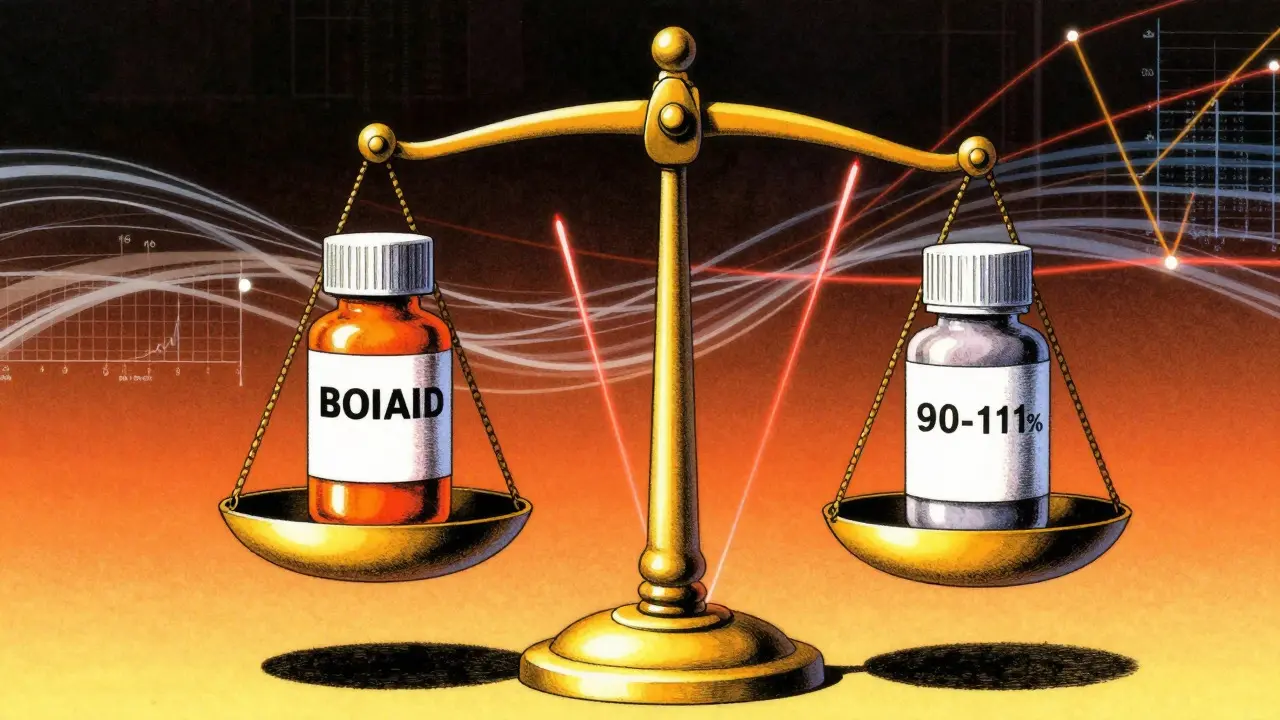
First, the acceptance interval for the average bioequivalence is tightened significantly. Instead of the standard 80-125%, NTI drugs must fall within a 90.00% to 111.11% range. This is often referred to as the "90-111% rule." This narrow window ensures that the exposure levels between the test (generic) and reference (brand) products are nearly identical.
Second, the FDA employs a method called Reference Scaled Average Bioequivalence (RSABE). This approach scales the limits based on the variability of the reference listed drug (the brand name). If the brand name drug itself has high variability in how different people absorb it, the limits might adjust slightly, but they never exceed the strict 90-111% cap for NTI drugs. Additionally, the upper limit of the 90% confidence interval of the ratio of within-subject standard deviation of the test to reference product must be ≤ 2.5. This ensures the generic is not more variable than the brand.
Study Design: Replicate Studies Are Mandatory
Meeting these tight statistical limits requires better data. To get that data, the FDA mandates specific study designs. For NTI drugs, sponsors typically must conduct replicate studies rather than simple two-period crossover studies.
In a replicate study, subjects take both the brand and generic versions multiple times. This allows statisticians to calculate the within-subject variability (WSV) accurately. Because the margins for error are so small, these studies often require larger sample sizes to achieve statistical power. The FDA’s pharmacometric approach notes that to achieve a passing rate of 80% in a BE trial, the maximum observed geometric mean ratio should be 1.4, highlighting the precision needed in study execution.
Five Criteria for NTI Classification
How does the FDA decide if a drug needs these special rules? They look at five specific criteria to determine if a drug qualifies for NTI designation:
- Dose Difference: There is a maximum 2-fold difference between the minimum effective dose and the minimum toxic dose.
- Concentration Range: There is a maximum 2-fold difference between the lowest and highest drug concentration in the therapeutic range.
- Monitoring: Routine therapeutic drug monitoring is required or recommended.
- Variability: The drug exhibits low-to-moderate within-subject variability (≤ 30%).
- Dosing Increments: Doses are often adjusted in small increments (<20%) during treatment.
If a drug meets these characteristics, it triggers the stricter regulatory pathway. This systematic approach helps move away from subjective judgment toward objective, data-driven classification.

Global Differences and Harmonization Challenges
While the FDA has a clear stance, the global landscape is not uniform. Health Canada and the European Medicines Agency (EMA) also recognize the need for stricter controls on NTI drugs, but their approaches differ. Some agencies primarily recommend direct tightening of average bioequivalence limits without the scaled approach the FDA uses. This lack of harmonization can complicate development for multinational companies. The FDA acknowledges this and lists further harmonization of NTI drug classification and bioequivalence approaches among global regulatory agencies as a priority area.
Clinical Reality vs. Regulatory Approval
Despite these strict standards, concerns persist in the medical community. Dr. Honghui Zhou, Director of the FDA’s Office of Generic Drugs, emphasizes that generic NTI drugs are approved as clinically substitutable. However, real-world experiences, particularly with antiepileptic drugs, have raised doubts among some clinicians and patients. Conflicting literature results have led to debates about indiscriminate drug substitution.
Some states in the US have responded by requiring patient consent or prohibiting automatic substitution for certain NTI drugs, even when the FDA has approved them as therapeutically equivalent. The FDA maintains that real-world evidence supports the equivalence of these generics when they meet the new standards, but they acknowledge the need for better education for pharmacists and patients to bridge this trust gap.
Conclusion
The FDA’s special requirements for NTI drugs represent a shift toward precision in generic drug approval. By tightening quality assays to 95-105%, enforcing bioequivalence limits of 90-111%, and mandating replicate studies, the agency aims to eliminate the risks associated with switching between brand and generic versions of sensitive medications. While challenges in global harmonization and clinical perception remain, these standards provide a robust framework for ensuring patient safety in one of the most critical areas of pharmacotherapy.
What is the bioequivalence limit for NTI drugs?
The bioequivalence limit for NTI drugs is tightened to 90.00% to 111.11%, compared to the standard 80-125% for non-NTI drugs. This ensures minimal variation in blood concentration between generic and brand-name versions.
Which drugs are classified as NTI drugs?
Common NTI drugs include immunosuppressants like tacrolimus and cyclosporine, antiepileptics like phenytoin and carbamazepine, cardiovascular agents like warfarin and digoxin, and mood stabilizers like lithium. The FDA identifies them through product-specific guidance rather than a single public list.
Why are NTI drugs treated differently by the FDA?
NTI drugs have a narrow gap between effective and toxic doses. Small changes in blood concentration can lead to treatment failure or severe side effects. Therefore, stricter quality and bioequivalence standards are necessary to ensure patient safety when switching between brands and generics.
Do NTI drugs require replicate studies?
Yes, the FDA typically mandates replicate studies for NTI drugs. These studies allow for accurate calculation of within-subject variability, which is essential for meeting the stringent Reference Scaled Average Bioequivalence (RSABE) criteria.
Is there a public list of NTI drugs?
No, the FDA does not maintain a comprehensive public list of NTI drugs. Instead, NTI status is identified through product-specific guidance documents issued by the agency for individual medications.
How does the FDA define the therapeutic index for NTI drugs?
In 2022, the FDA established that a therapeutic index ≤ 3 is a reasonable cutoff to define NTI drugs, based on pharmacometric research analyzing various medications' safety margins.