
You take your morning pill, trusting that it’s safe. But what happens when a hidden defect or contamination is discovered? The public assumes the government can simply flip a switch and ban the drug. In reality, the legal machinery behind removing unsafe medications from shelves is slower, more complex, and often less powerful than you might think.
When a medication poses a risk, the U.S. Food and Drug Administration (FDA) steps in. However, unlike many assume, the agency rarely has the direct power to force a pharmaceutical company to pull a product off the market. Instead, a intricate dance of voluntary cooperation, legal threats, and regulatory pressure unfolds. Understanding this process reveals why some dangerous drugs linger longer than they should and how the system actually protects-or fails to protect-patients.
The Myth of Direct FDA Power
Let’s clear up the biggest misconception first. Contrary to widespread belief, the FDA does not have the statutory authority to mandate the withdrawal of most prescription or over-the-counter drugs directly under the Federal Food, Drug, and Cosmetic Act (FD&C Act). This fact is confirmed by medical literature, including entries from the National Center for Biotechnology Information (NCBI).
So, if the FDA can’t just say "stop," how do recalls happen? They happen because manufacturers choose to comply. Dr. Caleb Alexander, an internist at Johns Hopkins University, explains it plainly: "People often talk colloquially about the FDA 'pulling the drug from the market,' and in almost all instances, the answer is no... The manufacturer pulled the drug from the market, and the FDA simply made it untenable for the manufacturer to behave otherwise."
This dynamic creates a unique legal environment. The FDA acts as a persuader rather than a commander. It uses its oversight capabilities to make continuing to sell a defective product so legally and financially risky for a company that recalling it becomes the only logical business decision. For controlled substances, the rules are slightly different, with very limited mandatory powers, but for the vast majority of pills and biologics, the request-based system is the standard.
Classifying the Danger: Class I, II, and III
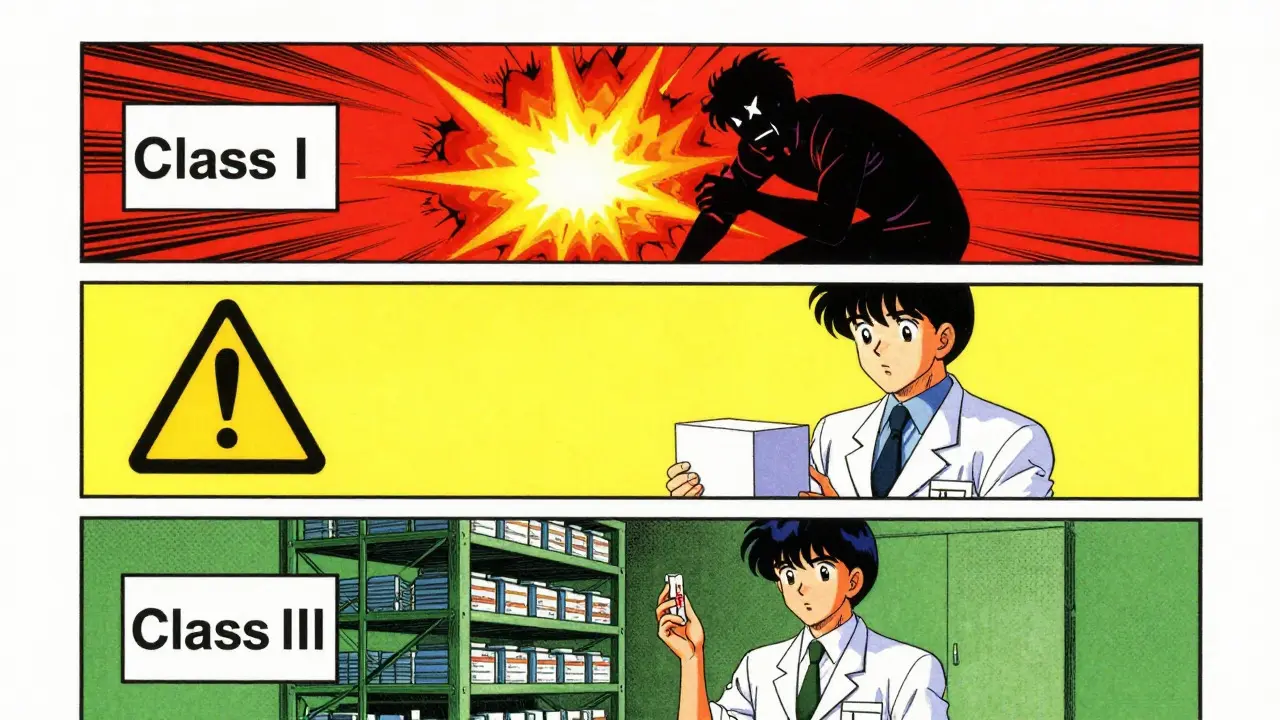
Not all recalls are created equal. The severity of the issue dictates the speed and depth of the response. The FDA categorizes every recall into one of three classes based on the potential health impact. This classification system, outlined in 21 CFR Part 7, determines everything from who gets notified to how fast action must be taken.
| Recall Class | Risk Level | Typical Cause | Notification Depth |
|---|---|---|---|
| Class I | Highest Risk | Serious adverse health consequences or death likely | Patient-level notification required |
| Class II | Moderate Risk | Temporary or medically reversible adverse health consequence | Distributor or pharmacy level |
| Class III | Lowest Risk | Unlikely to cause adverse health consequences | Often distributor level only |
Class I recalls are the emergencies. These involve products where use could lead to serious harm or death. Think contaminated blood thinners or mislabeled insulin doses. Class II recalls cover issues like temporary side effects or minor packaging errors that might confuse a patient but aren't immediately life-threatening. Class III recalls are administrative, dealing with labeling typos or cosmetic defects that don't affect safety.
In recent years, Class II recalls have accounted for roughly 70% of all pharmaceutical recalls. While less dramatic, they still require rigorous tracking to ensure patients aren't exposed to substandard care. The "depth" of the recall refers to how far down the supply chain the notification goes. A Class I recall demands reaching the individual patient, while a Class III might stop at the warehouse door.
How the Process Starts: Detection and Reporting
A recall doesn't start in a vacuum. It begins with detection. Manufacturers are legally required to perform stability testing at least annually to ensure their drugs remain potent and pure. If these tests fail, the company must initiate a voluntary recall strategy.
However, companies don't always catch the problem first. The FDA monitors post-marketing safety through systems like MedWatch, which received over 1.2 million adverse event reports in 2022 alone. When a cluster of bad reactions appears, or when foreign regulators flag an ingredient, the FDA investigates. Once the agency identifies a violation, it contacts the manufacturer. At this point, the clock starts ticking.
The Cleveland Clinic’s pharmacotherapy guidelines note that once a manufacturer decides to recall, they must notify the FDA immediately and develop a comprehensive Recall Strategy. This includes determining the depth of the recall, choosing notification methods, and setting up return procedures. The goal is to contain the hazard before it spreads further.
What Happens When Companies Say No?
This is where the legal framework gets teeth. If a manufacturer refuses a voluntary recall, the FDA isn't powerless. Under Section 304 of the FD&C Act, the agency can seek a court injunction. This legal remedy allows a federal judge to halt further manufacturing or distribution of the drug.
While this sounds robust, it’s slow. Litigation takes time, and during that time, unsafe meds may remain in pharmacies. This delay is a major point of contention among public health advocates. Dr. Sidney Wolfe of Public Citizen’s Health Research Group testified before Congress in 2019, arguing that the inability to order immediate mandatory recalls creates dangerous delays. He pointed to the 2018 valsartan contamination case, where it took six months for full market withdrawal due to international supply chain complexities.
Conversely, industry groups like PhRMA argue the current system works. They cite data showing that 99.7% of drug recalls are voluntary and occur within 10 days of FDA identification. From their perspective, the threat of litigation and reputational damage is enough to compel compliance without needing new laws.
Drugs vs. Devices: A Regulatory Split
It’s crucial to distinguish between drugs and medical devices. The FDA has much stronger authority over devices. Under 21 CFR 810, the agency can issue mandatory device recalls if there’s a reasonable probability of serious adverse health consequences. This power was granted by the Medical Device Amendments of 1976.
This asymmetry exists because the legal frameworks evolved differently. The drug provisions stem from the original 1938 FD&C Act, which relied heavily on voluntary compliance. Devices, regulated later, were given stricter enforcement tools. This difference means a faulty pacemaker can be forcibly removed by the government, while a contaminated batch of antibiotics relies on the manufacturer’s goodwill.
The Valsartan Case Study
To see this process in action, look at the 2018 valsartan recall. Valsartan is a common blood pressure medication. Tests revealed it was contaminated with NDMA, a probable carcinogen. The FDA issued public alerts on June 8, 2018. By late June, major manufacturers had voluntarily recalled affected lots.
However, the process wasn't seamless. Chinese active pharmaceutical ingredient (API) manufacturers delayed cooperation for 17 days, highlighting gaps in international oversight. This case demonstrated that even when domestic companies comply quickly, global supply chains can bottleneck the removal of unsafe meds. It also fueled arguments for stronger mandatory recall powers to handle cross-border delays.
Challenges in Implementation
Even when a recall is ordered, executing it is messy. A 2023 survey by the American Society of Health-System Pharmacists (ASHP) found that 68% of hospital pharmacy directors struggled to identify affected products due to inconsistent lot numbering systems. Another 42% reported communication breakdowns that delayed patient notification by an average of 3.7 days.
These operational hurdles mean that legal authority is only half the battle. Healthcare organizations need robust protocols. ASHP recommends a 12-point framework including defining roles, creating central documentation repositories, and training staff regularly. Without these internal processes, even a perfect legal recall fails at the bedside.
The Future of Recall Authority
Legislative efforts continue to address these gaps. The proposed PREVENT Pandemics Act includes Section 3103, which would grant the FDA explicit authority to order mandatory recalls of drugs and biological products. As of late 2023, this provision faced strong opposition from industry lobbyists, who spent millions arguing against it.
Despite the political stalemate, trends show increasing urgency. The number of drug recalls rose by 12.3% year-over-year in 2022, driven by pandemic-era supply chain disruptions. With biologics becoming more common and contamination risks rising, experts like Dr. Peter Lurie argue that the lack of mandatory recall authority remains a critical vulnerability. Whether Congress will close this loophole depends on balancing public safety with industry flexibility.
Can the FDA force a drug recall?
Generally, no. The FDA lacks direct statutory authority to mandate drug recalls under the FD&C Act. It requests voluntary recalls. If a manufacturer refuses, the FDA must seek a court injunction under Section 304 to halt distribution, which is a slower legal process.
What is the difference between a Class I and Class II recall?
A Class I recall involves a high risk of serious adverse health consequences or death, requiring patient-level notification. A Class II recall involves products that may cause temporary or medically reversible adverse health consequences, typically requiring notification at the distributor or pharmacy level.
Why does the FDA have more power over medical devices than drugs?
The Medical Device Amendments of 1976 granted the FDA stronger enforcement powers for devices, allowing mandatory recalls under 21 CFR 810. Drug regulations stem from the 1938 FD&C Act, which relies primarily on voluntary compliance and legal remedies for non-compliance.
How long does it take for a drug to be removed after a recall is issued?
Most voluntary recalls occur within 10 days of FDA identification. However, complex cases involving international supply chains or litigation can take months. For example, the 2018 valsartan recall took six months for full market withdrawal.
What happens if a manufacturer ignores an FDA recall request?
If a manufacturer refuses a voluntary recall, the FDA can pursue legal action under Section 304 of the FD&C Act. This involves seeking a court injunction to stop further manufacturing or distribution. This process is slower than a voluntary recall and carries significant legal costs for the company.